
Loan Management Systems in Kenya for Banks, SACCOs & MFIs: The Complete Guide (2026)
How a loan management system works end to end, from intake and credit approval to disbursement and audit, and what is different for lenders in Kenya.
Short answer: A loan management system digitises the loan lifecycle, from application and credit evaluation through approval and disbursement, with an audit trail that ties every step together. In Kenya the right system also has to fit your regulator, the identity and credit bureau checks lenders run, check-off lending, the Data Protection Act, 2019 and the core banking or SACCO system that keeps your loan ledger.
Lending is a workflow problem before it is a money problem. Between a borrower's first application and the moment funds hit their account sit dozens of steps — data capture, document collection, credit evaluation, approvals, compliance checks, and disbursement — and every one of them is a place where a manual, paper-based process leaks time, introduces errors, and weakens the audit trail.
A modern loan management system turns that chain into a single, traceable digital workflow. This guide is the starting point for everything loan management: how each stage works, where automation pays off, and what banks, SACCOs, and microfinance institutions should look for. Where a topic deserves more depth, we link to a dedicated article.
What a loan management system does
A loan management system (LMS) digitises the full loan lifecycle — origination, underwriting, approval, disbursement, and the audit record that ties them together — on one platform with role-based access and a complete history of every action. The payoff is faster decisions, fewer errors, and the kind of end-to-end traceability regulators and auditors expect. The platform view is set out in Supporting Business and Individual Loans Under One Roof and Data-Driven Loan Intelligence.
Loan origination and intake
Origination is where speed and data quality are won or lost. Digitising intake — structured application forms, mobile-friendly capture, and self-service document upload — removes the re-keying and chasing that slow down paper processes:
- Digitizing Loan Intake: The First Step to Smarter Lending
- Streamlined Application Intake and Fast Application Submission
- Seamless Document Collection for Loan Applications and Mobile-Friendly Uploads for Field Operations
- Digital Co-Applicant and Guarantor Flows and How to Capture Accurate Borrower Data for Loan Risk
Credit evaluation and approval
This is the heart of the system: turning an application into a defensible credit decision through structured proposals, risk assessment, and multi-level approval workflows that route the right cases to the right people:
- Credit Evaluation Microservice and Proposal Preparation in the Credit Proposal Workflow
- Custom Approval Workflows for Lending and Internal Decision Accuracy via MCC Review
- Risk Assessment for Large Loans and Governance & Compliance in Workflow Automation
- Faster Loan Approvals with Real-Time Document Uploads, Seamless Credit Workflow Transitions, and Workflow Automation & State Machines
Disbursement
Once approved, disbursement should be automatic, controlled, and logged — triggered by the workflow rather than a manual hand-off. See Smooth Loan Disbursement and the event-driven Disbursement Trigger Microservice.
Documents, verification, and audit readiness
Lending generates a mountain of documents, and their integrity is what makes a loan defensible later. Automated validation, metadata, and immutable history logs turn that mountain into an asset:
- Auto-Validation of Uploaded Documents and Automated Document Verification
- How Loan Document Metadata Enables Audit Readiness and Document Upload as a Service
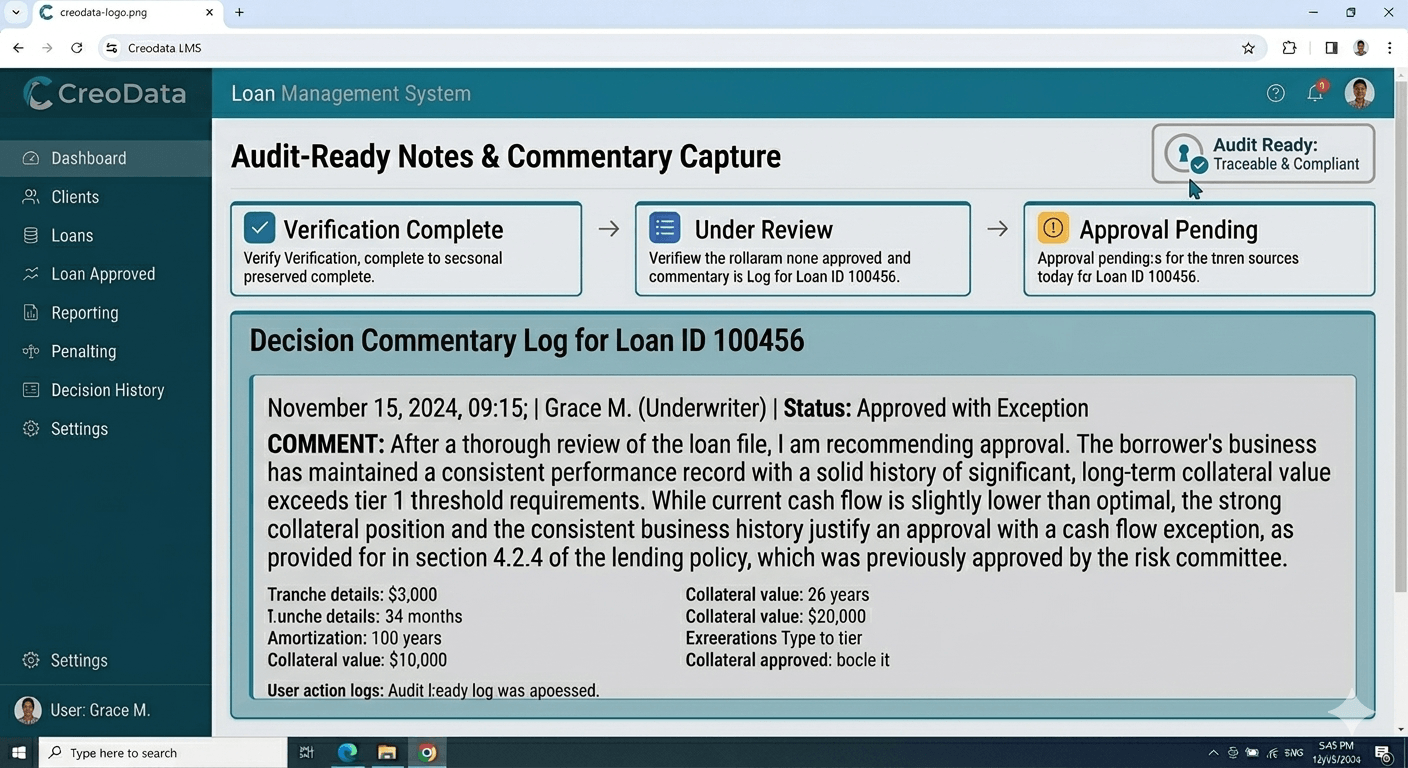
- Audit-Ready Event Logs, Regulatory-Ready History Reporting, Time-Stamped Application Audits, and Internal Audits Made Easy with History Logs
Security, roles, and oversight
Lending data is sensitive, and access must be tightly governed by role — with dashboards that give each function the oversight it needs:
- Azure AD for Loan Security and Role-Based Assignment
- User Action Traceability in Loan Workflow and BM Tracking: Loan Workflow Visibility and Control
Integration, automation, and scale
A loan platform delivers most when it connects to your core banking system and scales with volume — using cloud-native architecture rather than brittle batch jobs:
- Connecting to Core Banking Systems and Automated Loan Processing via Azure
- Scaling Loan Operations Efficiently and the real-time view in Real-time Application Status Updates and Instant Loan Application Notifications
Loan management software in Kenya: what's different
The workflow above applies to lenders anywhere. Six things shape it for a Kenyan bank, SACCO or microfinance institution. This is a practical summary, not legal advice: confirm each point against current law and your regulator's guidance.
Your regulator depends on what kind of lender you are. Banks are licensed and supervised by the Central Bank of Kenya (CBK) under the Banking Act, and microfinance banks by CBK under the Microfinance Act, 2006. Digital credit providers have been licensed by CBK since the Central Bank of Kenya (Amendment) Act, 2021 came into force in December 2021. Since 27 December 2024 the Business Laws (Amendment) Act, 2024 has extended CBK's mandate to all non-deposit-taking credit providers, although the implementing regulations were published only in draft in August 2025. Deposit-taking SACCOs are licensed and supervised by SASRA under the Sacco Societies Act, 2008. Since 1 January 2021, SASRA has also regulated non-deposit-taking SACCOs with non-withdrawable deposits of at least KES 100 million, or that mobilise members or share capital digitally or from people living outside Kenya. Other SACCOs sit with the cooperative registrar. For banks, note that CBK published draft revised Prudential Guidelines and Risk Management Guidelines for comment on 10 September 2026, and the 2013 guidelines stay in force until the revisions are final. Our guide to CBK-compliant digital lending sets out the non-bank regime in detail.
Identity, credit bureau and tax checks are part of origination. Kenyan lenders commonly verify a borrower's ID number against IPRS, the Integrated Population Registration System run by the National Registration Bureau, and check their KRA tax PIN and their credit history with a licensed credit reference bureau (CRB). The Banking (Credit Reference Bureau) Regulations, 2020 require 30 days' written notice before negative information is sent to a bureau. Their status is contested: the High Court declared them void in August 2023, and the Court of Appeal suspended that judgment pending CBK's appeal. A loan management system should keep every check result on the application, with the reviewer who relied on it. See compliance checks in loan origination in Kenya.
Check-off lending has its own affordability rules. Much consumer lending in Kenya is repaid by payroll deduction. Under section 19(3) of the Employment Act, 2007, total deductions may not exceed two-thirds of an employee's wages. Public servants must keep at least one-third of their basic salary after all commitments, under the public service HR policies manual. Government payroll deductions run through IPPD, the Integrated Personnel and Payroll Database. Creodata's Workplace Banking Application handles check-off origination for banks, with IPRS, CRB, KRA and sanctions screening checks built in.
Data protection applies to every lender. The Data Protection Act, 2019 is in force, regulated by the Office of the Data Protection Commissioner. The registration regulations exempt organisations with turnover below KES 5 million, but not those processing for financial services, so lenders register whatever their size. Your system should record consent, restrict access by role and log who viewed or changed personal data.
Core banking integration decides the architecture. In most Kenyan banks the loan ledger, repayment schedules and collections stay in core banking, and a loan origination system handles the credit workflow in front of it. The integration, meaning how customer data comes in and how an approved loan is booked and disbursed, is the most important thing to test in any demo.
SACCOs split origination from BOSA and FOSA. A SACCO's core system keeps BOSA deposits and share capital, FOSA accounts, dividends and the loan ledger. Origination software adds guarantor capture, appraisal and committee workflow alongside it. The SACCO loan origination guide covers where the boundary sits.
Choosing a loan management platform
Creodata's Loan Management System brings origination, document collection, credit evaluation, multi-level approvals, and disbursement together for banks, SACCOs, and MFIs across the region, on Microsoft Azure or on-premises. Book a demo to see it against your own lending workflow.
Further reading for Kenyan lenders
- Loan origination software in Kenya: a buyer's guide
- Loan origination system RFP checklist for Kenya
- LOS vs loan management system vs core banking
- CBK-compliant digital lending: what the rules require of your loan origination system
- Loan origination software for SACCOs in Kenya
- Credit approval workflows in Kenyan banks
Frequently asked questions
What is a loan management system?
A loan management system is software that digitises and automates the full loan lifecycle — application intake, document collection, credit evaluation, approval, disbursement, and the audit record — on a single platform. It replaces fragmented spreadsheets, email, and paper with one traceable workflow, which speeds up decisions and strengthens compliance.
How does a loan management system speed up approvals?
It removes the delays built into manual lending: applications and documents are captured digitally and validated automatically, proposals and risk assessments are structured and consistent, and approval workflows route each case to the right approver with no physical hand-offs. Real-time status tracking means nothing sits idle waiting for someone to notice it.
Is a loan management system suitable for SACCOs and microfinance institutions, not just banks?
Yes. The same origination, approval, and audit controls apply whether you are a commercial bank, a SACCO, or a microfinance institution — and a good platform supports both individual and group lending. Pricing is quoted per institution, based on the modules, offices and users, deployment and integrations involved, so a smaller lender does not pay for scale it does not need.
How does a loan management system support audit and compliance?
Every action — who submitted, reviewed, approved, or changed a record, and when — is logged immutably, and documents carry metadata that makes them easy to locate and verify. This produces a complete, time-stamped history that can be reported to auditors and regulators on demand, rather than reconstructed after the fact.
What is the difference between a loan origination system and a loan management system?
A loan origination system (LOS) covers the journey to a booked loan: application, document collection, identity and credit checks, credit analysis, committee approval and disbursement. A loan management system, in the narrow sense, runs the loan after that: repayment schedules, interest, arrears, collections and the ledger. The terms overlap in everyday use, and in Kenya many banks run an LOS on top of core banking, which does the servicing. Our comparison of LOS vs loan management system vs core banking explains which one you need.
Who regulates loan management in Kenya?
It depends on the lender. CBK regulates banks, microfinance banks, digital credit providers and, since 27 December 2024, all non-deposit-taking credit providers. SASRA regulates deposit-taking SACCOs and larger or digitally mobilising non-deposit-taking SACCOs. No regulator approves loan software; the system's job is to help the lender show that its own policy and the law were followed.
What checks should a loan management system in Kenya support?
At a minimum, identity verification against IPRS, a credit bureau check, KRA PIN validation and sanctions and PEP screening, with each result stored on the application before approval. For check-off loans, add payslip affordability against the two-thirds deduction limit and employer or IPPD deduction data.
This is the hub for Creodata's loan management coverage. Explore the linked guides for depth on origination, credit workflows, disbursement, audit, and integration — or see the Loan Management System in a demo.