
Document Upload as a Service
Learn how a dedicated UploadDocumentsFn microservice handles loan document ingestion, validation, and secure storage—so lending platforms stay modular, compliant, and scalable.

Introduction: Why Document Upload as a Service?
In modern cloud-native applications — especially in domains like lending/loan management, financial services, or any system that requires document handling — it's common to need functionality for users to upload documents: identity proofs, income statements, collateral documents, signed contracts, etc. Systems that process loans need to accept scanned documents, attachments, PDFs, images, etc., link them to customer records, and store them securely.
Rather than embedding document-upload logic deep within a large monolithic application, it often makes sense to isolate this functionality into a dedicated service — e.g. a function-based microservice. In this article, we explore a hypothetical (but practical) service: UploadDocumentsFn. We outline how it works, why it matters, what benefits it brings, and for whom it is particularly well-suited.
What is UploadDocumentsFn — Service Overview
UploadDocumentsFn is a dedicated service (or microservice) whose sole responsibility is to handle document uploads (ingestion), validation, and storage. It exposes a well-defined API (e.g., REST or gRPC) that other parts of the system — for example, the loan-application service, KYC/onboarding service, or contract-processing service — can call when a document needs to be uploaded or retrieved.
Key Responsibilities
1. File Ingestion
- Accept file uploads from clients (e.g. borrowers uploading identity proofs, income statements, collateral documents)
- Support multiple file types: PDFs, images (JPEG/PNG), Word documents, and others as allowed by business rules
- Handle multipart uploads, chunked uploads (for large files), resumable uploads, and possibly large file sizes (scans, multi-page PDFs)
2. Validation
- Ensure file type and size meet defined constraints (e.g. no prohibited types, file size under a certain limit)
- Perform basic content validation — e.g. checking file is not empty, checking for viruses or malware (via virus scanning), checking PDF integrity, optional OCR checks to verify document quality or readability
- Validate business-level constraints: certain document types may be required (e.g. ID + proof of address + income statement), or required metadata (e.g. associated user ID, loan application ID, document type label)
3. Storage
- Once validated, store the file securely in cloud storage (e.g. blob storage, object storage) with encryption at rest
- Create metadata records associated with each upload (document type, upload timestamp, uploader identity, related entity ID — e.g. loan application or customer ID)
- Provide retrieval endpoints (download, preview), deletion endpoints, and versioning or audit logs (who uploaded what and when)
4. Integration / API Exposure
- Expose clean API endpoints so other services (e.g. loan-origination, contract-processing) can call
UploadDocumentsFn - Provide hooks for asynchronous processing if needed (e.g. after upload, trigger a workflow: OCR, document verification, notification, status update)
By encapsulating all document-upload logic into UploadDocumentsFn, other parts of the system don't need to be concerned with the low-level details of file handling — they simply call an API when needed, passing metadata like "this is a borrower's ID upload for loan application #1234," and receive back a reference (a document ID or URL) if successful.
How UploadDocumentsFn Maps to Creodata's Loan Management Platform
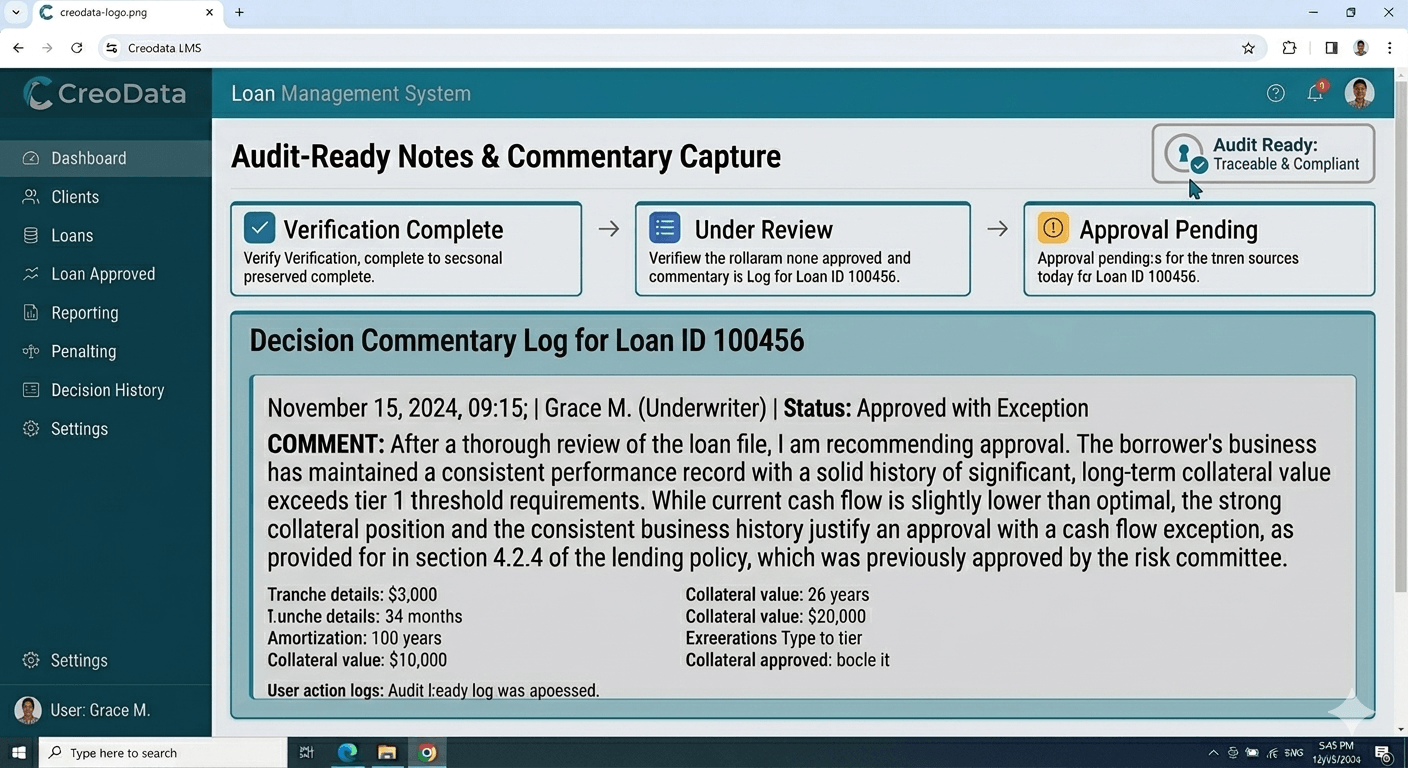
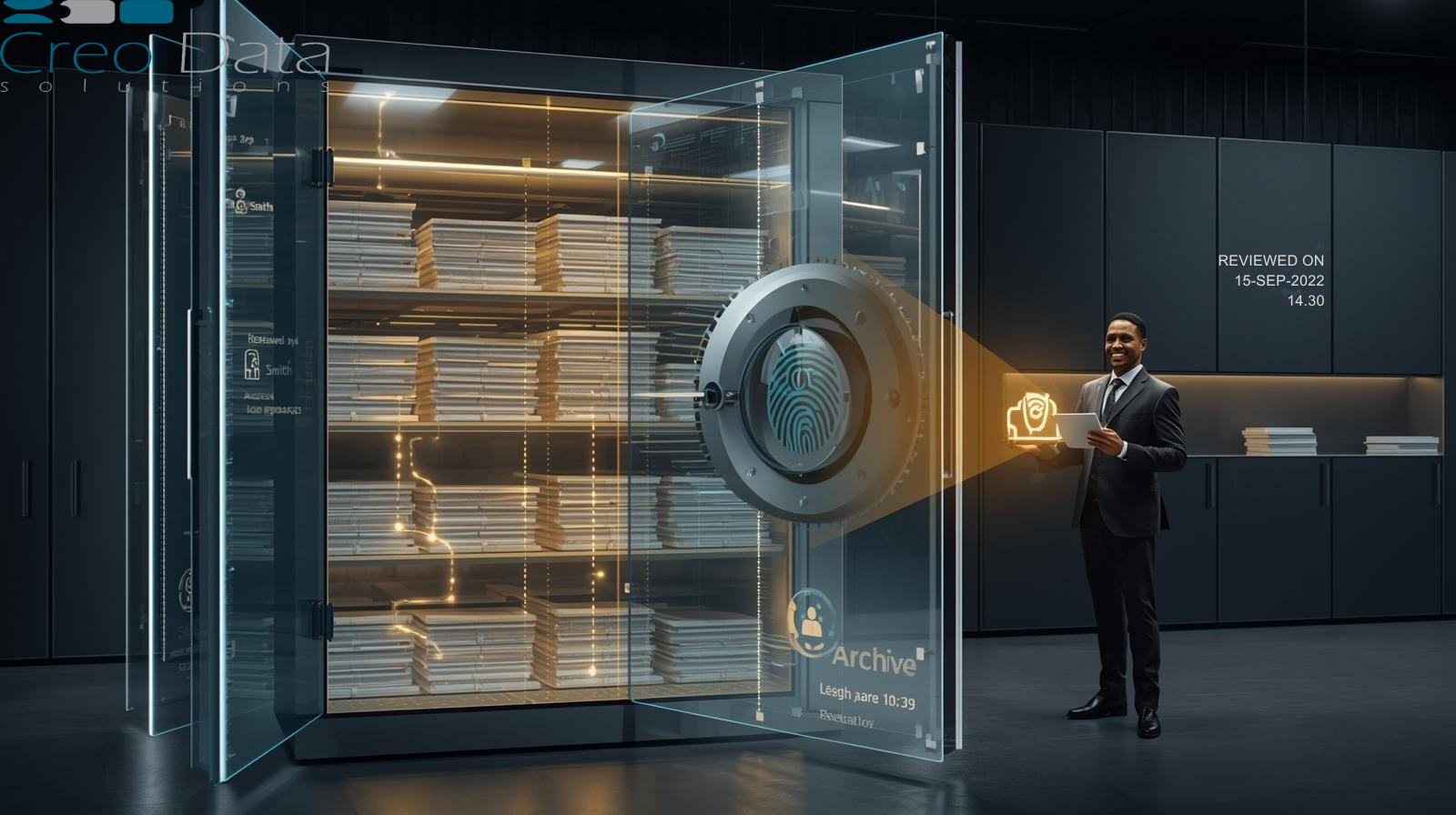
Creodata Loan Management System already describes part of their offering as including "secure digital vaults" for customer documents: documents uploaded via application or onboarding are stored securely, with encryption, access control, audit logs, and integrated document management.
Here is how UploadDocumentsFn — or a very similar microservice — would fit into such a platform:
- When a borrower applies for a loan and submits KYC documents, identity proofs and income proofs are sent through
UploadDocumentsFn. - Once uploaded and validated, the service stores them in the secure vault (cloud storage, encrypted).
- The loan-origination service receives references/IDs to those uploaded documents, associated with that borrower's profile or loan application.
- When loan officers or underwriters log in to review applications, they retrieve documents from the vault — via secure download or preview — without worrying about how storage works under the hood.
- Audit trails record every action (upload, view, download), helping compliance and governance teams track who accessed what and when.
- During contract signing, disbursement, repayment, or delinquency workflows, related documents (e.g. signed agreements, collateral release) can also be handled via the same
UploadDocumentsFn— reusing the same module for consistent and secure document management across the loan lifecycle.
This modular integration supports Creodata's promise of "end-to-end loan processing" while giving institutions flexibility, security, and compliance — and abstracts away the complexity of document handling.
Advantages of Document Upload as a Service
1. Consistency and Reuse
Once implemented, UploadDocumentsFn becomes a reusable component: every part of the system that needs document upload (onboarding, KYC, loan application, contract processing, collateral management, customer profile updates) can call the same service. This avoids duplicated logic, reduces bugs, and enforces consistent validation and storage rules across the system.
2. Ease of Compliance and Security
Because the service is dedicated to handling sensitive documents, you can apply strong security controls — encryption at rest and in transit, role-based access, audit logging, retention policies (archive or delete old documents), and compliance with data-protection standards. Centralizing these controls in one service reduces the risk of inconsistent enforcement that can occur in monolithic applications.
3. Scalability Under Load
If there is a surge — many borrowers uploading documents at once (e.g. during end-of-month loan rush, group-lending bulk uploads, refinancing cycles) — UploadDocumentsFn can scale horizontally (e.g. more instances, auto-scaling functions). This avoids overprovisioning the rest of the system for a temporary spike, making the system cost-efficient yet responsive.
4. Independent Evolution and Agility
If in future you need to support new file types (e.g. scanned photos, videos, additional document formats), or new features (OCR, automatic document classification, automated redaction, watermarking, versioning), you can evolve UploadDocumentsFn independently — without touching loan logic, workflow code, or other parts of the system.
5. Improved Maintainability and Team Organization
With a separate service, a dedicated small team can own document handling (upload + storage + security). This fosters accountability, clearer ownership, and easier maintenance — since that team doesn't need to wade through unrelated code or worry about side-effects.
6. Fault Tolerance and Resilience
If there is a bug or outage in UploadDocumentsFn (e.g. storage service temporarily down, virus scanning service misbehaves), it affects only document-upload flows — not the rest of the system. Other services (loan processing, repayments, reporting) remain functional. This isolation reduces the blast radius of failures and increases overall system reliability.
Target Audience / Ideal Use Cases
UploadDocumentsFn as "Document Upload as a Service" is especially valuable for:
- Financial institutions, small banks, SACCOs, microfinance institutions — often needing KYC, income proof, collateral documents, signed contracts, etc.
- Fintech lenders, digital lenders, or any institution doing remote/online onboarding — where borrowers upload scanned IDs or documents from the web or mobile, requiring secure, scalable document ingestion and storage.
- Organizations dealing with sensitive documents and compliance requirements — (e.g. identity documents, legal contracts, collateral deeds) needing encryption, audit logs, access control, and compliance.
- Systems with high document upload volume or bursts — for example group-lending schemes, bulk applicant intake, mass onboarding campaigns, refinancing seasons, loan renewals. A dedicated upload service scales better under such demand.
- Teams valuing modularity, maintainability, and long-term agility — where separate teams own different domains and document handling becomes a reusable, isolated domain.
- Enterprises needing multi-product or multi-service ecosystems — for example, a company offering loan management, contract processing, expense management, and customer onboarding. A central
UploadDocumentsFnlets all these services reuse the same component rather than reimplementing upload logic in each.
Conclusion
Document upload is a deceptively simple requirement — but when you factor in file types, sizes, validation, storage, security, compliance, metadata, retrieval, audit logging, and varying business contexts (loan applications, contract management, KYC, collateral, renewed documents), it rapidly becomes non-trivial. Embedding this complexity into a monolithic application leads to tangled code, duplication, maintenance headaches, and risk.
By contrast, a dedicated microservice — UploadDocumentsFn — encapsulates this complexity into a reusable, isolated component. It ensures document ingestion, validation, and storage are handled in one place, with clear APIs, rigorous security, and scalability. This modularity supports a clean architecture, simpler maintenance, team ownership, and the flexibility to evolve independently as requirements grow (new file types, compliance needs, integrations, retrieval flows).
For platforms like Creodata's Loan Management System — which already offer secure digital vaults, document handling, and multiple products (loan management, contract processing, etc.) — such a service is fundamental. It enables financial institutions, microfinance entities, SACCOs, fintech lenders, and other organizations to offer reliable, secure, compliance-ready document management without reinventing the wheel per module.
For more information, visit Creodata.com