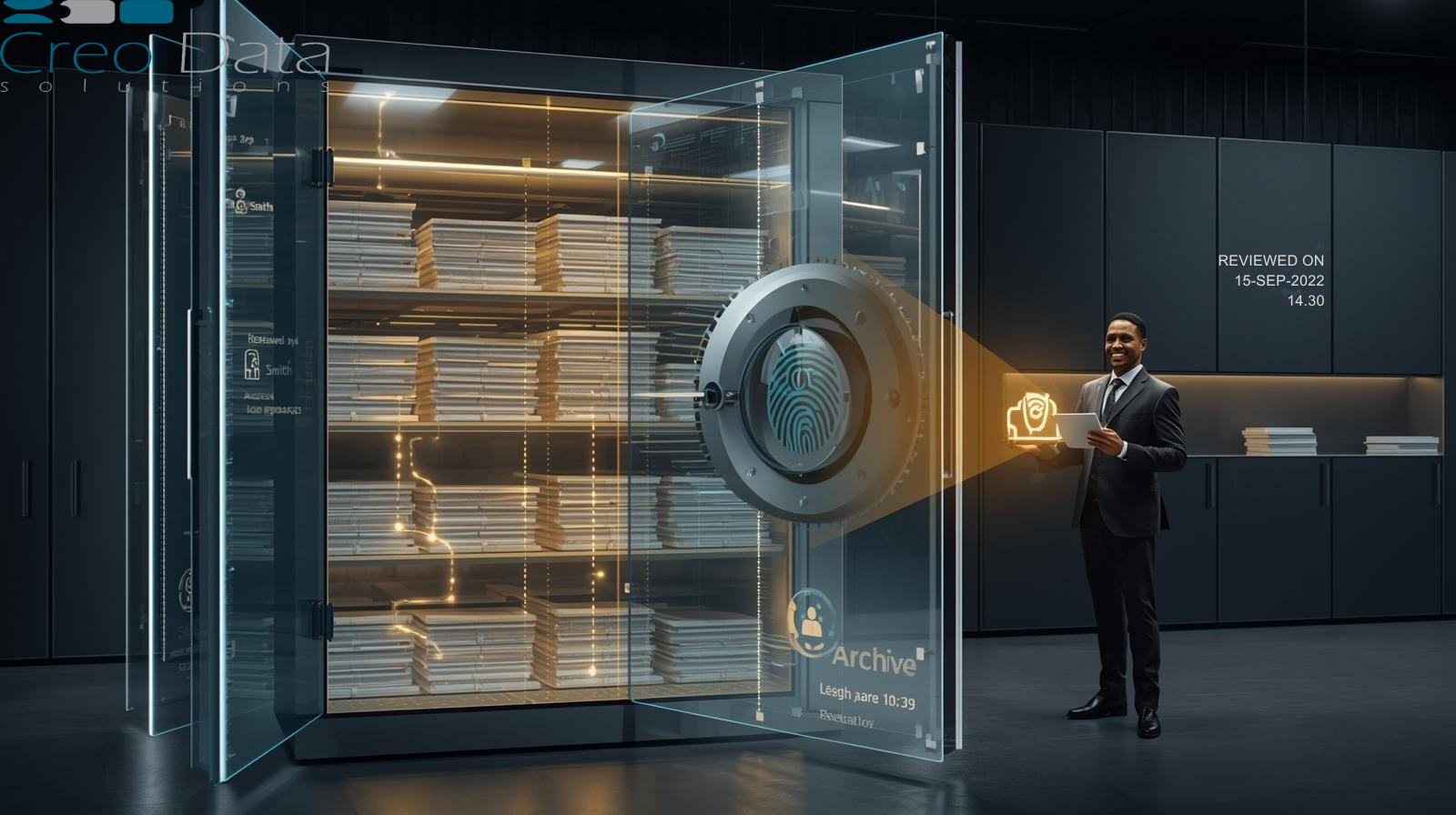

Audit-Ready Notes & Commentary Capture
Log user comments and notes alongside status changes in loan workflows for richer context, stronger accountability, and audit-ready decision trails.
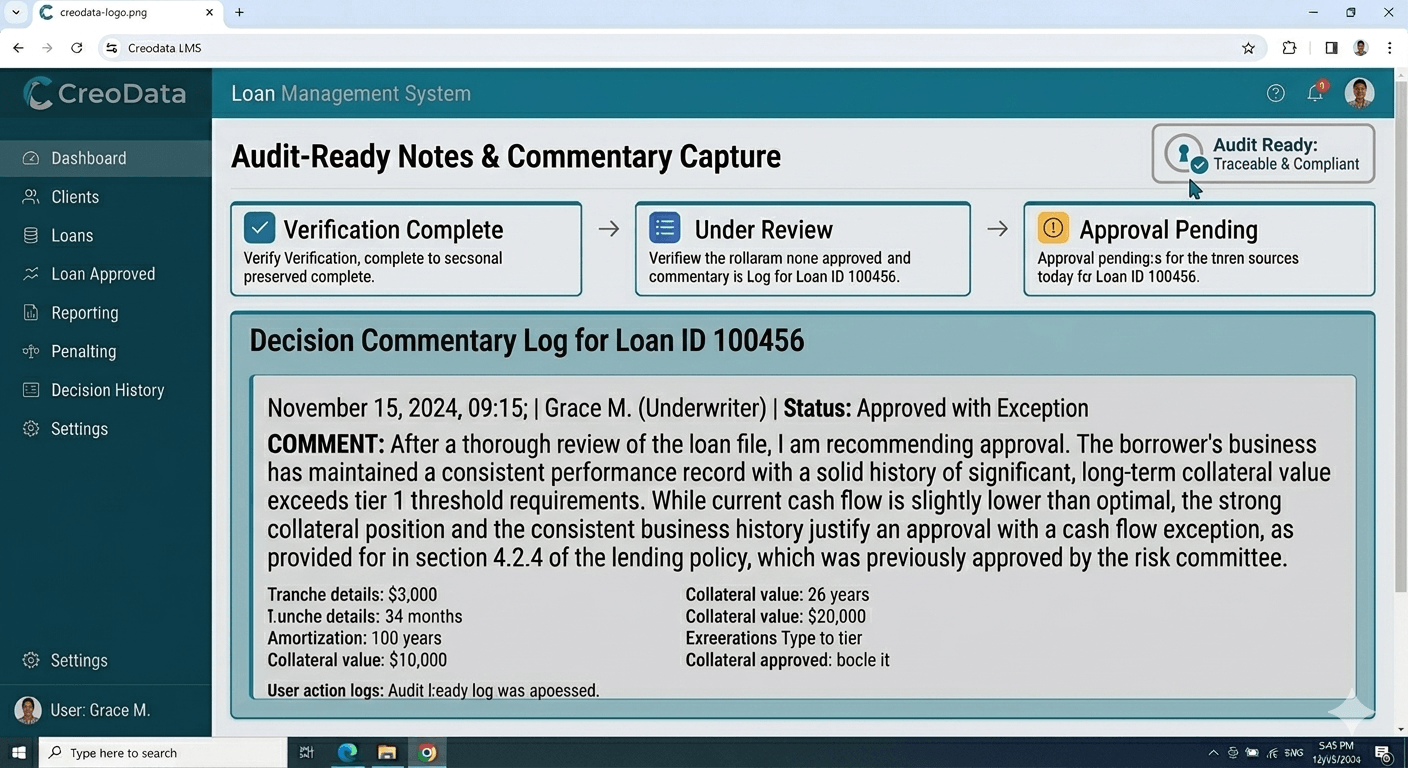
Ensuring Context-Rich, Traceable User Comments in Loan Decisioning
In modern loan management systems, maintaining comprehensive audit trails and history isn't just a nice-to-have — it's a regulatory and operational necessity. Within this context, Comments/Notes Logging plays a pivotal role. This feature ensures that any comments or notes added by users — such as underwriters, verifiers, risk officers, relationship managers, or auditors — are logged alongside status changes and linked to relevant loan events. The result is richer contextual insight for decision-making, enhanced accountability, and improved compliance readiness — forming the essence of what we term Audit-Ready Notes & Commentary Capture.
What is Comments/Notes Logging in an Audit Trail?
At its core, Comments/Notes Logging is the capability of a loan management system to record:
- Who added a comment or note
- When the comment was added
- What loan or workflow stage it relates to
- The content of the comment
- Associated status or workflow transitions (e.g., "Underwriter review → Approval pending")
Rather than merely logging numerical or status changes, this approach captures qualitative context that describes why certain decisions were made, not just that a change occurred. In essence, it short-circuits ambiguity by making human reasoning a first-class part of the audit history.
This rich historical record becomes indispensable during audits, regulatory reviews, dispute resolutions, and internal quality assurance exercises. In an industry like lending — where documentation is evaluated repeatedly over long loan life cycles — preserving context demonstrates both good governance and operational transparency.
How Comments/Notes Logging Works
In a robust loan management platform such as Creodata's Loan Management System (built on Microsoft Azure with enterprise-grade security and compliance), audit logging is already integrated into the core feature set. While the public product information emphasizes comprehensive audit trails for all system activities and transactions, an audit-ready comments feature logically extends these capabilities to verbalized reasoning and decision context.
A typical implementation includes:
1. User Prompt on Workflow Action
When a user changes a loan's status — for example, from "Verification Complete" to "Under Review" — the system can require or suggest adding a comment.
2. Structured Metadata Capture
Each comment is captured with a timestamp, user identity, role, and link to the relevant loan stage. This creates structured historical context rather than unstructured text floating separately.
3. Immutable History with Versioning
Once saved, comments are stored immutably (cannot be altered or deleted without logging) in the audit trail to preserve integrity and assist forensic review.
4. Integrated Contextual View
Comment logs are surfaced in loan history dashboards so that underwriters and auditors can see the evolution of decisions alongside transaction status changes.
5. Search, Filter, and Reporting
Senior management or compliance officers can generate reports filtered by user, loan stage, date range, or keyword to support internal reviews or external audit demands.
Taken together, these mechanisms create a layered history where numerical changes and human judgment coexist, making the system far more transparent and defensible during scrutiny.
Why Audit-Ready Notes Matter
As highlighted across audit trail best-practice literature, an audit trail by definition is a chronological record of events that provide documentary evidence of the sequence of activities affecting a transaction or system state. Traditional audit logs capture what changed and when, but often miss why — which is where comments/notes logging fills the gap.
1. Strengthened Compliance & Regulatory Readiness
Financial regulators increasingly demand detailed evidentiary records showing not just actions but rationale, particularly for lending decisions with high risk or potential consumer impact. A logging system that includes commentary allows lenders to:
- Demonstrate decision criteria transparently
- Provide evidence in regulatory examinations
- Reduce delays in compliance audits
This is especially important in jurisdictions where audit readiness forms part of ongoing regulatory compliance, and systems must prove they can reconstruct decisions reliably.
2. Enhanced Decision-Making Context
When an underwriter or verifier documents why they moved a loan forward or held it back, future reviewers gain valuable insight. This becomes particularly helpful when:
- Reviewing exceptions and overrides
- Investigating performance issues in loan portfolios
- Making strategic adjustments to lending criteria
Context-rich commentary helps teams understand the thinking behind prior decisions rather than guessing based solely on status or numeric data.
3. Operational Accountability
Comments/Notes Logging provides a clear accountability path:
- Each note is tied to a specific user identity and role
- Timestamped entries prevent disputes about when a decision or analysis occurred
- History cannot be spoofed, deleted, or altered without trace
Such accountability helps deter inappropriate actions or careless decisions, fostering a stronger culture of responsibility and diligence.
4. Better Internal Audits and Quality Control
Internal auditors and quality assurance teams often require narrative insight to understand workflow handoffs, exceptions, or unusual decisions. Without comments, auditors might need to interview staff or piece together undocumented context — a time-consuming and error-prone process.
Advantages of Comments/Notes Logging within Audit Trails
The combination of audit trail strength and commentary capture unlocks many benefits:
A. Regulatory Confidence and External Audit Efficiency
Organizations can produce:
- Comprehensive historical records
- Documented rationales tied to compliance requirements
- Evidence packages for external reviewers
This significantly reduces audit prep time and increases regulator confidence in your processes.
B. Reduced Operational Risk
By having documented commentary, institutions can:
- Recognize systemic issues earlier
- Detect anomalies and outliers in decision trends
- Improve policies based on documented evidence
This reduces risk exposure over time.
C. Improved Collaboration and Knowledge Retention
When multiple stakeholders touch a loan file (underwriters, verifiers, risk officers, relationship managers), comments connect those workflows and help future users understand past reasoning without repetitive phone calls or chalkboard discussions.
D. Contextual Reporting
Apart from numerical metrics, leadership reports enriched with commentary provide strategic insights into portfolio quality, exception volumes, and underwriting rigor.
E. Historical Integrity and Forensic Value
Immortalizing comments within the audit trail protects them from manipulation, ensuring historical integrity if the system is ever subpoenaed, examined, or questioned.
Disadvantages and Challenges of Comments/Notes Logging
No system feature is without tradeoffs. While the benefits are compelling, there are some important disadvantages and challenges to consider:
1. Volume & Searchability
Without careful design, comment logs can grow rapidly — especially in high-volume lending environments. This leads to:
- Larger storage requirements
- Difficulty in searching or filtering relevant commentary
- Noise overwhelming actionable insights
This parallels general audit log challenges where large volumes of data can strain storage and analysis tools.
2. Quality & Consistency of Comments
Because comments are human-generated:
- They may be inconsistent in detail or quality
- Some users may add vague or unhelpful commentary
- Others may omit valuable context
This variability requires strong user guidance and training to ensure usefulness.
3. Privacy & Compliance Risks
Although audit trails improve compliance, capturing commentary sometimes creates privacy concerns. Free-text comments might inadvertently include sensitive personal data, which must be managed in line with data protection standards like PCI DSS, GDPR, and ISO 27001, all of which Creodata's Loan Management System adheres to as per their product page.
Proper controls must ensure:
- Sensitive information isn't exposed in reports
- Access to logs respects user roles
- Retention policies align with privacy law
4. Overhead in Training and Governance
To make commentary truly effective — and not a perfunctory tick-box exercise — institutions must invest in:
- User training
- Templates or guidelines for note quality
- Governance rules on when commentary is required
Without these, notes can devolve into noise rather than insight.
5. Implementation Complexity
While most modern systems support audit logging, capturing and presenting narrative context alongside numerical logs requires thoughtful design. This increases:
- Initial development or configuration effort
- Complexity of data models
- Demand on UI and reporting workflows
Best Practices for Effective Comments/Notes Logging
To maximize benefits while minimizing drawbacks, institutions should consider:
Structured Comment Templates
Encourage structured entries (e.g., "Reason for exception," "Risk justification," "Policy reference") to standardize inputs.
Role-Based Visibility Controls
Ensure that only authorized roles see sensitive commentary, protecting privacy while enabling compliance.
Intelligent Search & Tagging
Tag comments with relevant metadata (e.g., loan stage, risk category) to improve searchability and reporting.
Retention & Archiving Policies
Establish clear log retention policies that satisfy regulatory timelines and reduce unnecessary storage.
Training & Governance
Invest in user training and enforce policies to ensure comments add value rather than noise.
Conclusion
Comments/Notes Logging as part of an audit trail — framed here as Audit-Ready Notes & Commentary Capture — is a powerful feature for modern loan management systems. It enhances contextual decisioning, strengthens compliance readiness, improves accountability, and creates richer historical insights that go beyond mere status changes. In the context of platforms like Creodata's Loan Management System — which emphasizes built-in audit logging and compliance features — this capability becomes part of a broader strategic advantage in operational governance and regulatory resilience.
Like any comprehensive feature, it comes with challenges in storage, quality control, privacy, and governance, but with proper implementation and best practices, the advantages significantly outweigh the drawbacks. In industries where traceability, transparency, and defensibility are key, audit-ready commentary capture transforms passive logs into actionable institutional knowledge.
For more information, visit Creodata.com