
Internal Audits Made Easy with History Logs
Give internal audit teams searchable history logs across the loan lifecycle so compliance verification and governance reviews take minimal manual effort.
In a world where regulatory scrutiny, operational risk, and governance pressures are at an all-time high, financial institutions are increasingly turning to automated systems that not only support daily operations but also enable internal teams to conduct thorough, efficient audits. This is particularly true in the lending domain, where thousands of decisions, approvals, and record updates take place throughout the loan lifecycle — from application through approval, disbursement, repayment, and closure.
Financial institutions — whether small banks, SACCOs, or microfinance organizations — need mechanisms that capture, record, and make easily searchable every action taken within their loan management systems. This ensures that internal audit teams can rapidly and confidently verify compliance, trace decision-making, and demonstrate governance controls with minimal manual effort.
This article explores how internal audit tracking via history logs streamlines compliance and auditing functions within modern loan management platforms. We reference features and capabilities from CreoData's Loan Management System, showing how proper audit trail mechanisms reduce manual log collation, improve transparency, and reinforce trust with internal stakeholders and external regulators.
Understanding Internal Audit Tracking and History Logs
Internal audit tracking refers to the systematic capture and retention of chronological records of user actions, status changes, transaction modifications, and workflow events that occur within a software system. In a loan management context, this includes:
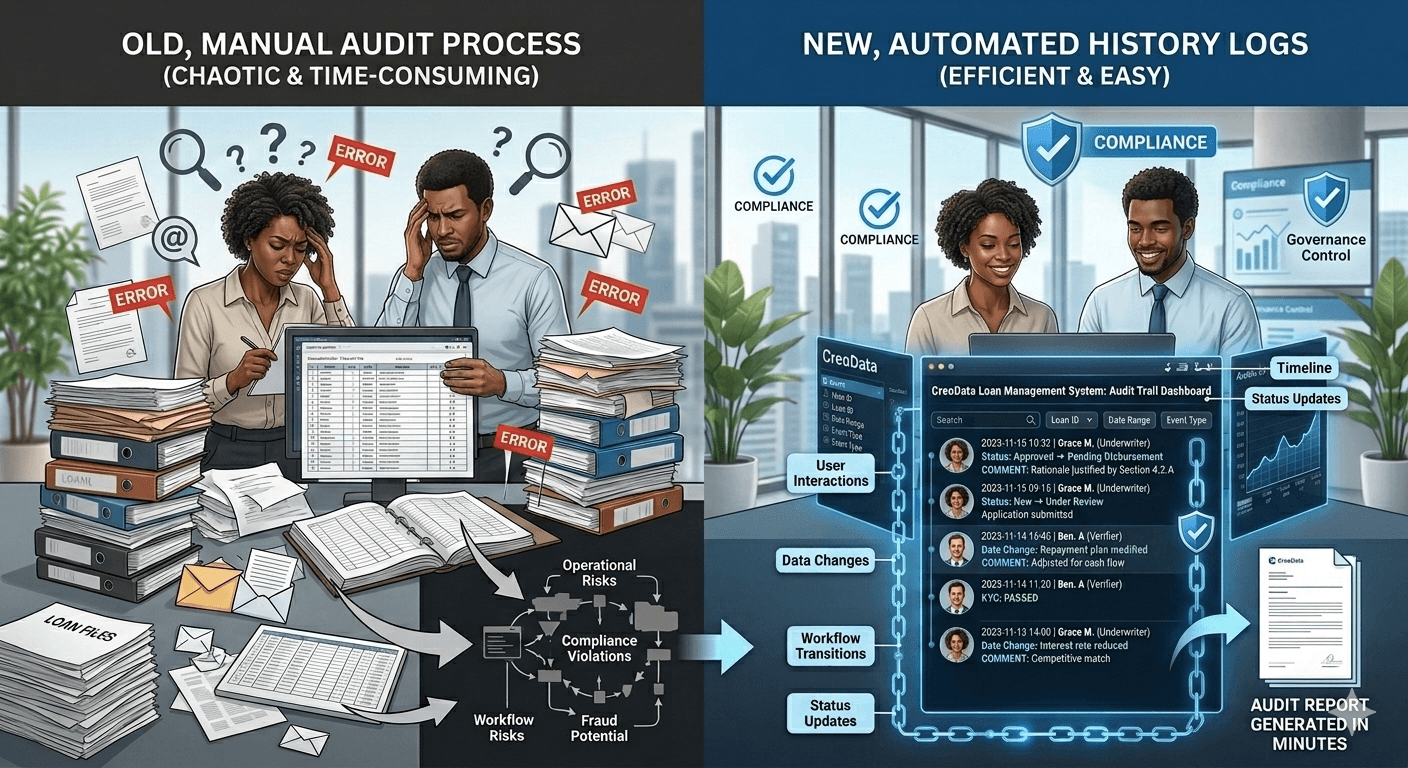
- User interactions: Login events, access requests, status updates, approvals, rejections.
- Data changes: Modifications to borrower information, collateral details, interest schedules, repayment plans.
- Workflow transitions: Every milestone in the loan process — from submission to underwriting, approval, disbursement, and repayment — is logged with timestamps and user identity.
- Status updates and events: Changes in loan status (e.g., "Under Review," "Approved," "Disbursed") are precisely recorded.
These history logs create a comprehensive audit trail that shows exactly who did what, when, and how — providing visibility and accountability across the lifecycle of every loan. Automated audit trails are essential for internal audit teams tasked with verifying compliance with internal policies, industry regulations, and best governance practices.
Why Internal Audits Are Critical in Lending Operations
The lending process is inherently risk-intensive. It involves judgment calls, regulatory requirements, financial calculations, and sensitive customer data. Without a clear audit trail of activities, institutions face risks such as:
-
Compliance violations: Lending is regulated by central banks, anti-money-laundering laws, customer protection rules, and reporting standards. Lack of clear logs makes it harder to demonstrate compliance.
-
Operational errors: Manual tracking or paper-based processes often lead to misplaced records, inconsistent documentation, and errors that auditors struggle to reconcile.
-
Fraud and misuse: Without comprehensive logs, detecting unauthorized changes or improper approvals becomes difficult.
-
Inefficient review cycles: Internal auditors may spend weeks manually collating logs, querying users, and reconstructing events — delaying audit reporting and decision-making.
Automated history logs eliminate or drastically reduce manual collation work by capturing these events transparently and in real time, structured for query and analysis.
How History Logs Simplify Internal Audits
Automated, Time-Stamped Activity Capture
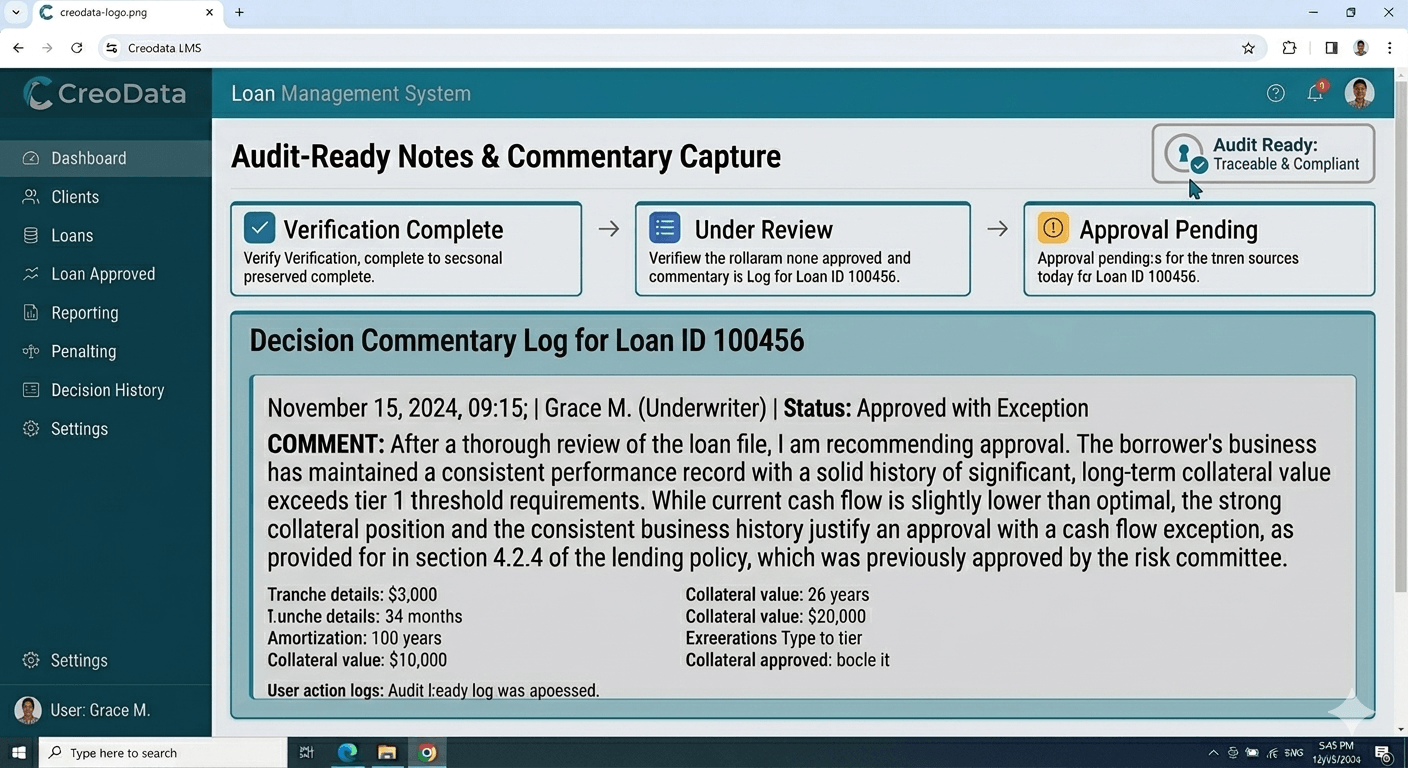
A well-designed loan management system automatically logs every action performed within the platform — whether it's a login, status transition, loan document update, or approval. These entries are essential to internal audits because they provide an immutable sequence of events that auditors can trust when reconstructing workflows or investigating discrepancies.
For example, if an audit team needs to confirm whether a loan officer followed the correct approval process for a high-value loan, the system's audit trail shows each step chronologically, with corresponding timestamps and user IDs. This not only proves compliance but also swiftly highlights anomalies.
Searchable and Filterable Logs
Internal auditors often work with tight deadlines. History logs that are indexed, searchable by fields (such as user ID, loan ID, date range, or event type), and exportable to reporting tools save immense time. They allow auditors to filter events by specific criteria — for instance:
- Events related to a particular loan batch
- All amendments made by a specific user
- All status changes within a defined period
This level of flexibility transforms audit preparation from a manual slog into a guided investigation powered by data.
Preservation of Data Integrity and Traceability
History logs must be immune to tampering and reflect exactly what happened without the possibility of unauthorized alteration. A robust loan management platform ensures records remain intact, providing auditors and compliance officers with trustworthy evidence they can confidently present to regulators or governance boards.
Transparent Workflow Visibility
Loan processes often involve multiple stages and teams — from customer onboarding to underwriting, legal checks, risk assessment, disbursement, and collection. History logs provide a 360-degree view of these workflows, showing transitions and exceptions in real time. Auditors can visualize entire loan journeys, making the verification of process compliance straightforward.
How CreoData's Loan Management System Supports Internal Audit Tracking
CreoData's Loan Management System — a cloud-based lending platform designed for small banks, SACCOs, and microfinance institutions — embeds audit trail and history logging as part of its core capabilities. Built on Microsoft Azure, the solution ensures robust security, high availability, and compliance readiness.
Comprehensive Audit Logs for All Activities
CreoData's platform captures detailed logs for every user interaction and transaction within the system. Whether a loan officer updates a borrower's profile, a manager approves a loan, or a system administrator modifies a workflow configuration, every action is recorded with explicit timestamps and user identification.
Integrated Data Governance Features
The platform is designed with governance and compliance in mind, aligning with standards such as PCI-DSS, GDPR, and ISO frameworks. Audit logging is part of this compliance focus, enabling financial institutions to meet internal, external, and statutory audit requirements with minimal overhead.
Centralized Loan Lifecycle Tracking
Rather than relying on disparate spreadsheets, emails, or paper trails, CreoData's system consolidates loan lifecycle data in one authoritative platform. The internal audit team can query this single source of truth to construct audit reports without needing to chase multiple sources.
Key Advantages of Internal Audit Tracking with History Logs
Adopting automated audit trails provides several strategic and operational benefits:
Reduced Manual Effort and Time Savings
Audit teams no longer need to spend days manually extracting logs from multiple systems or interviewing staff to reconstruct events. Searchable history logs significantly speed up both routine and deep-dive audits.
Enhanced Compliance and Governance Confidence
With robust logs available on demand, institutions can confidently demonstrate compliance with internal policies and external regulations. This is especially important in regulated markets where institutions are subject to periodic reviews by central banks or external auditors.
Improved Risk Detection and Control
History logs are invaluable for identifying suspicious activity, unauthorized changes, or policy violations. Internal audit teams can quickly pinpoint irregularities and escalate them for remediation.
Better Decision-Making and Accountability
Logs that show who changed what and why foster accountability across teams. Audit findings become clearer and based on actual evidence rather than recollection or fragmented records.
Audit-Ready Reporting
Automated logs facilitate on-demand audit reporting, enabling institutions to generate compliance reports quickly. This is particularly valuable during regulator examinations, internal control reviews, or investor due diligence.
Target Audience for Internal Audit Tracking
The benefits of history logs and internal audit tracking extend across functional roles and organizational levels:
Internal Audit and Compliance Officers
These professionals are the primary beneficiaries of automated audit trails. They rely on history logs to conduct audits efficiently, ensure compliance, and prepare audit reports that satisfy regulators and senior leadership.
Risk Management Teams
Audit trails help risk officers monitor anomalies, detect control weaknesses, and ensure that risk policies are enforced across lending operations.
Finance and Operations Leaders
CFOs, COOs, and operational heads use audit data to monitor process efficiency, enforce governance standards, and build confidence in their institution's internal controls.
Loan Operations and Back-Office Staff
Loan officers and back-office administrators benefit from transparent workflows and traceable records that clarify decision history and document movement.
IT and System Administrators
Customization of audit logging parameters, storage policies, and access rights often resides with IT teams. They ensure the system captures necessary data while maintaining performance and security standards.
External Auditors and Regulators
Although not internal staff, external auditors and regulators often request access to system logs during inspections or compliance reviews. History logs make it easy to comply with such requests.
Conclusion
In financial institutions where accountability, transparency, and compliance are non-negotiable, internal audit tracking powered by detailed history logs is a transformative capability. It moves institutions away from piecemeal documentation and manual log collation toward a centralized, searchable, auditable system that supports governance at scale.
Solutions like CreoData's Loan Management System, with built-in audit logging, help institutions reduce risk, reinforce accountability, and empower internal auditors to conduct efficient, evidence-based reviews with minimal effort. By capturing every action across the loan lifecycle, these systems lay the foundation for stronger internal controls, smoother audits, and improved operational confidence.
For more information, visit Creodata.com