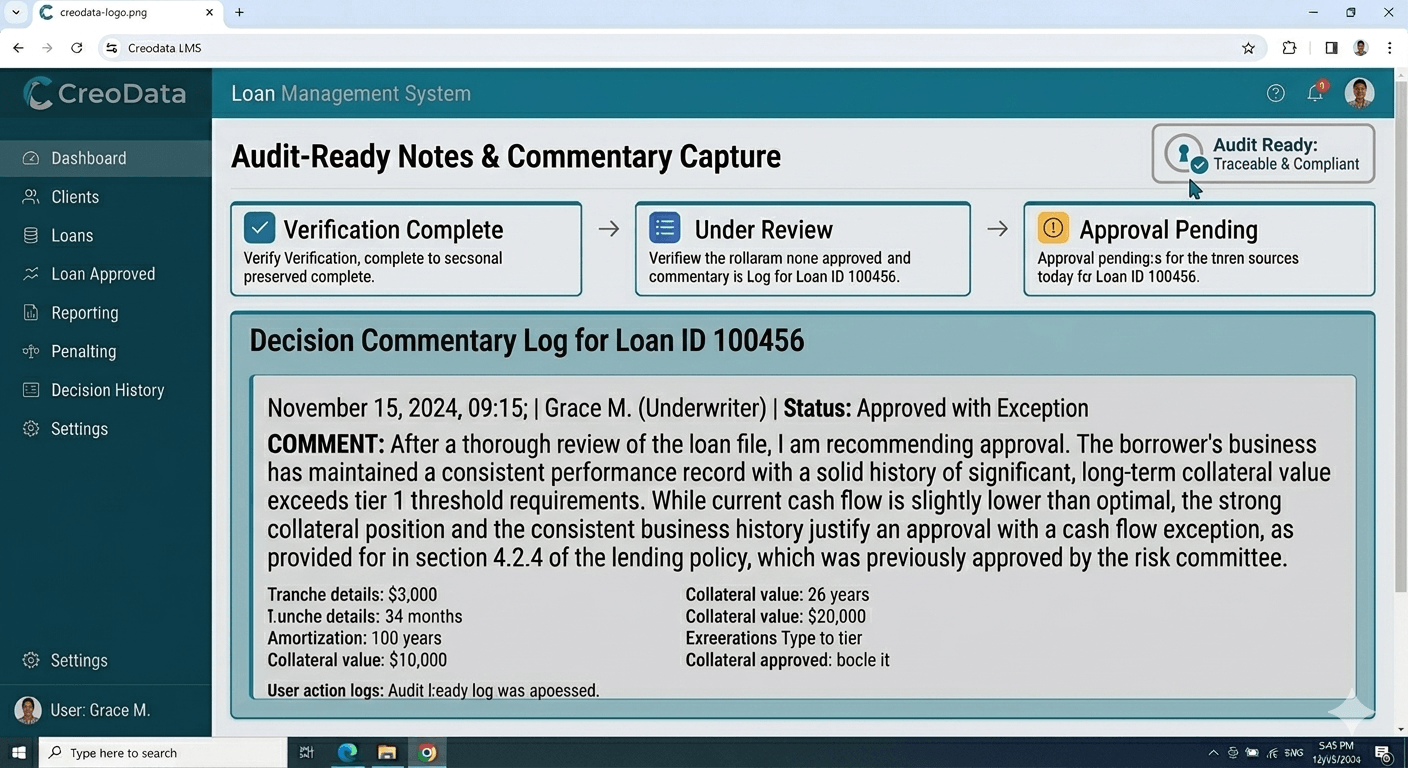

User Action Traceability in Loan Workflow
Track who submitted, verified, approved, and changed each loan application so every action across the lending workflow is fully traceable.

Introduction
In modern lending institutions — from small SACCOs and microfinance organizations to retail banks and credit unions — maintaining control, compliance, and clarity over each step of the loan process is critical. Every loan application passes through multiple stages: from submission and KYC checks, to underwriting, approval, disbursement, and repayment tracking. At each stage, different users or roles (loan officers, underwriters, managers, compliance officers) may interact with the application. Without proper tracking, it can be difficult to answer key questions: who submitted the loan? who verified the documents? who approved disbursement? when and how were changes made?
This is where audit trail and user/role tracking come in. By recording, for each action, which user (or role) performed it — along with timestamp, action type, before/after data — a loan management system can deliver full traceability and accountability. This capability is especially important in regulated environments, where transparency, compliance, and auditability are non-negotiable.
What Is User Action Traceability & Why It Matters in Loan Workflow
User Action Traceability refers to the systematic logging of who performed what action, and when, within a system. In a loan workflow context, typical actions might include:
- Submission of a loan application
- Upload of supporting documents
- Running KYC/credit-checks
- Verification of borrower data
- Approval or rejection of the loan
- Disbursement of funds
- Modification of loan terms (rescheduling, refinancing)
- Payment or repayment actions
- Adjustments, cancellations, rollbacks, or other modifications
For each action, traceability means capturing: the user identity (or role), timestamp, type of action, and often context (loan application ID, changed fields, previous vs new values, attached documents). Over the life of the loan — and even beyond — this generates a chronological audit trail or history log.
Why this matters:
-
Accountability & Transparency: Each action is attributable to a specific user. This discourages misuse or fraud, because employees know their actions are being logged.
-
Compliance & Regulatory Readiness: Many jurisdictions and regulatory frameworks require detailed record-keeping of lending activity, KYC/AML checks, approvals, and modifications. A complete audit trail simplifies regulatory audits, reporting, and due diligence.
-
Dispute Resolution & Forensics: If there is a dispute — e.g., borrower claims they were approved incorrectly, or terms changed — the audit trail provides objective evidence of who did what, when, and how.
-
Operational Oversight & Process Improvement: Reviewing the history can help identify bottlenecks, inefficiencies, or repeated errors — for example, frequent resubmissions, repeated rework, approval delays. This data supports optimization of workflows and staff training.
-
Internal Audit & Governance: Senior management and compliance functions benefit from being able to reconstruct entire loan workflows — critical in risk management and oversight.
In short: traceability transforms a loan workflow from a "black box" into a clear, accountable, auditable, and optimizable process.
How a System Like Creodata's Loan Management Supports This
The loan management solution offered by Creodata is a comprehensive, cloud-based platform built on Azure — designed to manage the full loan lifecycle: from application and customer onboarding, through approval, disbursement, repayments, and delinquency management.
Key relevant elements in Creodata's offering that support user action traceability:
-
Audit Logging & Audit Trails: On its product page, Creodata highlights "comprehensive audit trails for all system activities and transactions."
-
Role-Based Access Control (RBAC): The system supports fine-grained permissions, ensuring that only authorized users can perform specific actions (e.g., only senior staff can approve large loans), which helps in mapping actions to roles or users.
-
Customizable Workflows & Approval Hierarchies: Because the platform allows defining loan products and approval workflows, institutions can structure multi-stage workflows (submission → verification → approval → disbursement). In such structured workflows, each stage can be logged with user identity and timestamp.
-
Document Management & Digital Vaults: Creodata supports secure document handling (onboarding docs, collateral, KYC documents) with encryption and secure storage. Changes to documents (upload, update, delete, view) can also be logged in the audit trail.
-
Real-Time Reporting & Analytics: The system's dashboard and reporting capabilities enable oversight of loan portfolios — with history logs likely available for review or export when needed.
-
Cloud-Based & Compliance-Oriented Infrastructure: Being Azure-hosted, with security, encryption, and compliance standards, the platform supports the integrity, resilience, and availability of audit logs — critical for long-term traceability.
All these features combine to make Creodata's Loan Management solution a strong foundation for user/role tracking and traceability.
Advantages of User Action Traceability
Here are the key benefits that organizations get from implementing user/role tracking in their loan workflow:
1. Enhanced Accountability & Reduced Risk
When users know their actions are recorded, the risk of unauthorized or inappropriate modifications decreases. This acts as a deterrent to fraud or abuses of access.
2. Compliance and Regulatory Readiness
Regulators often demand clear records of loan origination, KYC, approvals, and modifications. Audit trails help institutions meet compliance requirements — and provide evidence during audits or regulatory reviews.
3. Operational Transparency & Internal Audit
Management, compliance teams, and internal auditors can review loan histories, decisions, and modifications — improving transparency and enabling robust governance.
4. Dispute Resolution & Customer Trust
If disputes arise — e.g., borrower disputes loan terms or claims miscommunication — having a detailed action log provides objective evidence, helping resolve conflicts and build customer trust.
5. Process Improvement & Efficiency Gains
Analysis of audit data over time can reveal inefficiencies: delays between steps, repeated rework, bottlenecks. Institutions can then refine workflows, reassign roles, or automate repetitive tasks to optimize operations.
6. Governance & Accountability Across Roles
Because the system supports role-based access and tracks role-based actions, institutions can define clear responsibilities (e.g., who can approve, who can disburse), segregate duties, and enforce internal controls — critical in risk-sensitive operations such as lending.
7. Audit-Ready Loan History for Regulatory or External Audits
Because all steps — from application to repayment — are logged, institutions can easily retrieve full loan history for external audits, compliance reviews, or historical analysis. This improves reliability, adherence to regulatory standards, and disaster recovery preparedness.
Target Audience
Which kinds of institutions or users benefit most from implementing user action traceability in loan workflows? The following are especially well-suited:
-
Small banks, SACCOs, credit unions, microfinance institutions aiming to professionalize operations — gain visibility, compliance, and scalability. Systems like Creodata's are explicitly built for such institutions.
-
Financial institutions under regulatory oversight, subject to compliance requirements (KYC/AML, data retention, audit, reporting). Traceability helps meet those obligations.
-
Institutions with multi-branch or multi-user operations, where many officers handle applications, underwriting, approvals, disbursement, or repayments — making clear assignment of responsibilities and audit trails essential.
-
Risk management, compliance, and internal audit teams — who need detailed logs for oversight, reviews, and regulatory readiness.
-
Senior management and leadership — for governance, operational visibility, performance monitoring, and strategic decision-making informed by historical data.
-
Institutions scaling operations or planning digital transformation — as user tracking provides structure, repeatability, and accountability which are critical for growth.
-
Any lending institution seeking enhanced customer trust and dispute mitigation — transparent logs increase credibility and protect both parties.
Conclusion
User action traceability — logging exactly who (or what role) performed which action, and when — is a foundational capability for modern loan management systems. It transforms the loan workflow into a transparent, auditable, and accountable process: from application submission, through verification, approval, disbursement, repayment, and modifications.
For institutions using cloud-based, full-lifecycle loan platforms like Creodata's Loan Management system, this capability is especially valuable. The platform's features — role-based access control, customizable workflows, audit logging, secure document management, and real-time reporting — make traceability both feasible and practical.
The advantages are manifold: regulatory compliance and audit readiness; internal accountability; dispute resolution; operational transparency; process optimization; and risk mitigation.
The institutions that benefit most include small banks, SACCOs, microfinance institutions, credit unions — especially those under regulatory oversight, operating across branches or multiple users, or seeking to scale while maintaining control. Compliance officers, internal auditors, operations managers, risk teams, and senior management all benefit from the clarity and governance that traceability affords.
For more information, visit Creodata.com