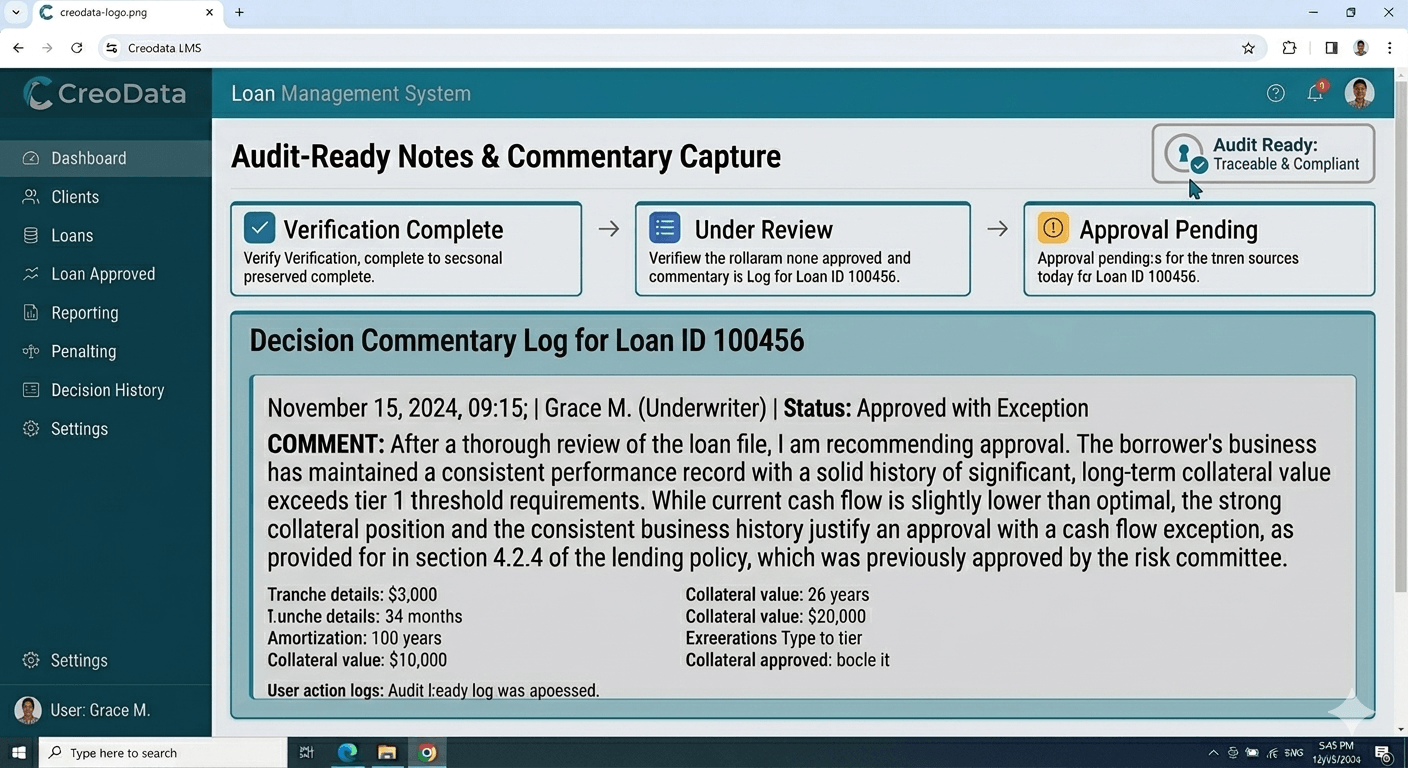

Regulatory-Ready History Reporting: The Cornerstone of Modern Lending Compliance
Generate complete, immutable history reports on demand to meet regulatory scrutiny and turn compliance from a reactive scramble into proactive operations.
In the strictly regulated world of finance, an audit trail is not just a technical feature—it is the definitive record of truth. For lenders, every loan application review, data field update, document upload, and approval decision is a potential point of regulatory scrutiny. The ability to instantly generate a complete, immutable history of these actions transforms the often-daunting task of compliance from a reactive scramble into a proactive, seamless part of operations. This capability, known as Regulatory-Ready History Reporting, is what separates modern, resilient financial institutions from those burdened by operational risk and regulatory exposure.
This article explores how comprehensive audit trails and automated reporting empower lenders to not only meet but exceed compliance demands. By drawing on principles evident in Creodata's loan management insights—such as building "a compliant, traceable document management system with audit trails"—we will examine how a transparent, automated history log supports governance, builds trust, and provides a strategic advantage.
The Critical Need for an Unbroken Chain of Evidence
Financial regulators require proof of consistent, fair, and secure processes. In lending, this means demonstrating:
- Who performed an action (user identification).
- What was changed or reviewed (the specific data, document, or decision).
- When it occurred (exact timestamp).
- Why it was justified (often linked to role-based permissions and workflow stages).
Manual processes or fragmented systems create gaps in this chain. A note in a file, an email approval, or a verbal agreement lacks the immutable digital fingerprint required for a robust audit. As highlighted in discussions on governance, systems must ensure "board-level oversight for high-value loans with automated workflow escalation," which is only verifiable through a detailed, system-generated history.
How Regulatory-Ready History Reporting Works
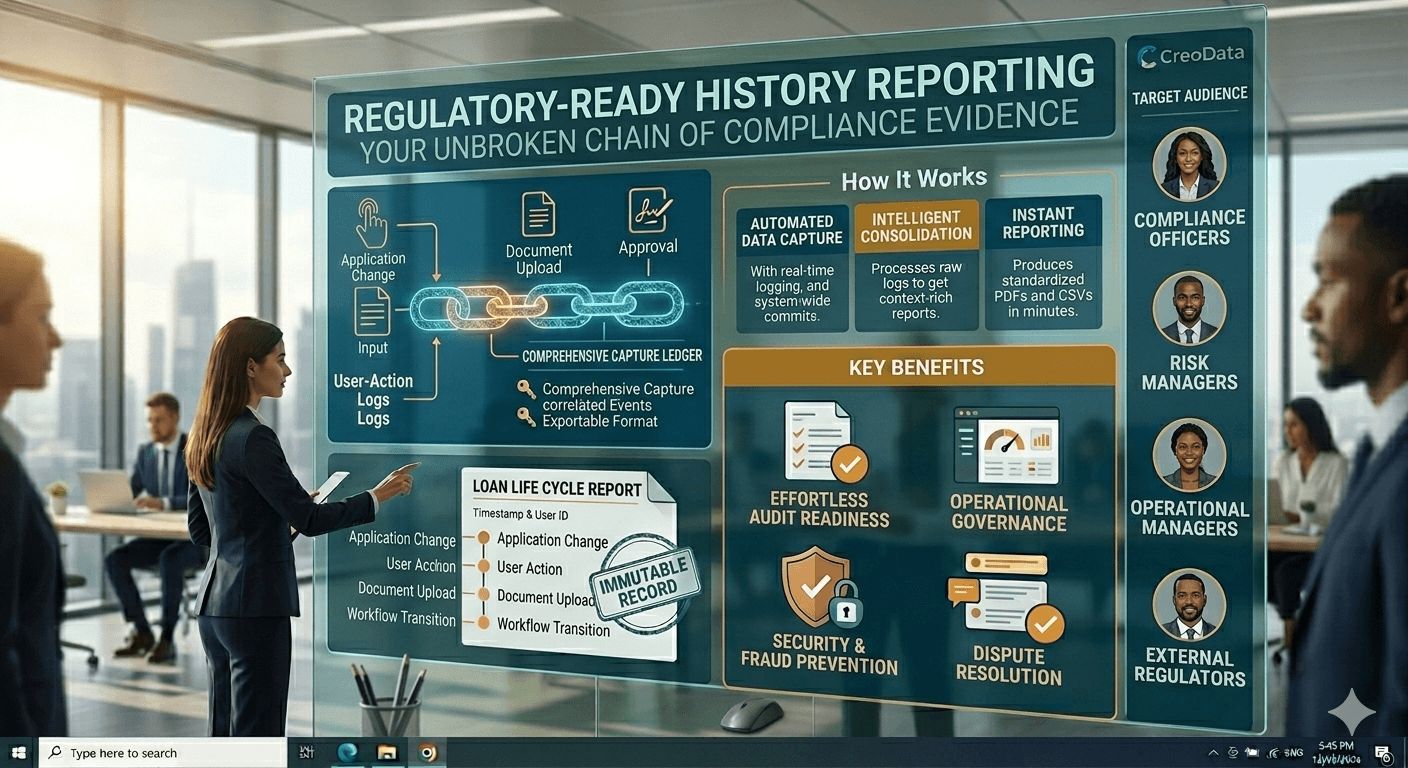
A true regulatory-ready system weaves audit capability into its very fabric. It automatically captures a wide array of events, creating a searchable, exportable ledger of all activity.
1. Comprehensive Data Capture
The system continuously logs:
-
Application Change-History: Every modification to a loan application—from correcting a borrower's address to adjusting the requested loan amount—is recorded with the old value, new value, user, and timestamp.
-
User Action Logs: All significant actions are tracked, such as "relationship manager requested clarification," "credit officer approved risk assessment," or "compliance officer placed a hold."
-
Document Audit Trails: As noted in Creodata's blog on audit-ready systems, metadata is key. For every uploaded document (ID, bank statement, collateral deed), the system logs who uploaded it, when it was verified, if it was replaced, and who viewed it, creating "complete audit trails... through automated tracking and version control."
-
Workflow State Transitions: The entire journey of a loan is mapped. The report shows when and why an application moved from "Under Review" to "Approved by Credit Committee" to "Pending Disbursement," including all automated routing decisions.
2. Intelligent Consolidation & Reporting
Raw logs are not reports. The power lies in systems that can:
-
Correlate Events: Tie a document upload to a specific KYC check, or link a policy override to the exact executive approval that authorized it.
-
Filter by Parameters: Generate a report for a specific applicant, a particular date range, a certain user, or all actions related to loans above a set value threshold.
-
Present with Context: Output reports in clear, standardized formats (PDF, CSV) suitable for direct submission to auditors or regulators, telling a coherent story of each loan's lifecycle.
Key Advantages of Automated, Integrated History Reporting
Implementing this feature delivers transformative benefits beyond simple checkbox compliance.
Effortless Audit & Examination Readiness
The most immediate advantage is the elimination of the pre-audit panic. Instead of teams spending weeks gathering emails and reconciling spreadsheets, a compliant report can be generated in minutes. This turns a major operational disruption into a routine administrative task.
Enhanced Operational Governance & Risk Management
Real-time visibility into the "who, what, and when" allows managers to monitor process adherence, identify bottlenecks (like recurring delays at a specific review stage), and detect unusual patterns of activity that could indicate errors or internal risk. It provides the data backbone for governance features like executive oversight and multi-level credit committee (MCC) reviews.
Strengthened Security & Fraud Prevention
A detailed audit trail acts as a powerful deterrent against malicious activity. Knowing every action is permanently recorded and attributable to a specific individual enforces accountability. It is a critical component of a secure role-based access control (RBAC) framework, ensuring you can verify that "only authorized users can perform specific actions at each workflow stage."
Process Optimization & Dispute Resolution
The historical data serves as a goldmine for process improvement. By analyzing the audit trail, institutions can see where approvals are delayed or where redundant steps exist. Furthermore, if a borrower questions a decision, the institution can pull a precise report showing all communications, reviews, and data points that led to the outcome, building client trust through transparency.
Demonstrable Regulatory Compliance
Ultimately, this capability provides concrete, irrefutable evidence of compliance with regulations like those governing fair lending, data privacy (GDPR), and anti-money laundering (AML). It shows regulators that the institution has effective controls in place and is operating with integrity and transparency.
Target Audience: Who Relies on Regulatory-Ready Reports?
This functionality is mission-critical for multiple roles within and interacting with a financial institution:
Compliance Officers & Internal Auditors
The primary users. They rely on these reports to perform internal checks, respond to regulatory inquiries, and ensure the institution's policies are being followed in practice, not just on paper.
Risk Managers
Use historical data to analyze decision patterns, identify areas of potential portfolio risk, and validate that risk assessment protocols are consistently applied.
Credit & Loan Operations Managers
Utilize reports to monitor team productivity, ensure service level agreements (SLAs) are met, and optimize workflow processes based on factual historical data.
External Regulators & Auditors
While not direct users of the software, they are the ultimate consumers of the reports generated. They expect clear, complete, and tamper-evident records of lending activities.
Executive Management & the Board
Gain assurance through summarized audit reporting that the organization's risk and compliance frameworks are functioning effectively, supporting features like board-approval workflows for high-value loans.
Implementing a Future-Proof Audit Strategy
To build a truly regulatory-ready system, lenders should seek platforms where audit capability is a core architectural principle, not an add-on. Key indicators include:
-
Automated, Unavoidable Logging: The system should capture all critical events by default, with no manual intervention required from users.
-
Immutable Records: Logs should be write-once and non-editable by users, even administrators, to ensure their integrity.
-
Seamless Integration with Workflows: The audit trail should be intrinsically linked to the loan's state machine, providing clear real-time tracking and traceability from application to disbursement.
-
Role-Based Report Access: The ability to generate comprehensive reports should itself be a controlled privilege, aligning with the principle of least privilege access.
Conclusion: From Compliance Burden to Strategic Asset
In an industry built on trust and governed by strict rules, the ability to prove your processes is paramount. Regulatory-Ready History Reporting transforms the audit trail from a defensive compliance document into a strategic asset that drives efficiency, mitigates risk, and builds confidence with both regulators and customers.
By investing in a loan management system with this capability deeply embedded—one that provides, as Creodata's resources suggest, "complete audit trails, governance, and compliance for lending institutions"—financial organizations do more than just prepare for examinations. They build a foundation of transparency and control that enables smarter lending, fosters a culture of accountability, and secures their reputation in the marketplace. In the final analysis, a clear history is not just about looking back; it is the essential record that allows a financial institution to move forward with confidence.
For more information, visit Creodata.com