
Lending Management System for Microfinance Banks and MFIs: A Buyer's Guide for Kenya, Uganda and Tanzania
What a lending management system covers, which parts a microfinance bank or MFI in Kenya, Uganda or Tanzania needs, and how to compare vendors.

Short answer: A lending management system is the software a lender uses to run a loan from application to final repayment: origination and approval before the loan is paid out, servicing and collections after it, and reporting across both. Few products do every part equally well. A microfinance bank or MFI should work out which part is weakest today, buy for that part, and make sure it connects to the system that holds the loan accounts.
This guide is for credit, operations, IT and procurement teams at microfinance banks, microfinance deposit-taking institutions (MDIs), credit-only microfinance institutions (MFIs) and microfinance service providers in Kenya, Uganda and Tanzania. Searches for "lending management system", "loan management system" and "microfinance software" return products that do very different jobs.
Creodata sells loan origination software, which is one part of a lending management system and not the whole of it. We say where it fits near the end. This is a practical guide, not legal advice: confirm requirements against current law and your regulator's guidance.
What is a lending management system?
"Lending management system" is an umbrella term. It covers every task a system performs between a borrower asking for a loan and the last instalment being paid.
| Part | What it does | Where it usually lives |
|---|---|---|
| Application intake | Captures the borrower, the product and the request | A loan origination system, or the front end of an all-in-one platform |
| Documents and checks | Collects each product's required documents and records identity and credit bureau results | Loan origination system |
| Appraisal and approval | Builds the credit proposal, routes it by amount to the people with authority, and records each decision | Loan origination system |
| Booking and disbursement | Creates the loan account and releases the funds | Core banking, or the servicing side of a lending platform |
| Servicing | Repayment schedule, interest, repayment posting and penalties | Core banking, or a loan management system in the servicing sense |
| Arrears and collections | Ageing, reminders and recovery follow-up | Loan management system or core banking |
| Reporting | Pipeline, turnaround, portfolio and regulatory reports | Split across both sides |
Vendors use "lending management system", "loan management system", "lending platform" and "microfinance software" for products that cover different rows of this table. Ask each vendor to mark the rows it covers in production today. Our explainer on LOS vs loan management system vs core banking sets out the three main system types, and what a loan approval system is looks closely at the approval row.
Why microfinance lenders buy differently from banks
Three features of microfinance lending shape the purchase.
- Many loans, mostly small. Servicing and collections carry most of the daily work, so the servicing side has to be dependable before anything else.
- Decisions close to the customer. Loan officers and branch managers decide most loans, often far from head office, so branch queues and branch limits matter more than one central committee.
- A changing loan book. As a lender moves into larger individual, SME or asset-backed loans, approvals move to head-office credit committees and the board. A one-step approval that suited small loans stops being enough.
Who regulates microfinance lenders in Kenya, Uganda and Tanzania?
Your licence decides who examines your loan files and which rules your systems have to help you evidence.
| Deposit-taking microfinance | Credit-only and non-deposit-taking lenders | Credit bureaus | Data protection | |
|---|---|---|---|---|
| Kenya | Microfinance banks: Central Bank of Kenya (CBK), Microfinance Act, 2006 | The Business Laws (Amendment) Act, 2024, which commenced on 27 December 2024, extended CBK licensing to all non-deposit-taking credit providers | Licensed by CBK | Data Protection Act, 2019; financial-services data controllers register with the ODPC whatever their turnover |
| Uganda | MDIs: Bank of Uganda, Micro Finance Deposit-Taking Institutions Act 2003 | Non-deposit-taking MFIs, SACCOs and money lenders: Uganda Microfinance Regulatory Authority (UMRA), Tier 4 Microfinance Institutions and Money Lenders Act 2016 | Four, licensed by the Bank of Uganda | Data Protection and Privacy Act 2019; yearly registration with the PDPO |
| Tanzania | Tier 1 institutions: Bank of Tanzania (BoT), Microfinance Act 2018 | Tier 2 providers (credit companies, individual money lenders and digital lenders): BoT, under GN 679 of 2019 | Two, licensed by BoT: Creditinfo Tanzania and Dun & Bradstreet Credit Bureau Tanzania | Personal Data Protection Act 2022, in force since 1 May 2023; registration with the PDPC |
Points behind the table that matter when you configure a system:
- Kenya. Regulations to implement the 2024 Act were published in draft in August 2025, and we have not found them gazetted. A credit-only lender should confirm with CBK how the regime applies to it.
- Uganda. Parliament passed a bill in November 2024 returning UMRA's functions to the Ministry of Finance; we have not found that it has commenced. The Credit Reference Bureau Regulations 2022 bring UMRA-regulated lenders into credit reporting. A licensed money lender's rate must sit within the cap announced in November 2024: 2.8% a month.
- Tanzania. A 2025 draft to replace the Tier 2 regulations has been published; we have not found it gazetted. In 2024 BoT moved against 69 unlicensed digital lending apps, so check the licence of any lending partner.
None of these laws names a system to buy. They do mean you must be able to show who approved a loan, on what evidence, and how the borrower's data was handled. We checked these points against published sources in September 2026; confirm the current position with your regulator.
Which parts does your institution need?
Microfinance banks, MDIs and Tier 1 institutions
You already run a core banking system for deposits and loan accounts, so servicing has a home. The usual gap is the path before the loan exists: proposals, documents, committee decisions and evidence, most of all on larger loans. A loan origination system in front of the core fills that gap without duplicating the ledger.
Credit-only MFIs and non-deposit-taking providers
With no deposit ledger, one platform that originates, disburses, services and collects is often the simplest choice. If one person approves every loan, its approval step will do. If loans above a threshold go to a committee, check that the platform can route by amount, enforce limits and record the decision, or plan for an origination layer in front of it.
Lenders moving into larger loans
These signs say that approval, not servicing, has become the weak part:
- committee packs are assembled from email and paper
- nobody can say where a file is waiting, or for how long
- audit finds approvals above limit or missing sign-offs
- each branch runs its own version of the process
- a new product or a new limit needs the vendor's developers
What to evaluate
Score every vendor against the same list.
| Criterion | What to test |
|---|---|
| Product configuration | Group, individual, SME and asset-backed products, each with its own fees, collateral rules and required documents, set up without code |
| Approval routing | Routing by amount, product and office, from branch manager to head-office committee to board |
| Branch operation | Each branch sees its own queue and limits, and head office sees every branch; what staff can do when the connection drops |
| ID and bureau evidence | National ID results and bureau reports stored with the file; which integrations are live in your country and which are planned |
| Servicing and collections | Schedules, repayment posting through the channels your borrowers use, and arrears ageing; which system owns the balance |
| Integration | How an approved loan reaches the system that books it, and how a failed posting is found and fixed |
| Turnaround and audit | A timer on each stage; every decision and document action logged; no administrator edits |
| Hosting and data protection | Cloud or on-premises; where data, backups and support access sit |
| Three-year cost and exit | Licence, integrations, hosting, support and changes itemised on your volumes; data returned in open formats |
The free loan origination RFP checklist turns the origination rows into scored questions. For country detail, see the buyer's guides for Kenya, Uganda and Tanzania.
Questions for the demo
Send every shortlisted vendor the same script in advance:
- Set up one of our products with its fees, required documents and approval route while we watch.
- Move three loans of rising amounts from a branch to head office and the board. What happens when the amount changes on the way?
- Try a self-approval: one user capturing and approving the same loan.
- Follow an approved loan into the servicing system, then reconcile a failed posting.
- Show one loan's full history as an auditor would see it.
Red flags
- "End to end" with no answer on which parts are live in production.
- Approval is a single status change.
- The national ID or bureau integration turns out to belong to another country.
- Changing a fee, a limit or a stage needs the vendor's developers.
- Two systems would both hold the loan balance.
Where Creodata fits
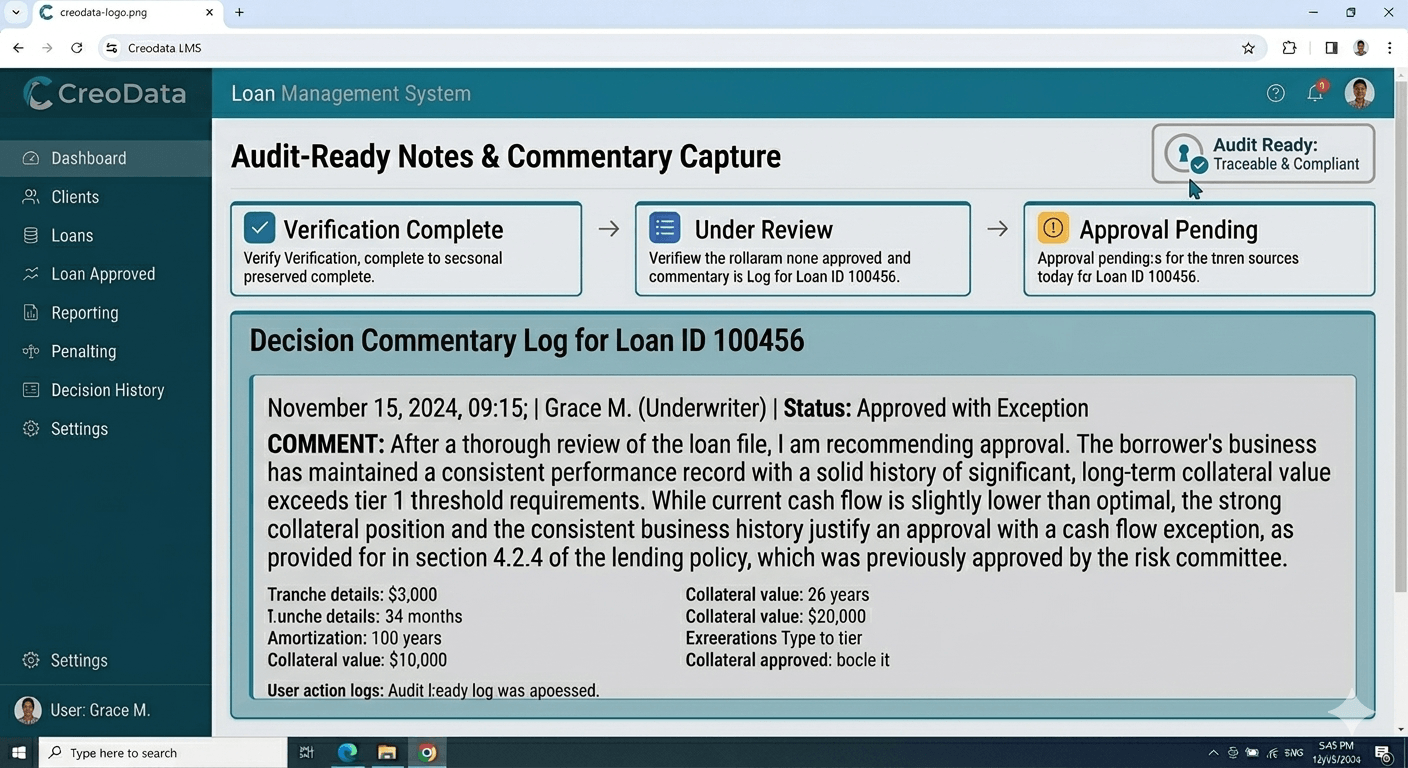
Creodata's Loan Origination System covers the origination rows of the table: application intake, document verification, credit analysis and approval, and the hand-off for disbursement. It is not a complete lending management system and we do not sell it as one. Repayment schedules, collections and the loan ledger stay in your core banking, SACCO or loan management system. It has no mobile-money, USSD or borrower-app channel and no scoring engine.
What it gives a microfinance lender is the approval path. A 13-stage, role-gated workflow routes each application by amount through committee, Board and risk gates, and re-checks the amount on the server at every decision. Products, fees, collateral, required documents and routing rules are configured without code. Queues and approval limits are scoped per office. Every stage has an SLA timer that shows where turnaround is lost, and every decision, assignment and document action is logged with the actor, a timestamp and a correlation ID.
In Kenya, IPRS, CRB and KRA checks are part of our Workplace Banking Application for check-off lending. In Uganda and Tanzania there is no built-in national ID or bureau integration: an ID verification result and a bureau report can be made required documents for any product, and direct integrations are scoped per institution. The same build runs on Microsoft Azure or on-premises, and the on-premises edition keeps borrower data in your own data centre. Pricing is quoted per institution. To see your own products and limits running, book a demo.
Frequently asked questions
What is a lending management system?
It is the software a lender uses to run loans from application to final repayment. It covers origination (intake, documents, appraisal and approval), booking and disbursement, servicing, collections and reporting. It may be one platform or several connected systems.
Is a lending management system the same as a loan management system?
Vendors often use the two terms for the same thing. "Loan management system" is also used in a narrower sense for servicing only: schedules, repayments, arrears and collections.
What is the difference between a lending management system and loan origination software?
Loan origination software is the part that runs before the loan is paid out: application, documents, appraisal, approval and hand-off for booking. A lending management system, in the wide sense, also includes servicing and collections afterwards.
Does a microfinance bank need more than its core banking system?
Not always. Many small, similar loans can be approved inside the core. A separate origination system earns its place when loans go to credit committees, when branches need their own queues and limits, or when audit keeps finding gaps in the approval record.
Who regulates microfinance lenders in Kenya, Uganda and Tanzania?
In Kenya, CBK licenses microfinance banks, and its licensing mandate now extends to non-deposit-taking credit providers. In Uganda, the Bank of Uganda regulates MDIs, and UMRA licenses non-deposit-taking MFIs, SACCOs and money lenders. In Tanzania, the Bank of Tanzania licenses Tier 1 and Tier 2 microfinance providers under the Microfinance Act 2018.
See how Creodata's loan origination software handles approvals for microfinance lenders in a demo, or score every shortlisted vendor with the free LOS RFP checklist.