
Loan Approval System: What It Is, the Stages from Branch to Board, and What to Require from Software
What a loan approval system does, the stages from branch to credit committee to board, delegated limits, maker-checker, audit trail and vendor tests.
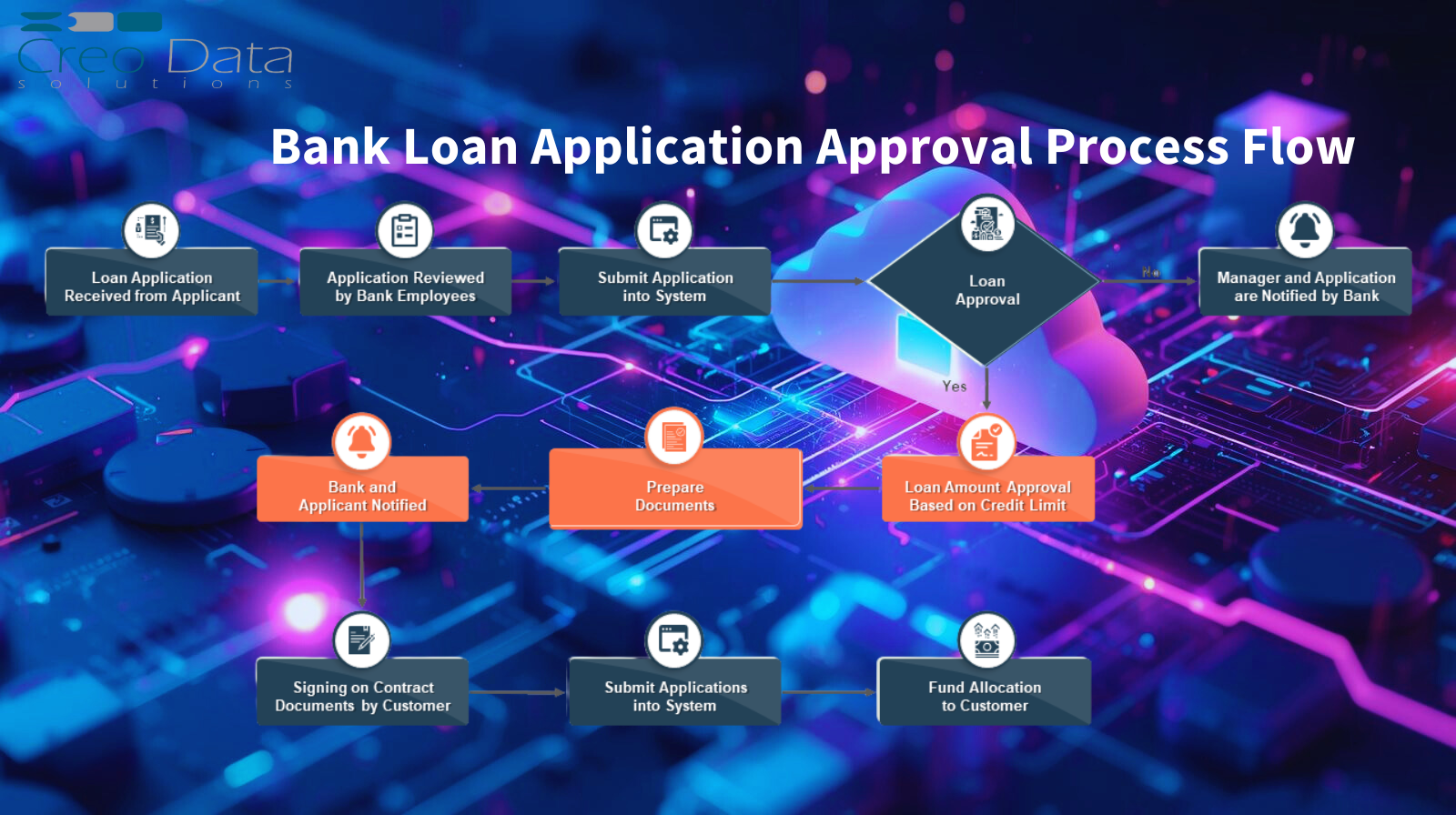
Short answer: A loan approval system is the software that carries a loan application from the officer who captures it to the person or committee with authority to approve it, enforces each approver's limit, and records every decision. It is the approval part of a loan origination system. It is not a loan management system, which runs the loan after it is paid out. When you buy one, test five things on your own products: configurable stages, limits the system enforces, maker-checker, an audit trail nobody can edit, and a clean hand-off to the system that books the loan.
This guide is for credit, IT and procurement teams at banks, microfinance banks, SACCOs and microfinance institutions (MFIs) in Kenya, Uganda and Tanzania who approve loans on paper files, by email or through a status field in a core system, and want software to replace that.
Creodata sells loan origination software that includes this approval layer, so we say where we fit near the end. This is a practical guide, not legal advice: your credit policy sets the actual approval chain, and you should confirm requirements against current law and your regulator's guidance.
What is a loan approval system?
A loan approval system does three jobs.
- It routes. Each application goes to the lowest level with authority to decide it, and to the next level when it exceeds that authority.
- It enforces. Nobody can approve above their limit, approve their own file or skip a stage, because the system refuses, not because a procedures manual says so.
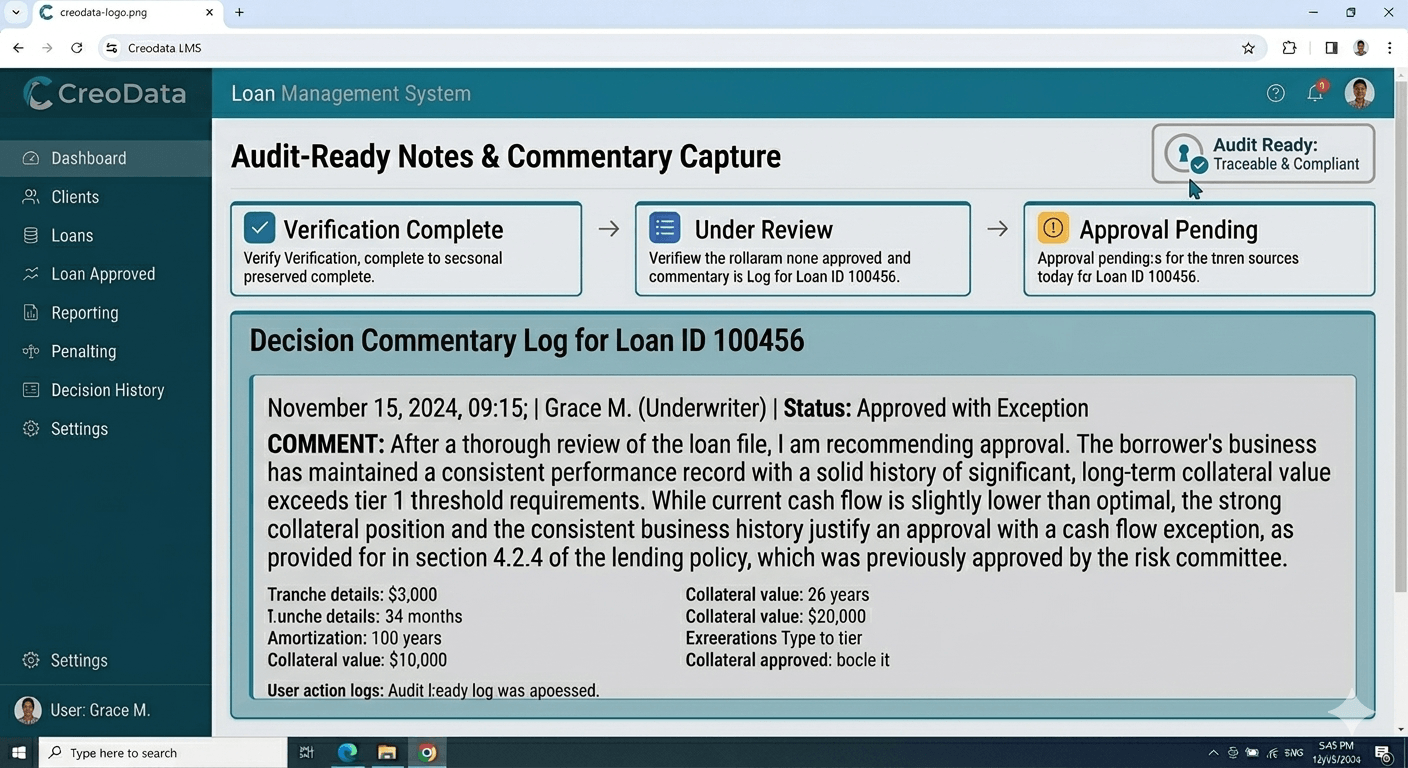
- It records. Every decision, return and change is kept with who made it and when.
Vendors also call this loan approval software or a credit approval workflow. A status field that anyone can change from "pending" to "approved" records an outcome. It is not an approval system.
Loan approval system, loan origination system or loan management system?
The three terms overlap in vendor brochures, so settle them before you write a requirement.
| Loan approval system | Loan origination system (LOS) | Loan management system (LMS) | |
|---|---|---|---|
| Covers | The decision: routing, limits, committee decisions and sign-offs | Everything before the loan exists: intake, documents, checks, appraisal, approval and hand-off for booking | Everything after the loan is booked: schedule, interest, repayments, arrears and collections |
| Record it owns | Who approved what, and within which limit | The application file and the credit decision | The loan account and its repayment history |
| How it is sold | Rarely alone: usually inside an LOS, or as approval steps in a core or SACCO system | As a product in its own right, or as a module of a core banking system | As a servicing product, an all-in-one lending platform, or inside core banking |
A lender looking for a loan approval system usually ends up comparing loan origination systems, because approvers need the application, the documents and the appraisal in one file. Approval steps inside a core banking or SACCO system can be enough when there are one or two levels and every product follows the same path. A loan management system is a different purchase; see LOS vs loan management system vs core banking.
The approval stages, from branch to board
Names differ between institutions, but most committee-approved loans pass through the same sequence.
| Stage | Who usually acts | What the system should hold |
|---|---|---|
| Capture and completeness | Branch officer; credit administration | The application, the documents that product requires, and who checked them |
| Appraisal and recommendation | Relationship manager or loans officer; credit analyst | The proposal and a recommendation, kept separate from the decision |
| First decision | Branch manager or branch credit committee | A decision within the branch limit, or a recommendation upwards |
| Management decision | Management credit committee | Decisions above branch limits, with reasons |
| Board decision | Board or board credit committee | The largest exposures, and any category the credit policy reserves for the board |
| Risk concurrence | Risk function | A separate sign-off on high-value or unusual facilities |
| Legal and finance clearance | Legal officer; finance | Security documents, conditions and fees confirmed before release |
| Booking and disbursement | Credit operations | Release by a different person from the one who entered it |
A small loan should stop at the first decision; a large one collects every decision on the way up. In a SACCO the chain is usually shorter: a loans officer appraises, the credit committee decides, and the board decides the loans the by-laws or credit policy reserve for it. In an MFI it often runs from loan officer to branch manager to a head-office credit committee.
Who supervises you changes the examiner, not the question. In Kenya, the Central Bank of Kenya (CBK) supervises banks and microfinance banks, and the Sacco Societies Regulatory Authority (SASRA) licenses deposit-taking SACCOs. In Uganda, the Bank of Uganda regulates banks, credit institutions and microfinance deposit-taking institutions, and the Uganda Microfinance Regulatory Authority (UMRA) licenses SACCOs, non-deposit-taking MFIs and money lenders. Parliament passed a bill in November 2024 returning UMRA's functions to the Ministry of Finance; we have not found that it has commenced. In Tanzania, the Bank of Tanzania licenses banks, and Tier 1 and Tier 2 microfinance providers under the Microfinance Act 2018. Whichever applies, an examiner sampling a loan asks who approved it, within what limit and on what evidence.
For Kenyan banks, CBK's Prudential Guidelines and Risk Management Guidelines have been in force since 1 January 2013, and CBK published draft revisions for comment on 10 September 2026. We do not summarise either here; read the current text with your compliance team.
If you are designing the chain itself, not choosing software, our guide to credit approval workflows in Kenyan banks goes further into routing design, turnaround time and weekly reporting.
Delegated limits: who may approve what
The credit policy delegates lending authority: this role or committee may approve up to this amount, for these products, in this office. A loan approval system has to hold that delegation and apply it:
- Limits are configuration. Credit risk can change a limit without a software release.
- Limits are checked when the decision is made. The check runs on the server at the moment of approval. Hiding a button from the wrong user is not enough.
- The amount is re-checked at every decision. A file that grows past a limit after the first approval must pick up the higher approver.
- Limits can differ by office. A large branch may hold a higher limit than a small one.
- Exceptions route upwards and say why. Categories the policy reserves for a higher level go there whatever the amount, with the reason on the file.
Changes to the limits themselves need a record too: who changed what, and when.
Maker-checker and segregation of duties
Maker-checker means one person prepares an action and a different person confirms it. In loan approval it applies in three places:
- At the decision. The person who captured or recommended the loan does not approve it.
- At configuration. The person who changes a limit or a routing rule does not approve loans under it.
- At booking and disbursement. One person enters the booking or payment and another releases it, so nobody moves money alone.
Ask every vendor to show the system refusing each of these when one login tries both halves. See maker-checker in loan booking and disbursement for the third.
The audit trail
The audit trail turns an approval into evidence. For each loan it should show:
- every decision, with the approver's identity, role, date and time, and comments
- the amount at the moment of each decision, and the limit that applied
- returns and declines, with reasons
- every assignment and document action: who uploaded, verified or replaced what
- changes to limits and routing rules
Two tests separate an audit trail from a log file. Nobody, including an administrator, can edit or delete an entry. And your own staff can pull the full history of one loan in minutes without the vendor's help. Our post on audit trail, role-based access and security in a lending platform has the detail.
What to require from loan approval software
Ask each vendor to demonstrate these on one of your own products.
| Requirement | What to ask the vendor to show |
|---|---|
| Configurable stages and roles | A stage added, and the role that acts at it changed, without code |
| Limits enforced by the system | An approval above limit refused, and the route recalculated when the amount changes |
| Per-office queues and limits | Two branches with different limits on the same workflow |
| Timers and escalation | A stage passing its target time, and who is alerted |
| Access control | Sign-in through your existing directory, with access by role and office |
| Audit trail | The full history of one loan, and proof that an administrator cannot alter it |
| Hand-off to booking | An approved loan passed to your core banking or SACCO system without re-keying, and what happens when a posting fails |
| Hosting and exit | Where data, backups and support access sit, and how loan files and approval history are returned |
The free loan origination RFP checklist turns requirements like these into scored questions. It was written for Kenya, but most rows carry over to Uganda and Tanzania.
Where Creodata fits
Creodata's Loan Origination System carries this approval layer inside a 13-stage, role-gated workflow from application intake to final disbursement. The loan amount routes each application through business credit committee, Head of Corporate or Retail, management credit committee, Committee or Board, and risk gates. Every decision endpoint re-checks the amount on the server, smaller loans skip the higher committees, and limits are set per office. Every stage has an SLA timer, overdue applications surface with priority and escalation, and every decision, assignment and document action is logged with the actor, a timestamp and a correlation ID. Products, fees, collateral, required documents and routing rules are configured without code. It runs on Microsoft Azure or on-premises.
It is the origination side only. Approved facilities pass to your core banking or SACCO system over a message bus, and schedules, repayments and collections stay there. It is not a scoring engine or a mobile lending platform. For check-off lending in Kenya, the Workplace Banking Application books loans under maker-checker. Lenders in Uganda and Tanzania get the same workflow; national ID and credit bureau integrations there are scoped per institution. Pricing is quoted per institution. To see your own approval matrix running, book a demo.
Frequently asked questions
What is a loan approval system?
It is software that routes each loan application to the person or committee with authority to approve it, enforces approval limits and segregation of duties, and records every decision. It is normally part of a loan origination system, not a separate product.
What is the difference between a loan approval system and a loan origination system?
Approval is one part of origination. A loan origination system also covers application intake, document collection and verification, appraisal, and the hand-off for booking and disbursement. Most lenders buy approval as part of an LOS.
Is a loan approval system the same as a loan management system?
No. A loan management system usually means servicing: repayment schedules, interest, arrears and collections after disbursement. Some all-in-one products sold under that name include a simple approval step; test it against your own approval matrix.
Who approves a loan in a bank, SACCO or microfinance institution?
It depends on the amount and the institution's credit policy. Commonly a branch manager or branch credit committee decides smaller loans, a management credit committee decides larger ones, and the board or its credit committee decides the largest.
Can a loan approval system approve loans automatically?
Some can, for small, standard loans, using scoring rules. That is automated decisioning, and it suits high-volume digital lending. A loan approval system for committee-approved lending puts the right file in front of the right people and enforces their limits.
See Creodata's loan origination software route a loan from branch to board in a demo, or score every shortlisted vendor with the free LOS RFP checklist.