
Loan Origination Software in Kenya: A Buyer's Guide for Banks, SACCOs and MFIs (2026)
How to choose loan origination software in Kenya: what an LOS does, who needs one, evaluation criteria, provider types, cost drivers and red flags.
Short answer: Loan origination software (LOS) runs a loan from application to disbursement: intake, documents, checks, appraisal, committee approval and hand-off to the system that books and services the loan. Choose one by scripting demos on your own products and approval matrix, testing the Kenyan checks and core-banking integration you need, and comparing three-year costs.
This guide is for credit, IT and procurement teams at Kenyan banks, microfinance banks, SACCOs and microfinance institutions (MFIs) replacing paper files, email approvals or an older system. A search for "loan origination software providers in Kenya" or "best loan management system in Kenya 2026" returns very different kinds of product, so it pays to know which kind you are looking at.
Creodata sells loan origination software for Kenyan banks, SACCOs and MFIs, so we say plainly where we fit near the end. The criteria before that are the ones we would use to choose any vendor. This is a practical guide, not legal advice: confirm requirements against current law and your regulator's guidance.
What does a loan origination system do?
A loan origination system is the workflow layer for credit decisions. It collects the application, ensures the right documents and checks are in place, routes the file to those with authority to approve it, and passes an approved loan to your core banking or SACCO system.
| Function | What it does | What matters in Kenya |
|---|---|---|
| Application intake | Captures applicant, product and loan details from branch, field or digital channels | Product-specific forms for check-off, SME, asset-finance and group loans |
| Documents | Collects and verifies each product's documents | Payslips, bank statements, title searches, logbooks |
| Checks | Calls identity, credit, tax and sanctions checks | IPRS, licensed credit reference bureaus (CRBs), KRA PIN, sanctions and PEP screening |
| Appraisal | Builds the credit proposal, affordability and risk view | Net-pay affordability for check-off; cash flow for SME lending |
| Approval | Routes each file to the right authority by amount, product and office | Branch and management credit committees, Board, and risk sign-off on large loans |
| Fulfilment | Legal, security perfection, conditions precedent and release for disbursement | Maker-checker before funds leave; charge registration and insurance evidence |
| Evidence | Records every decision and timestamp | An audit trail for internal audit, CBK or SASRA |
An LOS usually does not service the loan. Repayment schedules, interest accrual, collections and the loan ledger normally stay in the core banking system or, for SACCOs, the SACCO system (BOSA and FOSA). Some products sold as a "loan management system" do both; many do only one well. Our explainer on LOS vs loan management system vs core banking sets out the boundary. Settle it early.
Who needs loan origination software in Kenya?
Any lender whose approvals involve several people, branches or products soon outgrows spreadsheets and email. Regulation adds weight to that:
- Banks and microfinance banks. Banks are licensed and supervised by the Central Bank of Kenya (CBK) under the Banking Act; deposit-taking microfinance banks are licensed by CBK under the Microfinance Act, 2006. CBK published draft revised Prudential and Risk Management Guidelines on 10 September 2026; the 2013 guidelines apply until they are final.
- SACCOs. Deposit-taking SACCOs are licensed and supervised by the Sacco Societies Regulatory Authority (SASRA) under the Sacco Societies Act, 2008. Under the Non-Deposit-Taking Business Regulations, 2020, SASRA also regulates non-withdrawable-deposit-taking SACCOs with total non-withdrawable deposits of at least KES 100 million, or that mobilise members or capital through digital platforms or from people living outside Kenya. SACCO lending leans on guarantors and deposit multiples; see SACCO loan origination software in Kenya.
- Credit-only lenders and MFIs. Digital credit providers have needed a CBK licence since the Central Bank of Kenya (Amendment) Act, 2021 came into force in December 2021. The Business Laws (Amendment) Act, 2024, which commenced on 27 December 2024, extended CBK's licensing mandate to all non-deposit-taking credit providers, including asset-finance and logbook lenders and buy-now-pay-later providers. Implementing regulations were published in draft in August 2025; we have not found them gazetted. See CBK digital lending compliance and your loan origination system.
All lenders are also bound by the Data Protection Act, 2019, and financial-services data controllers must register with the Office of the Data Protection Commissioner (ODPC) regardless of turnover.
None of these laws tells you to buy software. They do make evidence of who approved what, on which documents and within which limit, something you must produce quickly.
The Kenyan checks and integrations that shape the choice
Most LOS demos look alike until you test them against the checks your credit policy requires:
- Identity through IPRS. The Integrated Population Registration System, run by the National Registration Bureau, is widely used by lenders to verify ID numbers. Ask whether the vendor integrates directly or through an intermediary, and what happens when it is unavailable.
- Credit reports from licensed CRBs. CBK licenses the bureaus, and many lenders use more than one. The CRB Regulations, 2020 (which set the KES 1,000 floor for negative listing and 30 days' notice before it) were declared void by the High Court in August 2023; the Court of Appeal suspended that judgment pending CBK's appeal, so they remain operative as far as we could find. Ask how reports are stored with the application and how a second bureau would be added.
- KRA PIN validation as an identity and consistency check for individuals and businesses.
- Sanctions and PEP screening of borrowers and guarantors before a facility is granted, either natively or by calling your existing AML system.
- Core banking integration so approved loans are booked without re-keying; see LOS integration with core banking.
- Check-off and IPPD if you lend against payroll. The Employment Act caps total deductions at two-thirds of wages, so deduction capacity must be confirmed before approval; government payroll runs on the Integrated Personnel and Payroll Database (IPPD). See check-off loans in Kenya and our Workplace Banking Application.
- Pricing inputs. Banks price new variable-rate shilling loans on CBK's revised Risk-Based Credit Pricing Model (KESONIA plus a premium) from 1 September 2025, so the LOS should carry the pricing fields your core system needs.
Compliance checks in loan origination shows how these checks can be orchestrated.
Evaluation criteria for loan origination software
Weight these before the first demo, and score every vendor against them.
| Criterion | What to test |
|---|---|
| Workflow configurability | Administrators change a product's stages without code, with the change versioned and approved |
| Approval matrix | Routing by amount, product, risk grade and office to branch committee, management committee, Board and risk; limits changed under maker-checker |
| Document requirements per product | A mandatory document missing blocks progress; documents are versioned with who verified them and when |
| Kenyan checks | IPRS, CRB, KRA PIN and sanctions/PEP: live in production in Kenya, planned, or to be built for you |
| Core banking integration | Automatic customer creation, booking and disbursement; how failed postings are reconciled |
| Check-off and IPPD | Deduction capacity, employer schemes and check-off schedules, if you lend against payroll |
| SLA and turnaround visibility | A timer on every stage, escalation on breach, and a live pipeline by stage, branch and officer |
| Audit trail and RBAC | An append-only log no administrator can edit; access scoped by role, branch and approval limit |
| Data Protection Act and hosting | A data processing agreement; where data, backups and support access sit; an on-premises option |
| Reporting | Pipeline, approval, decline and turnaround reports; direct data access for your BI tools |
| Vendor delivery and local support | A named team, in-flight migration, support in East Africa Time, local references |
| Three-year total cost | Licence, integrations, hosting, support and change requests, itemised on your volumes |
| Exit and data export | Loan files, documents and audit history returned in open formats |
Our free loan origination system RFP checklist turns these into 50 scored requirements. For workflow design, see credit approval workflows in Kenyan banks.
The types of loan origination software provider in Kenya
Loan origination software providers in Kenya fall into several types. Knowing which you are talking to tells you what to test.
| Provider type | Typical strengths | Watch for |
|---|---|---|
| Global LOS suites | Depth, configurability, large-bank references | Cost, implementation effort, and whether Kenyan checks are supported natively or through partners |
| Core-banking add-on modules | Tight integration with the vendor's own core system and one supplier to manage | Workflow depth compared with a specialist LOS, and lock-in to one core platform |
| Local loan management and SACCO systems | Local presence, member data and servicing in one place | Committee routing, multi-level approvals and audit depth for complex credit |
| Digital-lending platforms | High-volume automated decisions, digital channels and collections | Fit for committee-approved, document-heavy SME, asset-finance or secured loans |
| Workflow-first LOS | Configurable stages, approval matrices, SLAs and audit trail for complex credit | Servicing stays in your core system, so integration quality is critical; check which Kenyan checks are native |
These can be combined: a workflow-first LOS for committee-approved lending and a digital platform for instant loans, both booking into one core.
Questions to ask in demos
Do not accept the standard demo. Send every shortlisted vendor the same script, built on your own products, in advance:
- Configure a product with its document checklist and approval route while you watch. Who can do this after go-live?
- Route three applications of rising amounts to branch committee, management committee and Board. What happens if the amount changes after approval?
- Block a self-approval: one user capturing and approving the same file, or changing a limit and approving it.
- Run the Kenyan checks and show the results stored with the file, and what users see when a service is down.
- Book into core in a test environment and show how a failed posting is reconciled.
- Breach an SLA and show who is alerted.
- Produce the evidence for last month's approval: every decision, reason, document version and approver.
Call two comparable references and ask what went wrong, not only what went right.
What drives the cost of an LOS in Kenya
Vendors price loan origination software differently, so brochure figures rarely compare. Ask each to itemise the same lines over three years:
- Licence model: per user, branch, loan volume or module, or an enterprise fee, and what triggers a higher fee as you grow.
- Integrations: often priced one by one; third-party services such as CRB reports carry their own fees.
- Implementation: configuration, workflow design, migration of in-flight applications and training.
- Hosting: cloud subscription, or servers and operations on-premises.
- Support and change requests: whether new products or workflow changes are configuration you do or change requests you pay for.
- Internal effort: your own credit, IT and project time.
A low licence fee can hide higher integration and change-request costs; compare three-year totals.
Red flags
- The demo only uses the vendor's sample products.
- Changing a workflow stage or approval limit needs the vendor's developers.
- An administrator can edit or delete audit entries.
- The answer to "where is our data, and who can access it?" is vague or changes between meetings.
- "Loan management" turns out to mean servicing only, with approvals handled by email.
- There is no clear exit clause for returning loan files and audit history.
Download the free RFP workbook
The loan origination system RFP checklist and scoring template (Excel, 25 KB) holds 50 requirements in nine areas, each with a priority, the question to ask, the evidence to request and a 0–5 score for up to three vendors. The summary flags any Must-have scored below 3. The guide to the checklist explains how to use it.
Where Creodata fits
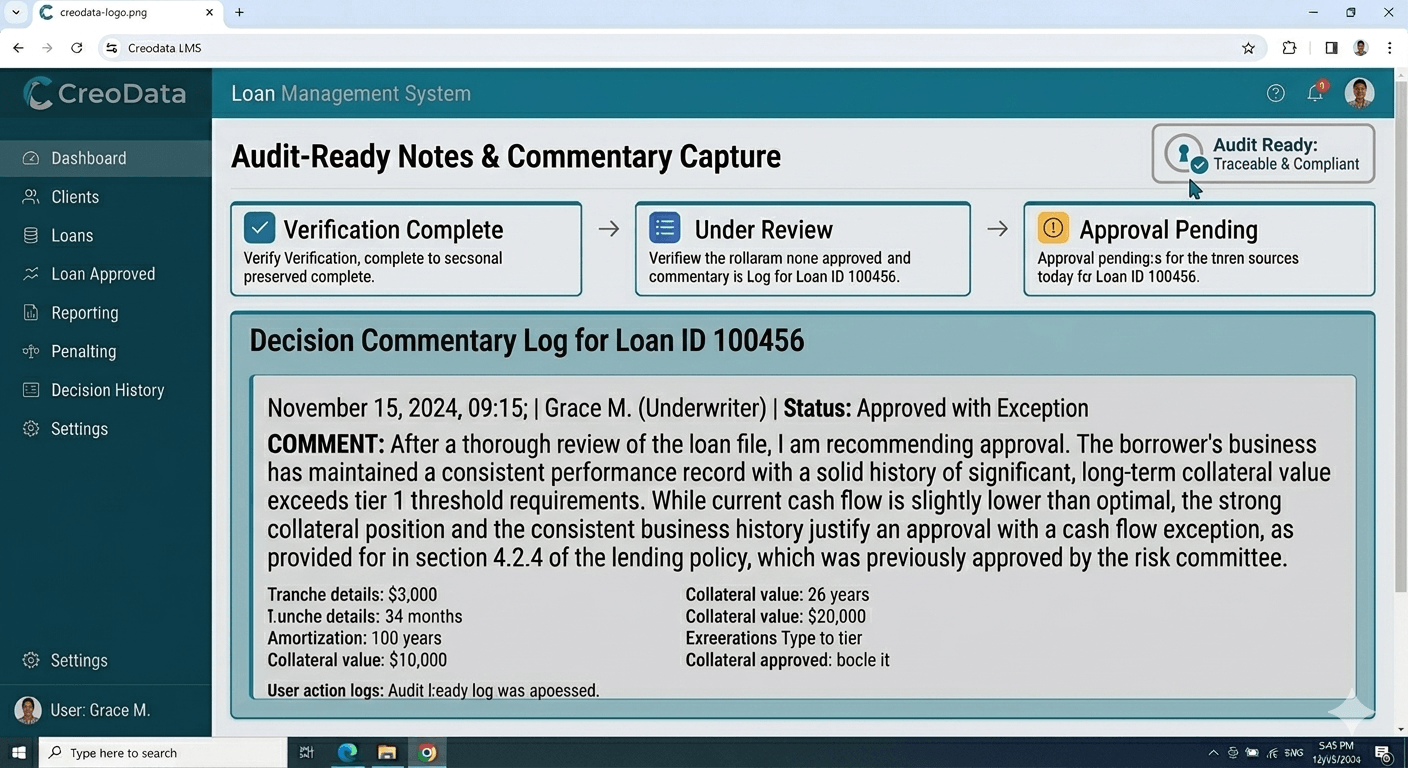
Creodata is a Nairobi software company, and our loan origination system is a workflow-first LOS for banks, microfinance banks, SACCOs and MFIs whose loans pass through credit committees and multi-level approvals. It runs a 13-stage, role-gated workflow from application intake to final disbursement, routes each application by amount through the business credit committee, Head of Corporate or Retail, management credit committee, Committee or Board, and risk gates (re-checking the amount at every decision, with configurable limits), puts an SLA timer on every stage, and records every decision, assignment and document action in an audit trail. Products, fees, collateral, requirements and routing rules are configured without code, and approval limits are scoped per office. It runs on Microsoft Azure or on-premises on Kubernetes with the same features; if borrower data must stay in Kenya, the on-premises edition keeps it in your own data centre.
For check-off lending, our Workplace Banking Application adds IPRS, CRB, KRA and sanctions/PEP checks, IPPD data and Finacle integration.
What we are not: a loan servicing platform (schedules, collections and the ledger stay in your core banking or SACCO system), a mobile-money lending platform or an instant-decision scoring engine. If you need those, a digital-lending platform fits better. Pricing is quoted per institution. If you are shortlisting, book a demo and bring your own products and approval matrix.
Frequently asked questions
What is the best loan origination software in Kenya?
There is no single best system, only the best fit for your products, approval structure and core system. A bank, a SACCO and a digital lender need different things. Shortlist two or three vendors that meet your Must-have requirements, run the same scripted demo on your own products, and score them with a weighted checklist such as our LOS RFP checklist.
What is the difference between a loan origination system and a loan management system?
A loan origination system handles everything up to disbursement. A loan management system usually means servicing afterwards: schedules, repayments, accrual and collections. In Kenya the terms are often used interchangeably, so ask each vendor which stages it covers and where the hand-off to core happens.
Do SACCOs in Kenya need loan origination software?
No law requires it, but many benefit. SACCO loans involve guarantors, deposit multiples and committee approvals, and SASRA-regulated SACCOs need evidence of how each loan was approved. A small SACCO may manage with its core system's loan module; one with several branches and multi-level approvals usually needs a proper workflow.
How much does loan origination software cost in Kenya?
It depends on the licence model, integrations, hosting and implementation scope, so published prices rarely compare. Ask each shortlisted vendor to itemise costs over three years on your volumes, and compare totals.
Should an LOS be hosted in the cloud or on-premises in Kenya?
Either can work. Cloud is faster to start; on-premises keeps borrower data in your own data centre. Weigh the Data Protection Act, 2019, your regulator's outsourcing rules and your risk appetite, and ask where production data, backups and support access sit.
Which Kenyan integrations should a loan origination system have?
Most lenders need IPRS, licensed CRBs, KRA PIN validation, sanctions and PEP screening, and core banking or SACCO system integration. Payroll lenders also need check-off and, for government employees, IPPD. Ask which are live in production in Kenya, which are planned and which would be built for you.
See how Creodata's loan origination software meets these criteria in a demo, or score every shortlisted vendor with the free LOS RFP checklist.