
Loan Origination Software for SACCOs in Kenya: Guarantors, Appraisal and SASRA Expectations
How SACCO loan processing works in Kenya, who regulates which SACCO, and what loan origination software should do alongside your BOSA/FOSA core system.

Short answer: SACCO loan origination software runs the journey from a member's application to an approved, documented loan: eligibility against deposits, guarantor capture and consent, appraisal, credit committee and board decisions, and hand-off to the core system for disbursement. It sits alongside your SACCO core system, which keeps member deposits, share capital, dividends and the loan ledger, and its main job is to make every decision traceable for your supervisory committee, auditors and regulator.
This guide is for SACCO CEOs, credit managers, operations heads and ICT managers at Kenyan SACCOs who are looking at a SACCO loan management system or loan processing software. Most of what you will find under "SACCO software" is a full core system: member accounts, BOSA and FOSA, and the ledger. This guide covers the origination layer that sits in front of it, and it is clear about where one ends and the other begins.
It is not legal advice. Your by-laws and credit policy set most of the rules a SACCO applies to loans, so confirm anything regulatory against current law and SASRA's guidance.
Who regulates which SACCO
Which rules apply depends on what business your SACCO does and how big it is.
- Deposit-taking SACCOs. SASRA (the Sacco Societies Regulatory Authority) was established under the Sacco Societies Act, 2008 to license SACCOs for deposit-taking business and to supervise them. Their prudential rules are in the Sacco Societies (Deposit-taking Sacco Business) Regulations, 2010 (Legal Notice 95 of 2010).
- Larger or digital non-deposit-taking SACCOs. The Sacco Societies (Non-Deposit-Taking Business) Regulations, 2020 (Legal Notice 82 of 2020) took effect on 1 January 2021. SASRA regulates non-deposit-taking business where total non-withdrawable deposits are at least KES 100 million, or where membership or share capital is mobilised through digital platforms or from people ordinarily resident outside Kenya. Existing SACCOs in scope had to apply to SASRA by 30 June 2021, and SASRA publishes a list of authorised non-withdrawable-deposit-taking SACCOs.
- Other SACCOs. SACCOs below those thresholds are not SASRA-regulated for that business and are overseen under the general co-operative framework by the cooperative registrar. Confirm your own SACCO's position with SASRA or the registrar.
Reform is under way. A Sacco Societies (Amendment) Bill 2025, which would add a central liquidity facility and a deposit guarantee fund, is before Parliament; we found no enactment as of 23 September 2026.
| SACCO type | Supervisor | Instrument | Status (23 Sep 2026) |
|---|---|---|---|
| Deposit-taking (FOSA) | SASRA | Sacco Societies Act 2008; Deposit-taking Regulations 2010 | In force |
| Non-deposit-taking, non-withdrawable deposits of KES 100m or more, or digital/diaspora mobilisation | SASRA | Non-Deposit-Taking Business Regulations 2020 | In force since 1 Jan 2021 |
| Other SACCOs | Cooperative registrar | Co-operative framework (confirm with the registrar) | Confirm |
| All SACCOs | Parliament | Sacco Societies (Amendment) Bill 2025 | Bill; not enacted as far as found |
Whatever the category, supervisors and auditors ask the same questions about loans: was the member eligible, were the guarantors valid and consenting, did the right committee approve it, and does the file show it? Those are origination questions.
The SACCO loan journey
SACCO lending differs from bank lending in ways the software has to respect. The member is also an owner, the security is often other members' deposits, and approval is by elected committees rather than only staff.
- Application. The member applies at a branch, through a field officer or online, choosing a loan product (development, school fees, emergency, asset and so on).
- Eligibility against deposits. Most SACCOs cap a member's borrowing at a multiple of their deposits and set a minimum membership period. These rules come from your by-laws and credit policy, and they differ by product.
- Guarantors. Members guarantee each other's loans with their deposits. Each guarantor's identity, consent and available guarantee capacity need to be confirmed. We are not aware of a statutory guarantor formula; your by-laws and credit policy set the rules.
- Appraisal. A credit officer assesses ability to repay, from payslip or business income, existing obligations and repayment history, and prepares a recommendation.
- Credit committee. The elected credit committee (or a delegated officer for small loans, where your by-laws allow) approves, defers or declines, and minutes record the decision.
- Board decisions. Loans above set limits, and loans to board members, committee members and staff, often need board approval or extra scrutiny under your by-laws and policy.
- Disbursement. The core system books the loan and disburses it, usually to the member's FOSA account or by bank transfer.
- Check-off. For employed members, the employer deducts repayments from payroll and remits them to the SACCO.
For check-off, the affordability test is partly set by law. Under section 19(3) of the Employment Act, 2007, total deductions from an employee's wages may not exceed two-thirds of wages, so the employee keeps at least one-third. For public servants, the Public Service HR Policies and Procedures Manual (2016) says officers may not commit more than two-thirds of their basic salary, so take-home must be at least one-third of basic pay. Government payroll deductions run through IPPD, the Integrated Personnel and Payroll Database. Our guide to check-off loans in Kenya covers the mechanics.
What SACCO loan origination software should do
| Stage | What the software should do | The evidence it leaves |
|---|---|---|
| Application | Structured intake per product, with required fields and documents set per product | Complete application with timestamp and the officer who captured it |
| Eligibility | Show deposits and existing loans pulled from the core system, and apply your eligibility rules | The figures the decision relied on, as at the decision date |
| Guarantors | Capture each guarantor, their consent and the guaranteed amount; attach signed forms | A guarantor record per loan that is hard to dispute later |
| Appraisal | Structured appraisal form and recommendation, with the officer's name | Who recommended what, on what basis |
| Committee | A committee queue, with the decision, the members present and the minutes attached | Approval evidence tied to the loan, not a separate minute book |
| Board and insider loans | Route by amount and by borrower type to the board stage | Proof that insider loans received the required approval |
| Branch queues | Applications and approval limits scoped per branch | Which branch handled each loan, and at what limit |
| SLA | A timer per stage, with overdue applications escalated | Where time was spent on every loan |
| Hand-off | Pass the approved loan to the core system for booking and disbursement | A single reference linking origination and core records |
| Audit | Log every action, decision and document change | A complete, time-stamped history |
Three of these deserve more detail.
Guarantor capture and consent. Guarantor disputes are a familiar problem in SACCO lending, and they are hardest to resolve when a guarantor says they never agreed and the file cannot show otherwise. The origination system should record each guarantor's identity, the amount guaranteed, their signed consent, and when and how it was given. Our post on digital co-applicant and guarantor flows walks through how that works. Guarantee capacity, meaning how much of a member's deposits are already committed, is usually calculated in the core system, so the two systems need to share it.
Committee workflow with evidence. A committee decision is only as good as its record. The system should present the appraisal and documents to the committee, record the decision and those present, attach the minutes, and route loans above a limit onwards to the board. Amount-based routing means small loans skip higher levels while large ones cannot. For group lending, bulk uploads for group loan schemes shows how documents for many applicants can be handled at once.
Insider lending. Loans to directors, committee members and staff attract the closest scrutiny from supervisors and auditors. Keep the software's role general: flag insider applicants, route them to the approval level your policy sets, and keep the evidence. The limits themselves belong in your policy; confirm them against current law and SASRA's guidance.
Where origination ends and the SACCO core begins
Be clear about this boundary before you buy, because much SACCO software is sold as one system that does everything.
Stays in the SACCO core system: member registration and share capital; BOSA deposits (non-withdrawable, the basis for borrowing and guarantees); FOSA savings and transaction accounts; dividends and interest on deposits; the loan ledger, repayment schedules, interest and arrears; check-off remittance reconciliation; and collections.
Sits in the loan origination system: application intake, eligibility and guarantor checks (using figures read from the core), appraisal, committee and board workflow, document requirements, SLA tracking, approval evidence and the audit trail, then a hand-off to the core for booking.
The integration question is therefore the most important one in any demo. How does the origination system read deposits, guarantee commitments and existing loans, and how does it pass an approved loan to the core? See loan origination system integration with core banking and LOS vs loan management system vs core banking.
Credit bureaus and data protection
Credit bureaus. A Court of Appeal ruling allows SACCOs to share members' details with credit reference bureaus. The Banking (Credit Reference Bureau) Regulations, 2020 require 30 days' written notice to a customer before negative information is submitted, and forbid negative listing for amounts below KES 1,000. Their status is contested: the High Court declared them void in August 2023, and the Court of Appeal suspended that judgment pending CBK's appeal, so they are operative under that stay with the appeal pending as far as we could find. Check how they apply to your SACCO.
Data protection. The Data Protection Act, 2019 is in force and the Office of the Data Protection Commissioner (ODPC) regulates it. The registration regulations (Legal Notice 265 of 2021) exempt small organisations below KES 5 million turnover, but not those processing for purposes in the Third Schedule, which includes financial services, so SACCOs register whatever their size. Guarantor records are personal data too: the guarantor's details and consent should be protected by the same role-based access and logging as the borrower's.
Anti-money-laundering obligations for SACCOs are a separate subject; see AML software for SACCOs in Kenya.
Questions to ask a vendor
- Which records are stored in your system, and which are read from our core? Show it live.
- How are guarantor consents captured and evidenced, and can a guarantor's history be pulled for a dispute?
- Can our by-law eligibility rules and approval limits be configured without code changes?
- How are committee decisions and minutes attached to each loan?
- How are insider loans flagged and routed?
- Can queues and limits be set per branch?
- Is the audit trail append-only, and who can see it?
- Where is data stored, and is there an on-premises option with the same features?
The loan origination RFP checklist for Kenya turns these into a scored template; download the loan origination RFP checklist (Excel). The buyer's guide to loan origination software in Kenya compares the types of provider.
Where Creodata fits
Creodata's loan origination system is a workflow-first LOS that runs alongside your SACCO core system. It is not a SACCO core or BOSA/FOSA system: deposits, share capital, dividends, the loan ledger, repayments and collections stay in your core.
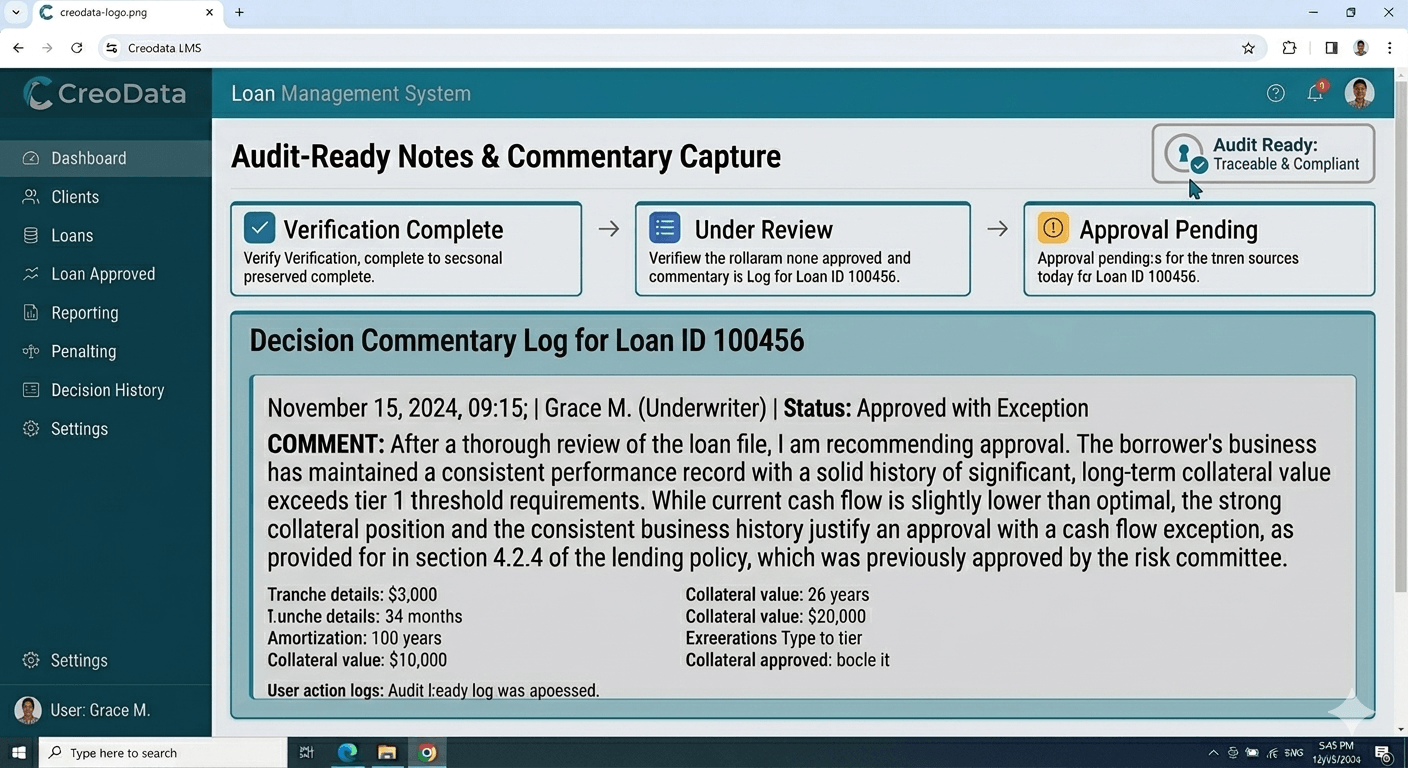
What it adds is the credit workflow. It uses role-gated stages from intake through committee review to disbursement, with amount-based routing through committee and board levels on configurable limits, re-checked at every decision point. Applications, queues and approval limits are scoped per branch, with an SLA timer on every stage and a full audit trail of every decision, assignment and document action. Required documents, including guarantor forms, are configured per product without code changes. It runs on Azure or on-premises with the same features. Our Workplace Banking Application is a separate product built for banks' check-off lending, with IPPD deduction data for government payrolls and IPRS, CRB and KRA checks; it is not a SACCO system. Pricing is quoted per institution.
If your SACCO wants committee evidence and guarantor records it can show an examiner without searching a minute book, book a demo and bring one of your own loan products. For approval design in more depth, read credit approval workflows for Kenyan lenders; for the regulatory side of digital lending, see CBK-compliant digital lending.
Frequently asked questions
What is the difference between a SACCO loan management system and loan origination software?
"SACCO loan management system" usually means the full core: member accounts, deposits, the loan ledger, repayments and collections. Loan origination software covers the part before booking: application, eligibility, guarantors, appraisal and committee approval, with the evidence of each step. Many SACCOs run both, connected by an integration.
Does SASRA approve SACCO loan software?
No. SASRA licenses and supervises SACCOs; it does not certify software vendors. The software helps a SACCO show that its own loan policy was followed.
Which SACCOs does SASRA regulate?
Deposit-taking SACCOs under the Sacco Societies Act, 2008, and non-deposit-taking SACCOs with non-withdrawable deposits of at least KES 100 million or that mobilise members or share capital digitally or from people living outside Kenya, under the 2020 Non-Deposit-Taking Business Regulations. Other SACCOs are overseen by the cooperative registrar; confirm your own position.
Is there a legal rule on how many guarantors a SACCO loan needs?
We are not aware of a statutory guarantor formula. Guarantor numbers, eligibility and exposure limits are set by each SACCO's by-laws and credit policy, so your software should let you configure them rather than hard-code them.
Can SACCOs share member loan data with credit reference bureaus?
A Court of Appeal ruling allows SACCOs to share members' details with CRBs. The CRB Regulations 2020, which set a 30-day notice before negative listing, are operative under a Court of Appeal stay while an appeal is pending, so confirm current practice with your advocate.
Should SACCO loan software run in the cloud or on-premises?
Either can work. Ask where member data would be stored and processed, whether an on-premises option has the same features, and how the choice fits your data protection obligations and your board's risk appetite.
This guide summarises public sources as of 23 September 2026 and is not legal advice; confirm against current law and SASRA's guidance. See Creodata's loan origination software working alongside a SACCO core in a demo.