
21 Days to Decision: Where a Corporate Lender's Loan Turnaround Was Actually Going
Everyone blamed credit committee for a 21-day loan turnaround. Stage-level data showed the delay was in the handoffs — and three configuration changes fixed it.
Composite scenario drawn from typical East African deployments. Institution details are anonymised and figures are representative rather than attributable to a single client.
Everyone had a different explanation
A commercial bank's corporate lending book was growing, and its service reputation was not. Average turnaround from application to disbursement sat at 21 working days. Relationship managers were losing deals to a competitor quoting eight.
Ask five people where the time went and you got five answers. Relationship managers blamed credit committee scheduling. Credit blamed incomplete files arriving from the branches. Legal blamed the document management system. Finance blamed everyone. The head of credit had commissioned two internal reviews; both concluded that the process was "broadly sound but would benefit from better communication".
Nobody could produce a number for how long a file spent at each stage, because the file did not exist in one place. It moved through email, a shared drive, a spreadsheet tracker maintained by a credit administrator, and — for the committee stages — a printed pack.
What the data showed once there was data
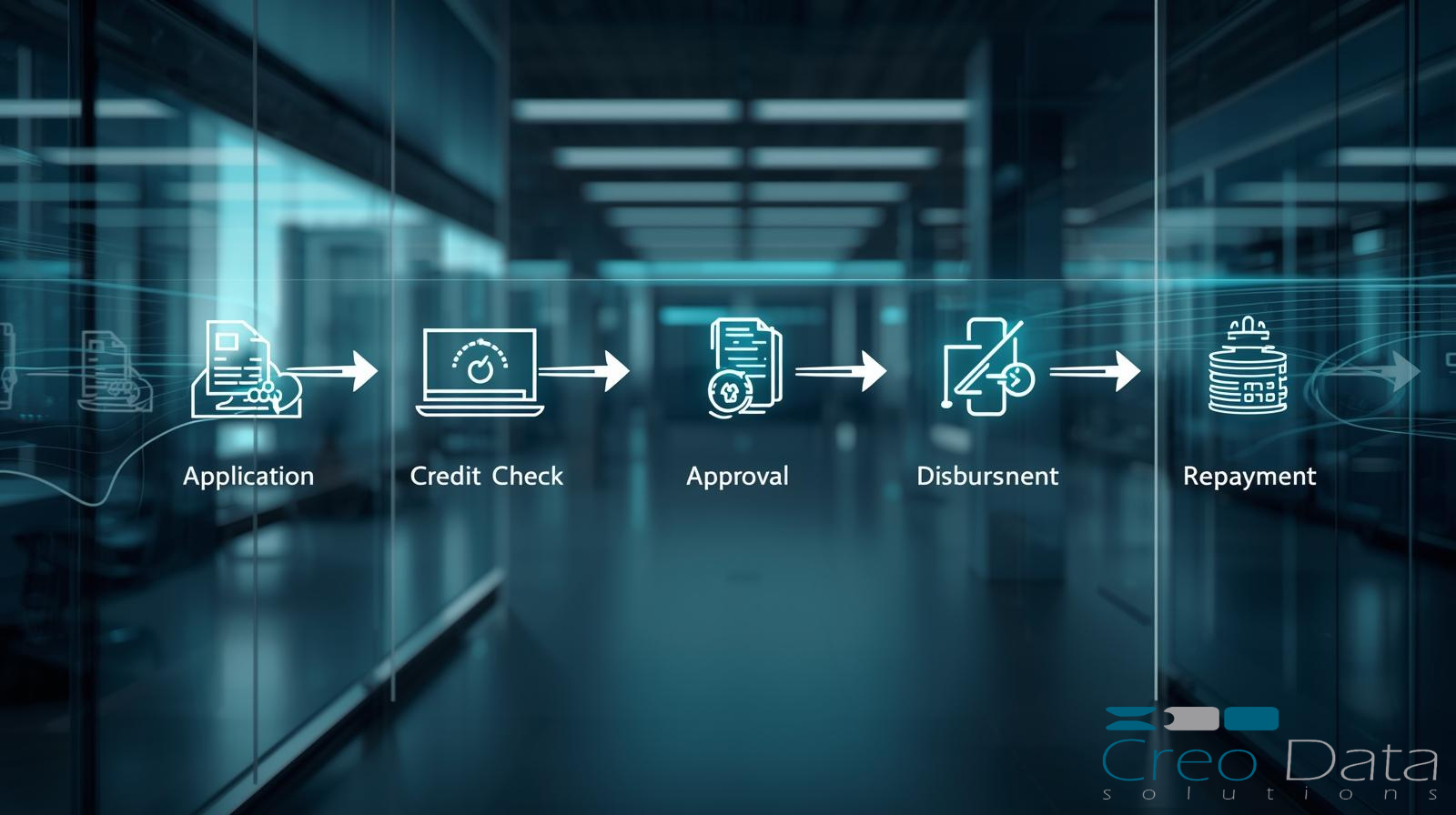
The bank deployed the Creodata loan origination platform, mapping its existing process onto the system's 13-stage, role-gated pipeline: intake by the customer service officer, assignment by the branch manager, assessment by the relationship manager and credit administration, the credit decision tiers, then legal, finance, risk and disbursement.
The first eight weeks were, deliberately, just instrumentation. Every stage transition carried a correlation ID and a timestamp. At the end of it, the picture was unambiguous and not what anyone had argued for.
Actual decision time was short. Once a file was in front of a credit officer or a committee, it moved. Median time inside the assessment and decision stages was well under two days each.
The time was in the gaps. Files sat unassigned after intake for a median of 3.5 days, because assignment depended on a branch manager noticing an email. Files waited an average of 4 days between credit approval and legal review, because nothing told legal a file was ready. The single worst queue was between legal completion and finance — 5 days, caused entirely by a manual notification that was often not sent.
Small loans queued behind large ones. Every application followed the same path regardless of size, so a KES 2 million facility waited behind a KES 400 million one for the same committee slot.
Roughly 14 of the 21 days were dead time between stages. The credit committee, which had absorbed most of the blame for two years, accounted for about one and a half.
What changed
Three configuration decisions, not a process redesign.
Amount-based routing. The platform's five approval tiers were configured against the bank's delegated authority matrix. Facilities below the branch credit committee threshold now route directly to the officers who hold that authority and never reach the main committee agenda. Server-side enforcement means the routing cannot be bypassed by an optimistic relationship manager — the approval simply is not available to the wrong role.
SLA monitoring per stage. Each stage carries a target. Breaches surface on the dashboard of the role that owns the stage and escalate to their line manager. The 3.5-day unassigned queue disappeared within a fortnight, not because anyone was disciplined but because it became visible.
Explicit handoffs. Stage transitions notify the receiving role automatically. The manual email that legal sometimes forgot to send no longer exists as a dependency.
Multi-office scoping was configured so that branch users see their own pipeline while regional and head-office roles see the aggregate — which removed a long-standing complaint that the old spreadsheet tracker exposed every branch's numbers to every branch.
Where it settled
Median turnaround for facilities under the committee threshold fell to 4 working days. Larger facilities settled around 9, constrained now by genuine committee scheduling rather than by queueing.
Two things surprised the bank.
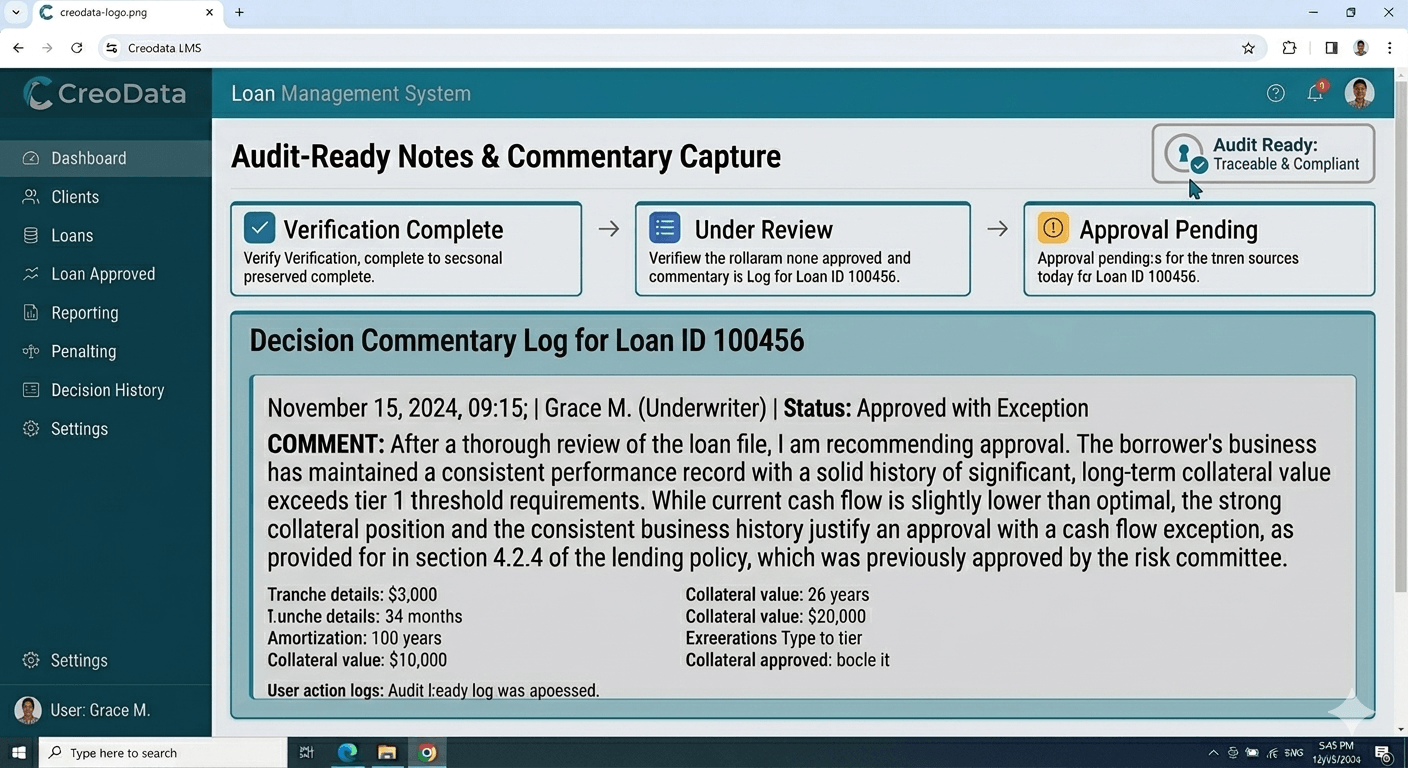
Audit preparation became trivial. Internal audit had previously reconstructed loan histories from email threads. With correlation IDs linking every action across every stage, a complete file history is a single query — including who approved what, under which authority, at what time.
Accountability conversations got easier. Because the audit trail is immutable and per-stage SLA data is visible to everyone, disputes about "who held this up" ended. The data was not used punitively; it was mostly used to reallocate two credit administration staff to the stages that were genuinely under-resourced.
What generalises
If your turnaround time is bad and your explanations are contested, you almost certainly have an instrumentation problem before you have a process problem. Three questions are worth asking before redesigning anything:
Can you state, with data, how long a file spends at each stage? If the answer comes from a spreadsheet somebody maintains, it is an estimate.
Does every application follow the same path regardless of size? Uniform routing is the most common and most easily fixed cause of slow small-ticket lending.
Are handoffs events or courtesies? If moving work to the next role depends on someone remembering to send an email, that dependency is where your days are going.
The bank in this story did not change its credit policy, its risk appetite or its committee structure. It made the process observable, routed by authority, and explicit about handoffs — and the deals stopped going to the competitor.
Further reading: The Complete Loan Management Guide · Custom Approval Workflows for Lending: From Intake to Disbursement · Loan Processing SLAs and Turnaround Time
Measuring loan turnaround and not liking the answer? Book a consultation or explore Creodata's loan origination system to see how stage-level SLA monitoring changes the conversation.