

Expense Management Software in West Africa: A Buyer's Guide (2026)
How to choose expense management software in West Africa: what the system does, who needs one, e-invoicing and payment rails in Nigeria, Ghana, Côte d'Ivoire, Senegal and the UEMOA, demo questions, cost drivers and red flags.
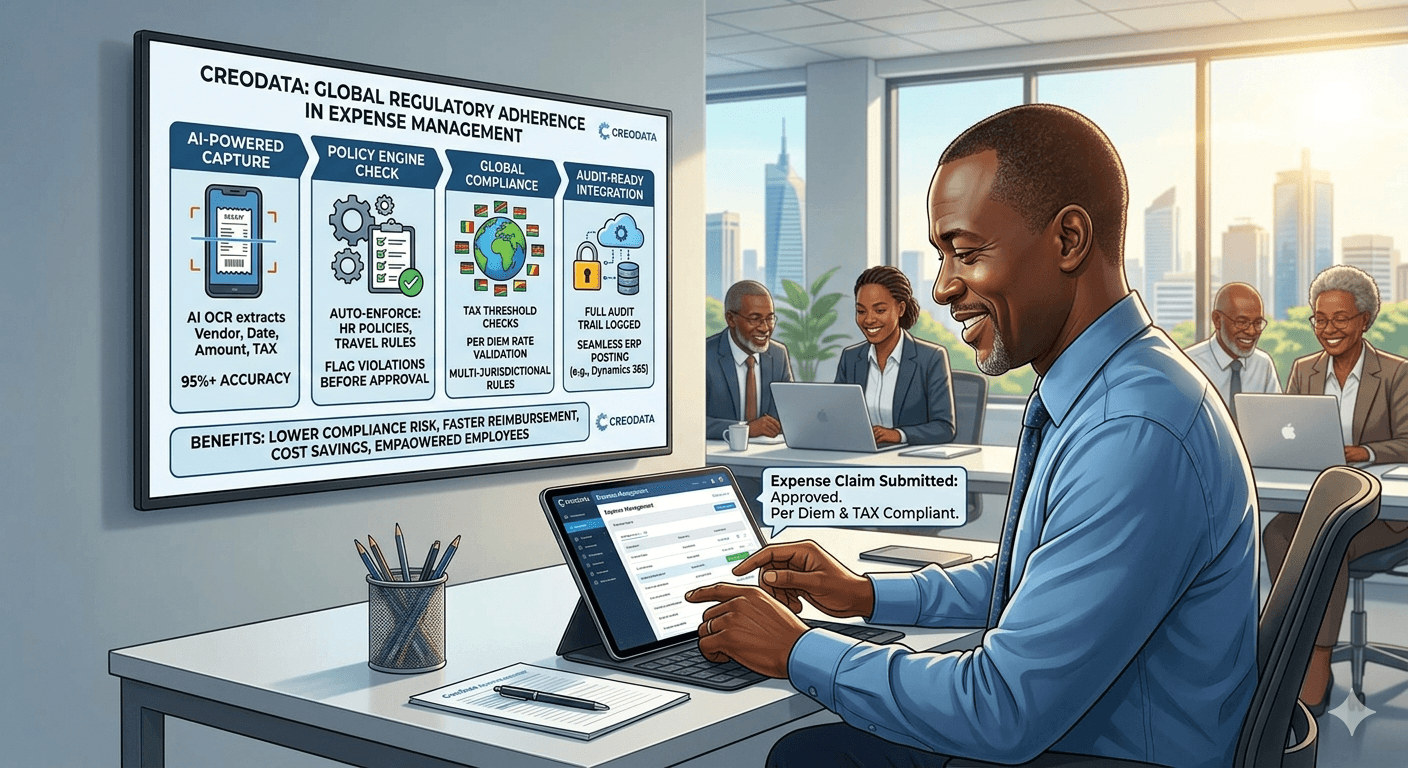
Short answer: Expense management software runs a payment request from the moment it is raised to the moment it is paid and posted. In West Africa the choice is shaped by e-invoicing reforms (the NRS Merchant-Buyer Solution in Nigeria, E-VAT in Ghana, the FNE in Côte d'Ivoire, certified invoices across the UEMOA) and by payment rails that differ by country. Script demos on your own approval chains, check how each system keeps the tax invoice behind every expense, test the payment and ERP integration you need, and compare three-year costs.
This guide is for finance, IT and procurement teams at banks, NGOs, legal firms and multi-entity enterprises in Nigeria, Ghana and francophone West Africa. It covers four markets in detail, the rest of the UEMOA more briefly, and three smaller anglophone markets in outline.
Creodata sells expense management software for West African organisations, so we say plainly where we fit near the end; the criteria before that apply to any vendor. This is a practical guide, not tax or legal advice: confirm every requirement with your tax adviser and auditors.
What does an expense management system do?
An expense management system replaces vouchers, spreadsheets and email approvals with one governed workflow:
- Capture. A request (petty cash, a reimbursement, a supplier invoice, a cashbook payment, an imprest or per diem) is raised with its receipts and tax invoices attached.
- Approve. It is routed by department, request type and amount, for example Head of Department, then Finance, then CFO.
- Escalate. An approval that passes its deadline moves on automatically.
- Pay. On final approval the payment goes out over bank transfer or mobile money, and its status is written back.
- Post. The paid item is posted to the ledger with its documents, so nobody re-keys it.
- Audit. Every step is recorded against one request, so auditors, tax inspectors and donors can see who approved what, when, and on what evidence.
Consumer-style expense apps usually cover capture and reporting. Enterprise systems are judged on steps 2 to 6.
Who needs expense management software in West Africa?
- Banks and financial institutions, where every internal payment needs maker-checker approval and evidence an examiner will accept.
- NGOs and donor-funded programmes, which must show donors a clean trail from request to ledger in each country office.
- Legal and professional-services firms, which need disbursements approved and documented.
- Multi-entity enterprises, with subsidiaries across anglophone and francophone markets but one CFO who wants one view.
The country requirements that shape the choice
The common thread: tax authorities are moving invoices online, and in some countries only the electronic invoice supports an expense or an input VAT claim. An expense management system does not replace those platforms, but it can make sure the right document is on file before money leaves.
Nigeria
The 2025 tax reform acts, largely effective from 1 January 2026, renamed FIRS the Nigeria Revenue Service (NRS). The Nigeria Tax Act widens recoverable input VAT to services and fixed assets, to the extent they relate to taxable supplies, so keeping valid supplier VAT invoices matters more than before. The tax administration act requires taxable persons to adopt e-invoicing once the tax authority introduces it, and the NRS Merchant-Buyer Solution (MBS) started with large taxpayers (annual turnover of NGN 5 billion and above), with a compliance deadline of 31 July 2026. Dates for smaller taxpayers are not settled.
Instant bank transfers run over NIBSS Instant Payment (NIP), and fintech wallets such as OPay, PalmPay and Moniepoint received national licences from the CBN in January 2026. The Nigeria Data Protection Act 2023 applies, with the NDPC as regulator; its GAID 2025 directive, issued in March 2025, repealed the NDPR 2019. See our Nigeria page.
Ghana
The VAT Act 2025 (Act 1151) replaced the 2013 VAT Act from 1 January 2026. Among its changes, the NHIL and GETFund levy became creditable as input tax and the flat-rate scheme was abolished. Input VAT claims need a valid VAT invoice. GRA's E-VAT electronic invoicing is being rolled out in phases, and obligations start when GRA onboards a taxpayer; it is not yet automatic for every VAT-registered business.
GhIPSS, owned by the Bank of Ghana, runs GhIPSS Instant Pay and mobile money interoperability between wallets and bank accounts. MTN MoMo is the dominant wallet, followed by Telecel Cash and AT Money. The 1% E-Levy on electronic transfers was repealed in 2025. The Data Protection Act 2012 (Act 843) remains the law, with registration at the Data Protection Commission; a replacement bill is being prepared. See our Ghana page.
Côte d'Ivoire
The DGI launched the facture normalisée électronique (FNE) in July 2025, and it became mandatory for all companies, whatever their tax regime, from 1 December 2025. As the DGI's announcement was reported, only FNEs are accepted to justify expenses and to deduct VAT. Mobile money is led by Orange Money, MTN MoMo, Moov Money and Wave. Personal data falls under Loi n° 2013-450 of 19 June 2013, supervised by ARTCI. See our Côte d'Ivoire page.
Senegal
The 2025 Finance Law (Loi n° 2025-02) provides for mandatory electronic invoicing for VAT-registered taxpayers, run by the DGID, with a penalty of 25% of the VAT concerned, capped at 5 million FCFA, for failing to issue, send or receive an e-invoice. The roll-out is in progress and no go-live dates have been confirmed; watch DGID announcements. Wave, Orange Money and Free Money are the main wallets. Loi n° 2008-12 governs personal data, with the CDP as authority. See our Senegal page.
The UEMOA countries
The eight UEMOA states (Benin, Burkina Faso, Côte d'Ivoire, Guinea-Bissau, Mali, Niger, Senegal and Togo) share the BCEAO and the CFA franc (XOF). The BCEAO launched PI-SPI, its instant payment platform, on 30 September 2025; it runs 24/7 across all eight countries, with 80 participating institutions by April 2026.
Invoicing rules are national, not regional:
- Benin requires a facture normalisée through a MECeF machine or the online e-MECeF, for all taxpayers since 1 July 2021.
- Niger requires certified invoices through SECeF for VAT-registered companies since 1 September 2021.
- Burkina Faso has used the facture normalisée since 2017 and launched the certified e-invoice (FEC) on 6 January 2026, starting with large and medium companies.
- Mali has a secured facture normalisée system, and Togo is moving from paper normalised invoices to certified e-invoicing under its 2026 Finance Law.
We have not verified the deductibility consequences in these countries; ask your tax adviser.
Smaller anglophone markets
Sierra Leone requires GST-registered businesses to use NRA electronic cash registers. Liberia uses both the Liberian dollar and the US dollar as legal tender, launched an instant payment system in December 2025 and enacted its first data protection law in 2026. The Gambia has approved an e-invoicing regulation, with no mandatory dates yet.
West Africa at a glance
| Country | Currency | Tax invoice behind an expense | Payments | Data protection |
|---|---|---|---|---|
| Nigeria | NGN | NRS MBS e-invoicing, large taxpayers first; input VAT widened to services and fixed assets | NIP; OPay, PalmPay, Moniepoint | NDPA 2023; NDPC |
| Ghana | GHS | VAT Act 2025 (Act 1151); GRA E-VAT, phased | GhIPSS; MTN MoMo, Telecel Cash, AT Money | Act 843; DPC |
| Côte d'Ivoire | XOF | FNE mandatory since 1 Dec 2025; only FNEs support expenses and VAT deduction | Orange Money, MTN MoMo, Moov Money, Wave; PI-SPI | Loi n° 2013-450; ARTCI |
| Senegal | XOF | E-invoicing in the 2025 Finance Law; roll-out in progress | Wave, Orange Money, Free Money; PI-SPI | Loi n° 2008-12; CDP |
| Benin | XOF | e-MECeF normalised invoice, all taxpayers | PI-SPI; mobile money | Code du numérique; APDP |
| Niger | XOF | SECeF certified invoice, VAT payers | PI-SPI; mobile money | Loi n° 2017-28; HAPDP |
| Burkina Faso | XOF | FEC from 6 Jan 2026, large and medium first | PI-SPI; mobile money | Loi n° 001-2021/AN; CIL |
| Sierra Leone | SLE | NRA electronic cash registers | National switch; mobile money | No law in force found |
| Liberia | LRD / USD | None found | Instant payment system (2025) | Law enacted 2026 |
| The Gambia | GMD | Regulation approved; no dates | BANTABA 2.0; mobile money | Act passed 2025 |
Checked against published sources on 29 September 2026. Rules change: confirm with your tax adviser before relying on any row.
The francophone angle
Buyers in francophone West Africa usually run the RFP, the demo, training and the contract in French, and search for a logiciel de gestion des dépenses or a circuit de validation des paiements. Ask each vendor whether the application, notifications and support work in French. Our product pages are available in French, including West Africa and Côte d'Ivoire.
Evaluation criteria
| Area | What good looks like |
|---|---|
| Request types | Petty cash, reimbursements, supplier invoices, cashbook payments, imprest and per diem in one system |
| Approval routing | Chains by department, request type and amount; delegation; no self-approval |
| Tax evidence | The MBS invoice, E-VAT invoice, FNE or certified invoice stored with each request, and finance able to make it a condition of approval |
| Multi-country set-up | Separate entities, currencies and thresholds per country, with one consolidated view |
| Payments | The rails you use in each country, with payment status written back |
| ERP integration | Automatic posting with documents attached; failed postings visible and retryable |
| Security and data | Single sign-on, role-based access, an audit trail no administrator can edit, and a clear answer on where data is held |
| Language | French and English for users, approvers and support where you need them |
Questions to ask in demos
- Raise a supplier invoice in Côte d'Ivoire with its FNE attached, and show what happens when the document is missing.
- Raise a Nigerian supplier invoice and show where the VAT invoice sits for an input VAT claim.
- Route requests of rising amounts in two country entities and show each reach a different chain.
- Block a self-approval and let an approval breach its deadline: show who is alerted and what is recorded.
- Pay a request over the rail you use in each country, in a test environment, including a failed payment.
- Post to your ERP and show a failed posting being retried.
- Produce the evidence for last month's largest payment: request, tax invoice, approvals, payment reference and ledger entry.
Our expense management RFP checklist turns these into scored requirements.
What drives the cost
Ask each vendor to itemise, over three years: the licence model (per user, per transaction or enterprise fee, and per country entity); payment and ERP integration per country; implementation, including French-language training; hosting; and whether a new approval chain is configuration or a paid change request. Compare three-year totals.
Red flags
- The vendor claims to connect to or validate against the MBS, E-VAT or FNE platforms but cannot show it working.
- Tax invoices live in email or on phones, not with the request.
- Only the vendor can change approval limits or chains.
- An administrator can edit or delete audit entries.
- The vendor cannot say where your data is hosted, or how you get it back when you leave.
Where Creodata fits
Creodata is a Nairobi software company, and our expense management system is a workflow-first finance EDMS. It handles supplier invoices, petty cash and cashbook payments, routes each through a configurable chain such as Head of Department, Finance Reviewer and CFO by department and amount, and escalates approvals that pass their SLA. Approved items post to Microsoft Dynamics 365 Business Central over OData with their SharePoint documents linked, sign-in is through Microsoft Entra ID, each role has its own dashboard, and the system runs on Microsoft Azure.
Three limits to know before you shortlist us:
- Payments. M-Pesa B2C and B2B payment is built in for Kenya only. In West Africa, payment over NIP, GhIPSS, PI-SPI, mobile money or your bank is an integration we scope with each client; approvals, documents and posting work the same.
- Tax systems. The system stores the MBS invoice, E-VAT invoice, FNE or certified invoice with each request, and finance can make it a condition of approval. It does not connect to or validate against any tax authority's system.
- ERP. Business Central is the ERP we post to today. For any other ledger, we confirm the integration path during scoping.
We are not a corporate-card or travel-booking platform. Pricing is quoted per organisation. If you are shortlisting, book a demo and bring your approval matrix and one real request from each country.
Frequently asked questions
What is the best expense management software in West Africa?
There is no single best system, only the best fit for your countries, approval structure, payment rails, language and ERP. Run the same scripted demo with two or three vendors and score them against the criteria above.
Do expenses in Côte d'Ivoire need an FNE?
As the DGI's December 2025 announcement was reported, only FNEs are accepted to justify expenses and deduct VAT. Keep the FNE with every supplier payment, and confirm the current rules with your tax adviser.
Must every Nigerian business use the NRS e-invoicing platform now?
No. The verified mandate covers large taxpayers, with turnover of NGN 5 billion and above, and a compliance deadline of 31 July 2026. Dates for medium and small taxpayers have been reported inconsistently; confirm your position with your tax adviser.
Is every Ghanaian VAT-registered business on E-VAT?
No. GRA is onboarding taxpayers in phases, and obligations start when GRA onboards you. Review your input VAT evidence under Act 1151 with your tax adviser.
Can one system handle approvals in Nigeria, Ghana and the UEMOA?
Yes, if it supports separate entities, currencies and chains per country with one consolidated view, and works in French where needed. Test it with two country entities.
Does PI-SPI mean one payment integration covers all UEMOA countries?
No. PI-SPI connects participating institutions across the eight UEMOA countries, but you still pay through your own bank or e-money provider. Ask each vendor which integrations are live and which would be a new project.