
AML Compliance Software in Zambia: A Buyer's Guide for Banks, Microfinance and Fintechs (2026)
How to choose AML compliance software in Zambia: FIC reporting through goAML, provider types, evaluation criteria, what drives cost, and red flags.
Short answer: Good AML compliance software for a Zambian institution screens customers against sanctions and PEP data, rates customer risk, monitors transactions across every channel, turns alerts into documented cases, and gets suspicious and currency transaction reports to the Financial Intelligence Centre (FIC) through goAML within three working days. Choose on evidence from scripted demos on your own data, and compare three-year costs.
This guide is for compliance officers, MLROs, risk heads and procurement teams at Zambian banks, non-bank financial institutions, microfinance institutions, mobile-money and payment firms, insurers, pension funds, securities firms and other reporting entities. Zambia was not on the FATF's increased-monitoring or call-for-action lists after the June 2026 plenary, and we found no FATF listing of Zambia since 2010. Still, as a member of the Eastern and Southern Africa Anti-Money Laundering Group (ESAAMLG), Zambia faces mutual evaluations and follow-up that test how well AML measures work in practice, so what counts is complete, well-reasoned, on-time reports and evidence a supervisor can see.
Creodata offers AML compliance software in Zambia, so we say where we fit at the end; the criteria before that apply to any vendor, us included. This is not legal advice: confirm requirements with current law, the FIC and your supervisory authority.
What AML compliance software does
AML (anti-money laundering) software turns customer and transaction data into the decisions an AML programme must make, and keeps the evidence.
| Function | What it does | What matters in Zambia |
|---|---|---|
| Risk rating | Scores each customer's money-laundering risk | A model your compliance team can change, with approved overrides |
| Sanctions and PEP screening | Checks names against sanctions, PEP and adverse-media data | Matching that copes with Zambian name variants, and proof of the list version used |
| Transaction monitoring | Raises alerts on suspicious patterns | Cash, mobile money, agents and transfers, in Kwacha and foreign currency |
| Case management | Turns alerts into owned cases | The three-working-day clock, MLRO approval and restricted access |
| Regulatory reporting | Prepares suspicious and currency transaction reports | goAML files that the FIC's portal accepts |
| Audit trail | Records every action and decision | An append-only log that survives inspection |
Who needs AML software in Zambia
Zambia's AML duties sit mainly in the Financial Intelligence Centre Act, 2010 (Act No. 46 of 2010), amended by Act No. 4 of 2016 and Act No. 16 of 2020, and in its 2022 regulations. Money laundering is criminalised by the Prohibition and Prevention of Money Laundering Act, 2001 (Act No. 14 of 2001, amended by Act No. 44 of 2010). The FIC Act covers two classes:
- Reporting entities, such as banks, insurers, securities firms, casinos, lawyers, accountants and estate agents, which report suspicious transactions and threshold currency transactions to the FIC.
- Accountable institutions, a narrower class added in 2020: co-operative societies, motor vehicle dealers, property developers, safe-custody providers and travel agents, with customer due diligence, cash-reporting and record-keeping duties.
The Act, as amended in 2020, names the supervisory authorities: the Bank of Zambia (banks and non-bank financial institutions), the Pensions and Insurance Authority (insurers and pension funds), the Securities and Exchange Commission (capital markets), the Tourism and Hospitality Act licensing committee (casinos), the Registrar of Estate Agents, the Law Association of Zambia, the Zambia Institute of Chartered Accountants, the Chief Registrar of Lands and the FIC itself. If unsure where your licence sits, ask your supervisor or the FIC.
Needs differ: a large bank needs real-time monitoring across many channels, a microfinance institution needs screening, risk rating and reporting first, and a mobile-money business needs monitoring that keeps pace with high-volume digital flows. Spreadsheets fail as volumes grow.
The Zambian requirements that shape the choice
These rules separate a Zambian deployment from a generic one:
- The FIC and goAML. The FIC is Zambia's financial intelligence unit, headed by a Director-General since the 2020 amendment, and runs a UNODC goAML production portal at goaml.fic.gov.zm. The FIC (General) Regulations, 2022 also allow channels such as courier, but the portal is the practical route, so the software must produce files it accepts. Our Zambia FIC goAML compliance guide covers filing.
- Suspicious transactions: three working days. Section 29 of the FIC Act requires a report not later than three working days after forming a suspicion that property is the proceeds of crime or linked to terrorism or proliferation, including attempted transactions, so the system should record when suspicion was formed and show the deadline.
- Currency transactions: the Kwacha equivalent of USD 10,000. Section 30 of the FIC Act and regulation 7 of the FIC (Prescribed Threshold) Regulations, 2022 (SI No. 53 of 2022) require currency transactions at or above that line, in Kwacha or foreign currency, single or several that appear to be linked, to be reported promptly and within three working days. This is not a same-business-day aggregation rule, so linking must work across days, branches and channels, and the line's Kwacha value moves with the exchange rate. Accountable institutions use the same line.
- Figures that are not the reporting threshold. Wire and virtual-asset transfers of USD 1,000 or more, or the equivalent, must carry full originator and beneficiary information (regulation 6); cross-border cash or bearer negotiable instruments above USD 5,000 must be declared (regulation 8).
- Records for at least ten years from the end of the relationship, the transaction or the report, including copies of suspicious transaction reports (section 22 of the FIC Act).
- Beneficial owners without a percentage line. The FIC Act defines a beneficial owner by a natural person's ultimate ownership or control. The voting-share percentage test in some policies came from the 2016 General Regulations (SI 9 of 2016), which SI 54 of 2022 revoked without restating a percentage, so the software should trace ownership and control to the natural person.
Groups also operating in Kenya should not assume the rules match; see our buyer's guide to AML compliance software in Kenya.
The types of AML software provider in Zambia
A search for AML software or AML solutions in Zambia returns very different suppliers, and each needs different tests.
| Provider type | Typical strengths | Watch for |
|---|---|---|
| Global AML suites | Depth, large-bank references, mature analytics | Cost, long implementations, and whether FIC goAML reporting and mobile money work out of the box |
| Core banking add-on modules | Integration with the vendor's own core system | Screening and monitoring depth, lock-in, and whether FIC reporting is included |
| Local software houses and consultancies | Local presence and advisory expertise | Whose software it is, who supports it, and whether it is a full system or an obligations tracker |
| Identity verification and KYC API providers | Fast digital onboarding, often with a coverage page per country | What their Zambian coverage checks; usually onboarding only, not monitoring, cases or FIC reporting |
| Regional AML software vendors | goAML reporting and African payment channels built in | References of similar size and sector, support in Zambia, security assurance |
| Spreadsheets and in-house builds | Low starting cost, full control | Key-person risk, no audit trail, keeping up with regulatory change |
These can be combined if the pieces share one customer record.
Evaluation criteria
Weight requirements before the first demo, then score every vendor against them.
| Area | What to test |
|---|---|
| Regulatory fit | A goAML file that validates for the FIC's portal; deadline tracking; ten-year retention |
| Linked transactions | Linked currency transactions caught across days, branches and channels, on your own data |
| Currency conversion | Kwacha and foreign-currency amounts tested against USD 10,000 at a documented exchange rate, with the rate kept on file |
| Risk and ownership | Model changes without code; four-eyes overrides; ownership traced to the natural person |
| Screening | Matching on your own Zambian names; list coverage and cost; false-positive control |
| Monitoring and cases | Every channel you run; back-testing; SLAs; MLRO approval; append-only audit trail |
| Integration and deployment | Proven core-system integration; visible feed failures; data location; cloud and on-premises parity |
| Commercials | Three-year cost; contract currency; implementation plan; references; exit terms |
How to run the evaluation
- Agree priorities across compliance, risk, IT and procurement first.
- Long-list five to eight suppliers; drop any that fail a Must-have.
- Issue an RFP. Our free AML vendor RFP checklist was written for Kenya, but its requirements carry over once you swap in the FIC, the FIC Act and your supervisor.
- Run scripted demos on your own data: a domestic PEP at onboarding; a sanctions near-match; cash deposits each below the Kwacha equivalent of USD 10,000 spread over several days and branches; US dollar and Kwacha deposits by one customer; and an alert taken to an STR with the deadline visible and a goAML file you can validate.
- Call references of similar size and sector; ask what went wrong.
- Score independently, then calibrate, and file the scoring sheet with the decision papers.
What AML software costs in Zambia
Pricing models differ, so ask each shortlisted vendor to itemise the same lines over three years:
- Licence model: per module, tier, customer, transaction or enterprise.
- Contract currency: US dollars or Kwacha, and who carries the exchange-rate risk.
- List data: sanctions, PEP and adverse-media data, often a separate subscription.
- Implementation: data mapping, integration, rule configuration and training, delivered in Zambia, remotely or through a partner.
- Hosting: cloud subscription and consumption, or servers and operations on-premises.
- Support, including goAML schema and FIC rule changes.
- Internal effort: your own analyst and IT time.
A low licence fee can hide higher data or integration costs, so compare three-year totals.
Red flags
- The vendor cannot show a goAML file that validates for the FIC's portal.
- The currency threshold is hard-coded in Kwacha, or linking stops at one business day.
- The USD 1,000 or USD 5,000 figures are presented as the reporting threshold.
- Vendor material cites Zambian rules that do not match the current Acts and 2022 regulations.
- Screening is shown only on the vendor's own sample names.
- An administrator can edit or delete audit entries.
- A cloud vendor implies in-country hosting but cannot name the data centre.
- Must-have requirements are answered with roadmap dates.
Where Creodata fits
Creodata is a Nairobi-based software company, and our AML compliance software in Zambia is a regional vendor's answer to these criteria: sanctions, PEP and adverse-media screening with multi-script matching and a false-positive workflow; six-factor customer risk rating with four-eyes overrides; batch and streaming monitoring with back-testing; case management with enhanced due diligence; a beneficial-owner graph; and a draft, review, approve and submit lifecycle for STRs and CTRs. A separate product, our goAML reporting software for Zambia, generates and validates the goAML file, with a manual download if the portal is down.
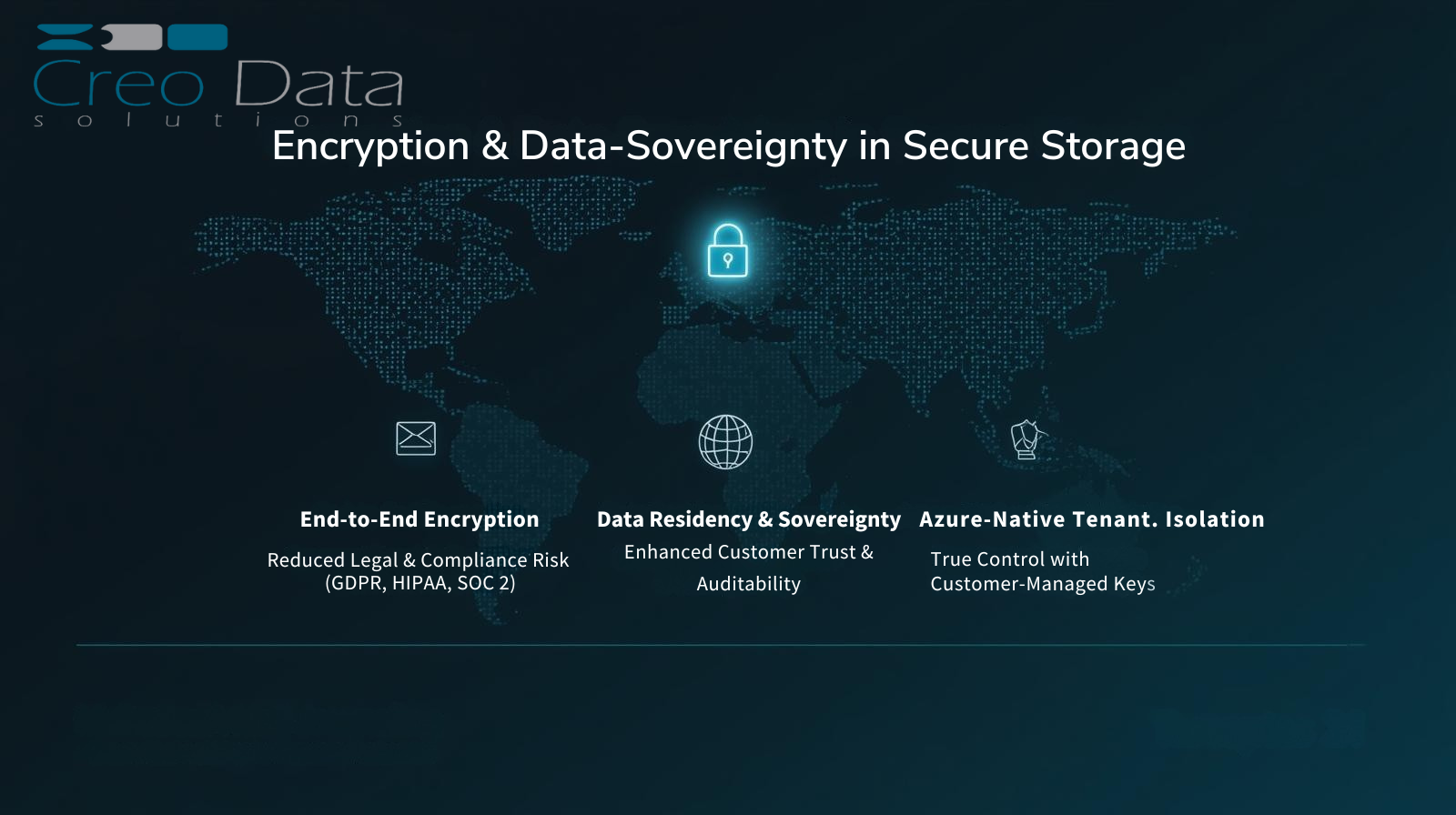
The cloud edition runs on Microsoft Azure as an Azure Managed Application. Azure has no region in Zambia, so if your data must stay in the country or your own data centre, use the on-premises edition, which has the same features. Modules are licensed separately, so a microfinance institution can start with screening and risk rating. See Creodata's AML compliance software for every module, or book a demo.
Frequently asked questions
What is the best AML software in Zambia?
There is no single best system, only the best fit for your size, channels and risks. Shortlist two or three vendors that meet your Must-haves, run the same scripted demos on your own data, and score them with a weighted checklist.
How much does AML software cost in Zambia?
It varies: vendors price by module, customer, transaction volume or enterprise licence, with list data, implementation and hosting often extra and fees sometimes in US dollars. Compare itemised three-year totals. Creodata has no public price list; a quote depends on the modules you switch on and whether you deploy on Azure or on-premises.
Does AML software file reports with the FIC?
Electronic reports reach the FIC through its goAML portal, so check that the software produces files the portal accepts and tracks each report to acknowledgement. With Creodata, reports are drafted, reviewed and approved in the AML software, and our goAML reporting software for Zambia generates and validates the file.
What does AML software need to detect under Zambia's currency transaction rule?
Currency transactions at or above the Kwacha equivalent of USD 10,000, in Kwacha or foreign currency, whether single or several that appear to be linked, for reporting within three working days (section 30 of the FIC Act; SI 53 of 2022). That needs a documented exchange rate and linking across days, branches and channels, not just within one business day.
Should AML software be hosted in the cloud or on-premises in Zambia?
Either can work. Cloud is faster to start; on-premises keeps data in your own data centre. Weigh your supervisor's expectations on outsourcing, your data-protection obligations and your risk appetite, and ask where data is stored and processed. Azure has no region in Zambia, so keeping data in the country means on-premises; Creodata's two editions have the same features.
How long does it take to implement AML software?
It depends mostly on data and integration. Screening and risk rating need clean customer data; monitoring also needs reliable feeds from every channel. Start with screening and risk rating, add monitoring once the feeds are proven, and ask vendors for a plan with named responsibilities on both sides.
See Creodata's AML software for Zambia in a demo, using your own linked-transaction and currency scenarios.