

Visual Insights into Expense Behavior: How Compliance Dashboards Transform Financial Governance
Monitor spending patterns and compliance metrics in real time with interactive dashboards that shift expense governance from reactive correction to proactive control.
Executive Summary
In today's complex financial landscape, organizations face mounting pressure to maintain rigorous control over expenses while navigating increasingly sophisticated compliance requirements. Traditional expense management systems often leave finance teams struggling with reactive processes and delayed visibility into spending patterns and policy violations. This gap in real-time oversight creates significant governance challenges, potentially exposing organizations to financial risks, compliance failures, and inefficient resource allocation.
Enter the modern compliance dashboard—an interactive, data-driven solution that transforms how finance teams monitor and manage expense behavior. These dashboards provide unprecedented transparency into spending patterns and compliance metrics, moving organizations from retrospective correction to proactive governance. Creodata's AI-Powered Expense Management Automation exemplifies this evolution by integrating sophisticated analytics with real-time monitoring capabilities, giving finance professionals the tools they need to maintain control while streamlining operations.
The Anatomy of a Modern Compliance Dashboard
Real-Time Monitoring Capabilities
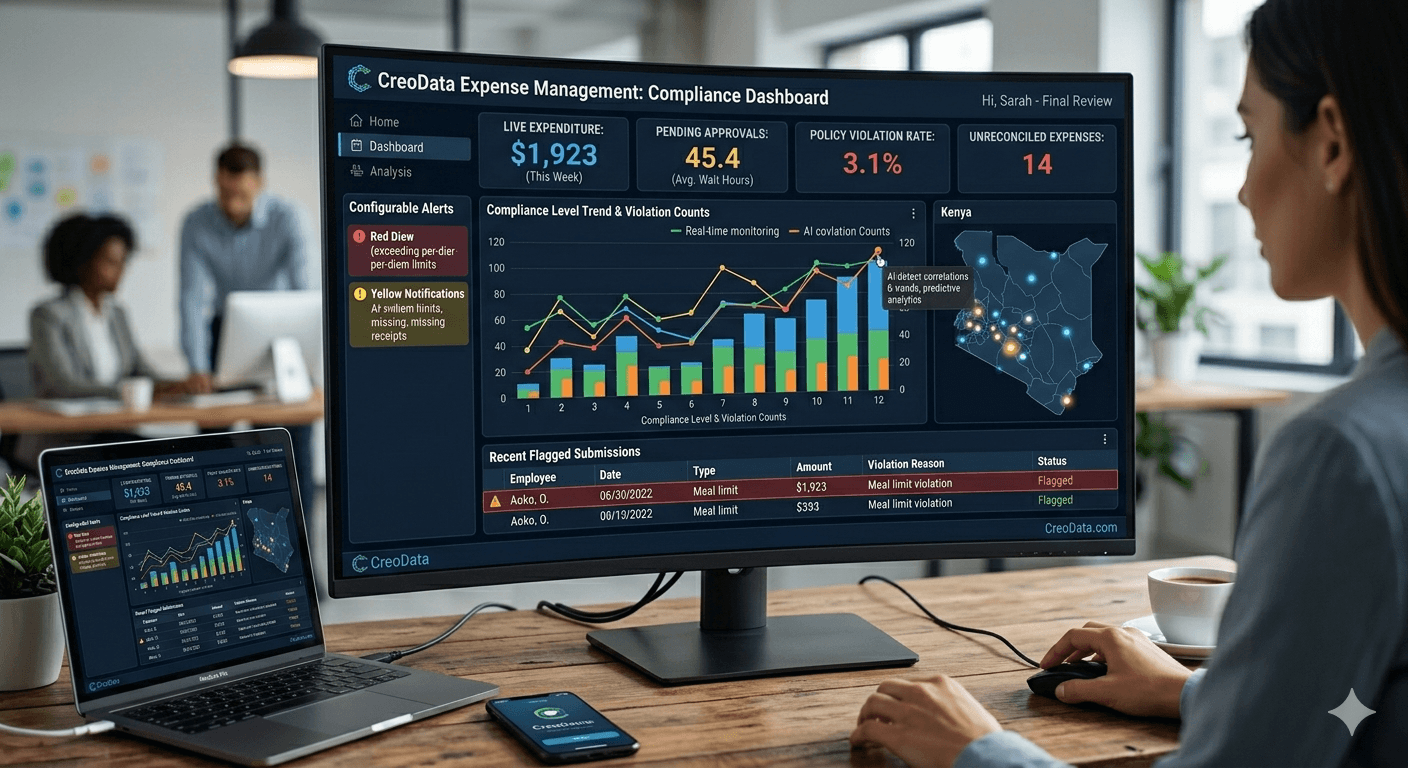
At the heart of effective expense governance lies the ability to monitor compliance levels in real time. Advanced compliance dashboards, like those integrated within Creodata's solution, provide continuous visibility into expense submissions as they flow through automated workflows. This represents a fundamental shift from traditional periodic reviews to ongoing oversight, enabling finance teams to identify potential issues before they escalate into significant problems.
These dashboards typically feature configurable alerts that notify managers of policy violations based on customizable thresholds. Whether an employee exceeds per-diem limits, submits non-compliant receipts, or violates approval hierarchies, the system flags these occurrences immediately. This proactive approach dramatically reduces the time finance teams spend hunting for anomalies and allows them to focus on strategic interventions rather than detective work.
Pattern Recognition and Recurring Violation Analysis
Beyond individual violations, sophisticated dashboards excel at identifying recurring patterns that might indicate systemic issues or potential fraud. Through machine learning algorithms and predictive analytics, these systems can detect subtle correlations that might escape human reviewers. For example, they might identify that expense violations consistently spike before quarter-end reporting, or that certain departments have higher rates of policy exceptions.
Creodata's platform emphasizes this capability through its AI-powered data extraction and analysis features. The system doesn't just capture expense data—it contextualizes it against historical patterns and organizational benchmarks. This enables finance teams to distinguish between isolated incidents and concerning trends, allowing for more targeted policy adjustments and training initiatives. Rather than simply reacting to violations, organizations can proactively address underlying behavioral patterns.
Key Advantages of Compliance Dashboards in Expense Management
Enhanced Policy Enforcement and Governance
Compliance dashboards transform policy from abstract guidelines to measurable standards. Creodata's solution automatically flags expenses that violate company policies before approval, preventing non-compliant expenditures from entering the reimbursement pipeline. This preemptive approach significantly reduces the financial and administrative burden of correcting violations after the fact.
The system supports highly customizable approval workflows based on amount thresholds, expense types, departments, and other variables, ensuring that governance controls adapt to organizational structure rather than forcing organizations into rigid compliance frameworks. This flexibility allows companies to maintain appropriate oversight without creating unnecessary bottlenecks in the expense approval process.
Operational Efficiency and Resource Optimization
By automating the detection and reporting of compliance issues, dashboards free finance teams from labor-intensive manual reviews. Creodata reports that organizations using their solution achieve 80% faster processing with 95% less manual work—dramatic improvements that allow finance professionals to redirect their efforts toward value-added activities.
The dashboard's advanced analytics capabilities provide actionable insights into spending patterns, enabling more informed budgeting and forecasting. Finance teams can identify areas of unnecessary expenditure, negotiate better vendor terms based on consolidated spending data, and optimize budget allocations based on historical compliance trends. This transforms the expense management function from a cost center to a strategic partner in organizational financial management.
Risk Mitigation and Fraud Prevention
Interactive dashboards serve as an early warning system for potential financial irregularities. By monitoring expense behavior across multiple dimensions—time, department, individual, vendor, expense category—these tools can detect anomalies that might indicate fraudulent activities. Creodata's enterprise-grade security and comprehensive audit trails further strengthen this capability by ensuring that all system activities are logged for compliance and forensic purposes.
The psychological impact of transparent monitoring should not be underestimated. When employees know that expense submissions undergo continuous automated scrutiny, compliance rates typically improve organically. This creates a culture of accountability while simultaneously reducing the burden on managers to police expense reporting manually.
Target Audience: Who Benefits from Compliance Dashboards?
Finance Teams and Controllers
For finance professionals charged with maintaining financial integrity, compliance dashboards provide unprecedented control with significantly reduced effort. These teams benefit from real-time visibility into expense patterns, automated violation detection, and streamlined approval processes. Creodata's solution helps finance teams automate data entry, validation, and posting to accounting systems—transforming their role from data processors to strategic analysts.
The reporting and analytics capabilities are particularly valuable for financial controllers who must demonstrate compliance to auditors, regulators, and executive leadership. With customizable dashboards and detailed audit trails, these professionals can quickly generate evidence of proper governance and oversight.
Management and Executive Leadership
Senior leaders require high-level visibility into organizational spending without getting bogged down in transactional details. Compliance dashboards offer executive-level summaries of compliance metrics, spending trends, and policy effectiveness. Creodata's solution gives management real-time visibility into spending patterns and supports enforcement of policy compliance, enabling more informed strategic decision-making.
For executives concerned with organizational risk, these dashboards provide assurance that expense-related risks are being proactively managed. The ability to monitor key compliance indicators in real time supports more agile governance and rapid response to emerging issues.
Employees and Department Managers
While compliance monitoring might initially seem like additional scrutiny for employees, well-designed dashboards actually improve their experience by clarifying expectations and streamlining submissions. Creodata's solution enables employees to submit expenses quickly via mobile and get reimbursed faster. Clear visibility into policy parameters and automated feedback on submissions reduces uncertainty and frustration.
Department managers benefit from dashboards tailored to their oversight responsibilities. They can monitor team spending against budgets, identify training needs based on compliance patterns, and make more informed decisions about resource allocation—all without becoming expense processing experts.
Conclusion: Transforming Governance Through Visual Intelligence
Compliance dashboards represent a paradigm shift in expense management—from reactive correction to proactive governance, from manual scrutiny to automated intelligence, from opaque processes to transparent operations. By providing visual insights into expense behavior, these tools empower organizations to maintain rigorous control while streamlining operations and enhancing the experience for all stakeholders.
Creodata's AI-Powered Expense Management Automation exemplifies how modern technology can address traditional governance challenges. With features like automated policy compliance checking, configurable workflows, and advanced analytics, the solution demonstrates how interactive dashboards transform expense management from an administrative burden to a strategic advantage.
For organizations seeking to strengthen financial governance while optimizing resources, compliance dashboards offer a compelling value proposition. They provide the visibility needed to detect issues early, the analytics to understand root causes, and the automation to address problems efficiently. In an era of increasing regulatory complexity and financial scrutiny, such capabilities are not merely convenient—they're essential components of responsible financial management.
For more information, visit Creodata.com