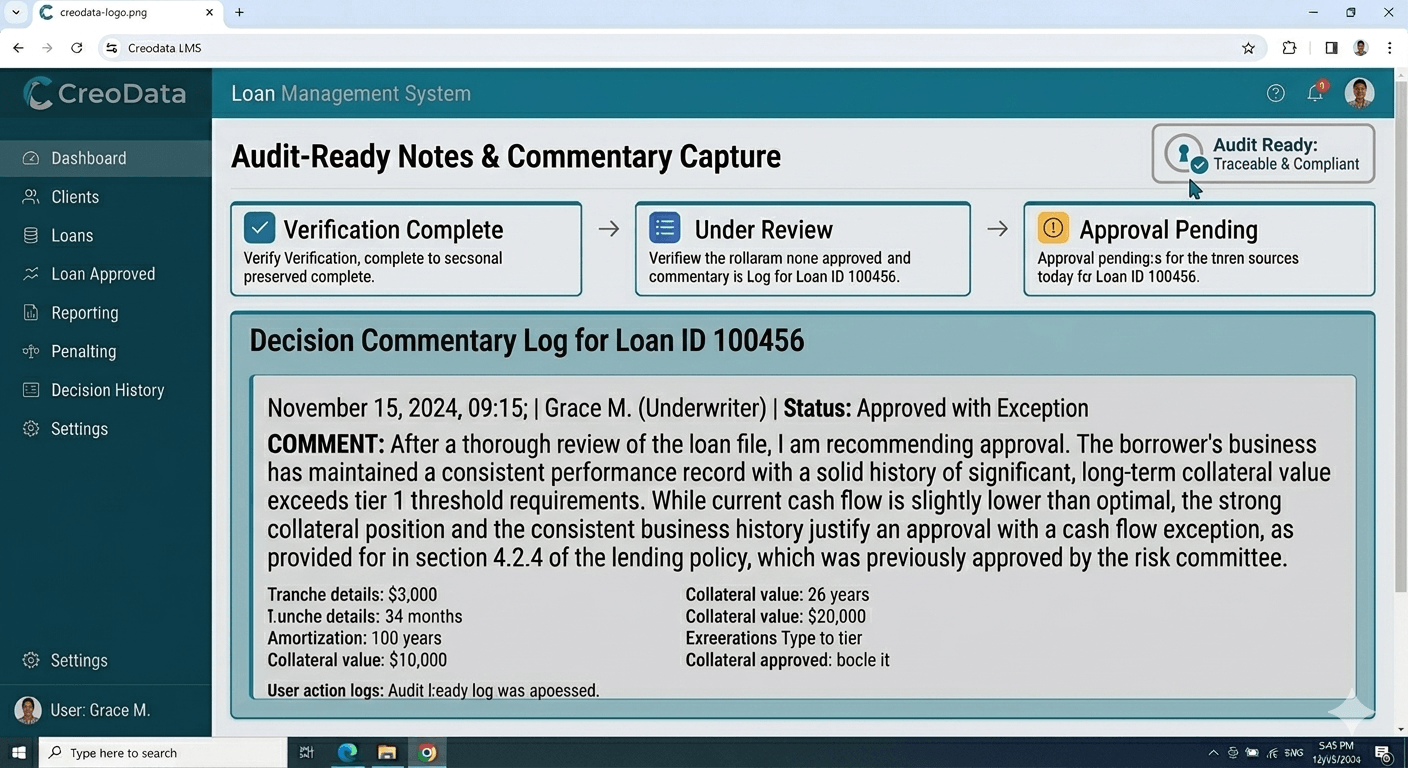

State-Before-and-After History Snapshot
Capture before-and-after snapshots of loan application state so auditors and compliance teams can verify exactly what changed at every workflow step.
Introduction
In today's highly regulated financial environment, transparency and traceability are no longer optional—they are mandatory. Loan management systems, in particular, must provide a clear, verifiable record of how applications move through each stage of their lifecycle. Regulators, auditors, and internal compliance teams expect organizations to demonstrate who did what, when it happened, and how decisions were made.
One of the most critical yet often overlooked elements of audit readiness is the ability to clearly see state changes in a loan workflow. Knowing that an application is "Approved" is useful, but knowing what it was before approval, when the transition occurred, and how it progressed through intermediate stages is far more valuable.
Creodata's Loan Management solution addresses this need through the Previous & Next Status feature, enabling a State-Before-and-After History Snapshot. This capability captures both the prior status and the new status for every workflow transition, providing audit teams with a precise, chronological view of how loan applications move through the system.
This article explores how this feature strengthens audit trail and history, supports regulatory compliance, and delivers operational and governance benefits for financial institutions.
The Importance of Audit Trail & History in Loan Management
Loan processing involves multiple steps, stakeholders, and decisions—each of which can significantly impact financial risk and regulatory exposure. Without a detailed audit trail, organizations face challenges such as:
- Difficulty proving compliance during audits
- Limited visibility into workflow bottlenecks
- Disputes over decision timelines
- Increased risk of fraud or unauthorized actions
- Weak accountability across teams
Traditional systems may log only the current status of a loan application, overwriting previous states as the process moves forward. This approach creates gaps in historical visibility and makes it difficult to reconstruct the exact journey of an application.
An effective audit trail must preserve every transition, ensuring that historical data remains intact and accessible. This is precisely what the Previous & Next Status feature in Creodata Loan Management is designed to achieve.
Understanding the "Previous & Next Status" Feature
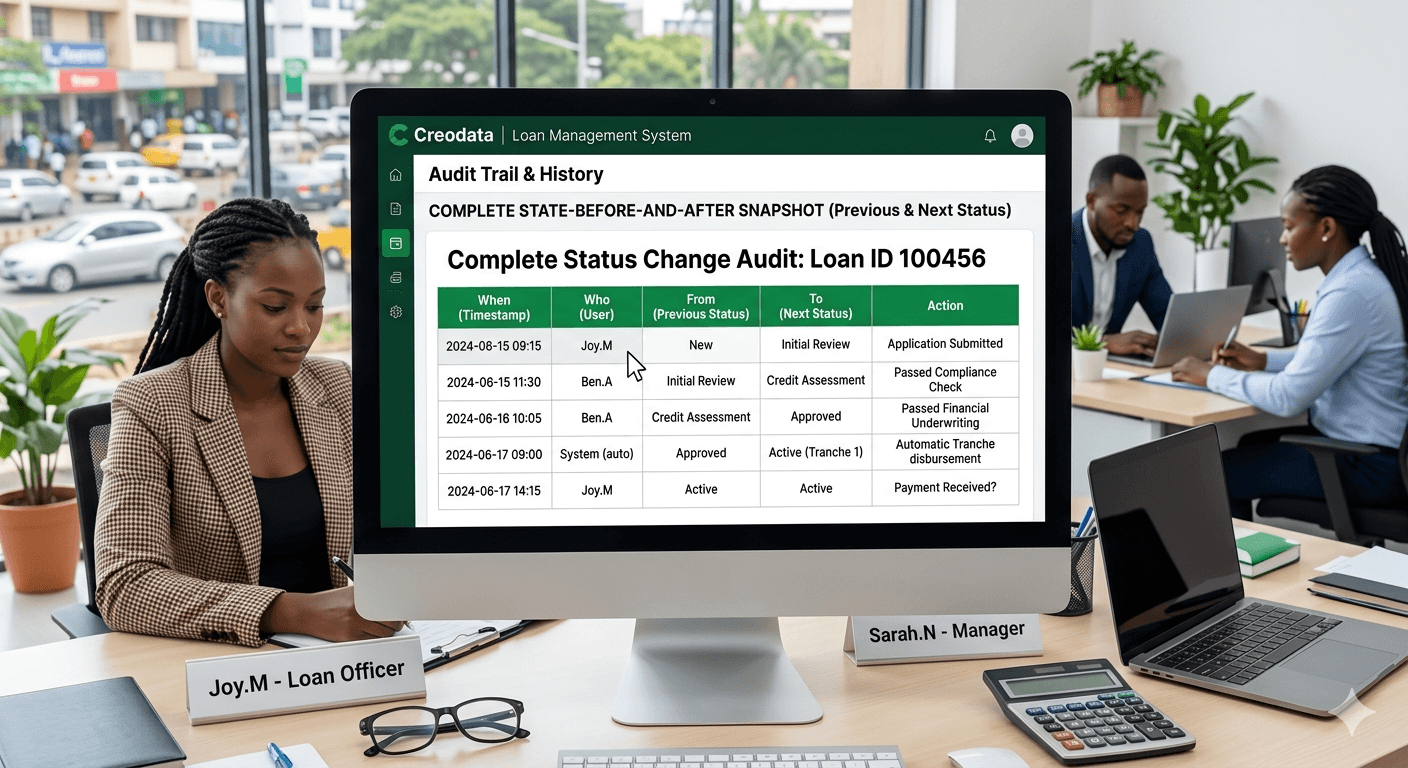
The Previous & Next Status feature records every workflow transition by capturing:
- The previous status of the loan application
- The new (next) status after the transition
- The timestamp of the change
- The user or role responsible for the action (where applicable)
Together, these data points create a state-before-and-after snapshot for each step in the loan lifecycle.
Instead of simply knowing where a loan stands today, audit and compliance teams can see exactly how it arrived there, step by step.
Use Case Overview: State-Before-and-After History Snapshot
The Challenge
In many lending organizations, audits often require answers to questions such as:
- When was this loan moved from "Under Review" to "Approved"?
- Was it previously marked as "Rejected" or "On Hold"?
- How long did it remain in each status?
- Were any steps skipped or reversed?
- Did transitions follow approved workflows?
Without a detailed state history, answering these questions requires manual reconstruction from emails, spreadsheets, or fragmented logs—if the information exists at all.
The Solution
Creodata Loan Management captures both the previous and next status for every transition, creating a complete, immutable history of the loan's journey. This enables auditors to review application movement with confidence, clarity, and precision.
How State-Before-and-After History Works in Creodata Loan Management
1. Workflow-Driven Status Transitions
Loan applications in Creodata move through predefined workflow stages, such as:
- Application Submitted
- Initial Review
- Credit Assessment
- Approval
- Disbursement
- Closure
Each transition between these stages is governed by system rules and user actions.
2. Automatic Capture of Status Changes
Whenever a loan application changes status, the system automatically records:
- The status before the change
- The status after the change
- The exact date and time of the transition
This happens in real time and does not rely on manual input, ensuring accuracy and consistency.
3. Immutable Historical Records
Once captured, status transitions are stored as part of the application's audit trail. These records are read-only, meaning they cannot be altered or deleted—an essential requirement for audit integrity.
4. Chronological Timeline View
Audit teams and authorized users can view the full history of an application in chronological order, making it easy to trace progress, identify delays, or investigate anomalies.
5. Integration with User and Role Tracking
When combined with role/user tracking, the state snapshot provides full context—showing not only what changed, but who initiated the change and under which authority.
Benefits of Capturing Previous & Next Status
1. Complete Transparency Across the Loan Lifecycle
By preserving every state transition, organizations gain full visibility into how applications evolve from submission to closure. Nothing is hidden, overwritten, or lost.
2. Stronger Audit Readiness
Auditors can easily verify:
- That workflows were followed correctly
- That no unauthorized status changes occurred
- That approvals happened in the correct order
This reduces audit preparation time and minimizes compliance risk.
3. Faster Investigations and Dispute Resolution
When questions arise—whether from customers, regulators, or internal teams—having a clear before-and-after history allows organizations to respond quickly with factual evidence.
4. Improved Accountability
Knowing that every transition is recorded promotes responsible behavior among users. Each action leaves a trace, reinforcing accountability across departments.
5. Insight into Process Efficiency
By analyzing how long applications remain in each status, organizations can identify bottlenecks, inefficiencies, or areas for process improvement.
Governance and Compliance Impact
The State-Before-and-After History Snapshot plays a critical role in governance and compliance by:
- Demonstrating adherence to internal policies
- Supporting regulatory reporting requirements
- Preventing unauthorized workflow manipulation
- Enabling consistent enforcement of approval processes
For regulated financial institutions, this level of traceability is often a legal and operational necessity.
Advantages of Creodata Loan Management
Creodata's Loan Management platform enhances audit trail capabilities through several key advantages:
Configurable Workflows
Organizations can define loan workflows that align with internal policies and regulatory requirements.
Automatic, Real-Time Logging
Status transitions are captured automatically, eliminating reliance on manual records.
Detailed Audit History
Every change is preserved with before-and-after visibility, supporting long-term audits.
Role-Based Access Control
Only authorized users can view or act on sensitive audit data.
Scalable Architecture
Handles high volumes of loan applications without performance degradation.
Unified Loan Lifecycle View
Combines status history with user actions, documents, and decisions in one system.
These advantages make Creodata Loan Management a reliable foundation for compliant, transparent lending operations.
Target Audience
The "State-Before-and-After History Snapshot" use case is particularly valuable for:
Internal Audit Teams
- Require detailed, verifiable records
- Need confidence in workflow integrity
- Conduct regular compliance reviews
Compliance and Risk Officers
- Monitor adherence to lending policies
- Reduce regulatory and operational risk
- Support external audits and inspections
Loan Operations Teams
- Gain visibility into application progress
- Identify delays and inefficiencies
- Improve process accountability
IT and System Administrators
- Ensure system-level auditability
- Maintain secure, immutable logs
- Support governance frameworks
Banks, Credit Unions, and Financial Institutions
- Operate under strict regulatory oversight
- Manage high loan volumes
- Require transparent, defensible processes
Real-World Business Impact
Organizations that implement detailed state transition tracking typically experience:
- Reduced audit findings and compliance issues
- Faster response to regulator inquiries
- Improved internal controls
- Better operational insights
- Increased trust from stakeholders
By turning workflow history into a strategic asset, lenders can move beyond basic compliance toward continuous process improvement.
Conclusion
In loan management, how an application moves through the workflow is just as important as its final outcome. The Previous & Next Status feature in Creodata Loan Management delivers a powerful State-Before-and-After History Snapshot, ensuring that every transition is recorded, traceable, and auditable.
This capability strengthens audit trail and history, supports regulatory compliance, enhances accountability, and provides valuable insights into process performance. For organizations operating in regulated lending environments, it transforms audit readiness from a reactive task into a built-in system strength.
By adopting Creodata Loan Management, financial institutions gain the transparency and control needed to operate confidently, compliantly, and efficiently in today's demanding regulatory landscape.
For more information, visit Creodata.com