
Scaling Costs with Business Growth: The Smart Path to Enterprise Compliance
Scale mail journaling costs with business growth using cloud SaaS pricing—start small, expand gradually, and pay only for what you use without peak-capacity upfront investment.
Introduction: The High Cost of "One-Size-Fits-All" Solutions
In the world of business software, few dilemmas are as persistent as the mismatch between a company's growth trajectory and its software licensing costs. For critical functions like email journaling—a non-negotiable requirement for compliance, legal discovery, and operational integrity—organizations have historically faced a stark choice: invest in a complex, expensive on-premise system with capacity you don't yet need, or risk non-compliance with piecemeal solutions. This forces a painful upfront capital expenditure and locks businesses into rigid, long-term commitments, creating financial strain just as they need agility the most.
This article explores a modern solution to this classic problem: the adoption of cloud-native, Software-as-a-Service (SaaS) models that allow costs to scale in perfect harmony with business growth. By examining solutions like Creodata's Mail Journaling SaaS, we will demonstrate how businesses can now start small, scale gradually, and only pay for what they use, all while achieving enterprise-grade security and compliance without the traditional overhead.
The Traditional Model: Paying for Empty Chairs
Legacy software procurement, especially for compliance-heavy tools, often follows a "peak capacity" purchasing model. An organization must estimate its maximum potential need—number of users, volume of emails, years of retention—and purchase licenses and infrastructure to match that future state. This approach is fraught with inefficiency:
- Significant Upfront Capital Expenditure (CapEx): Large initial investments in server hardware, software licenses, and implementation services strain budgets.
- Wasted Resources: Purchased capacity sits idle for months or years, depreciating in value while providing no return.
- Inflexibility: Scaling down during a business contraction is often impossible, leaving companies paying for licenses they no longer need. Scaling up requires another complex, costly procurement cycle.
- Hidden Operational Costs: The "total cost of ownership" balloons with expenses for dedicated IT staff, ongoing maintenance, security patching, and hardware refreshes every few years.
For a function as fundamental as email archiving, these constraints are particularly burdensome. Compliance isn't optional; it's a mandate. Yet, the cost of guaranteeing it has been disproportionately high for growing and midsize companies.
The Modern Paradigm: Scaling Costs with Consumption
Cloud-based SaaS solutions, like the Mail Journaling SaaS offered via the Azure Marketplace, fundamentally rewrite this economic model. They transition costs from a fixed, upfront capital expense (CapEx) to a variable, predictable operational expense (OpEx). This aligns perfectly with the financial reality of a growing business.
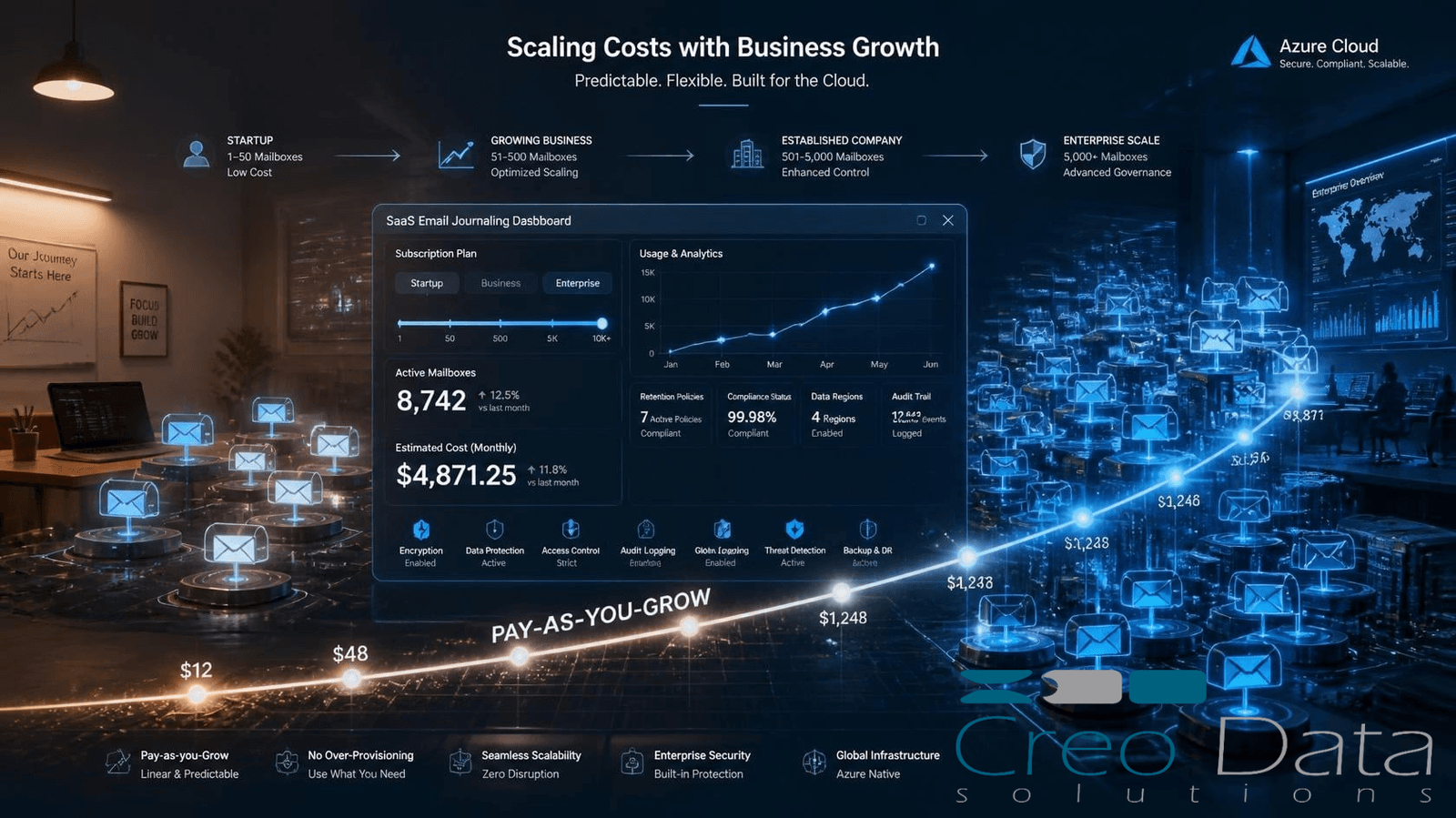
Here's how this scalable model works in practice, transforming each stage of a company's growth:
Phase 1: The Startup & Launch
A new company or a department launching a compliance initiative can begin immediately. There is zero investment in hardware and no need to negotiate complex enterprise licenses. As highlighted on Creodata's site, deployment happens in minutes from the Azure Marketplace with a "5-minute setup." A business can activate journaling for its initial 50 mailboxes, paying a simple per-user monthly fee. This low barrier to entry ensures compliance is established from day one, without derailing the budget.
Phase 2: Steady Growth & Expansion
As the company hires more employees, opens new departments, or acquires another firm, scaling the journaling solution is effortless. Adding 100 new mailboxes is an administrative task, not a technical project. The cloud-native architecture automatically handles the increased email volume. Costs increase linearly and predictably with headcount, providing perfect financial visibility. There are no "step functions" in cost or painful renegotiations.
Phase 3: Enterprise Scale & Sophistication
When the organization reaches a larger scale, its needs often become more complex. It may require advanced eDiscovery for litigation, different retention policies for various departments, or integration with other systems like SharePoint. At this stage, the flexible SaaS model continues to deliver value. The business can upgrade its plan or enable premium features (like Legal Hold) on-demand, paying only for the enhanced capabilities it actually uses. The underlying Azure infrastructure ensures "global scalability" to handle millions of messages without performance degradation.
Key Advantages of a Scalable Cost Model
Adopting a consumption-based solution for critical infrastructure like email journaling delivers compelling advantages beyond simple cost savings.
1. Improved Cash Flow & Financial Agility
By eliminating large upfront payments, companies preserve capital for core business investments like sales, marketing, and R&D. The predictable monthly OpEx model simplifies budgeting and financial forecasting, providing stability.
2. Elimination of Waste & Overspending
You pay for active users and consumed storage, not for shelfware or unused licenses. This aligns cost directly with value and business activity, ensuring you are never funding idle capacity.
3. Built-In Future-Proofing & Innovation
With a SaaS model, the vendor is responsible for all updates, security patches, and infrastructure upgrades. Your business automatically benefits from new features and stays on a modern, compliant platform without additional project costs or downtime. This is a critical advantage in the fast-evolving landscape of compliance regulations.
4. Operational Efficiency & Focus
IT teams are liberated from the burdens of patching servers, managing storage arrays, and performing complex backups. As the product page states, it offers "zero maintenance," allowing internal staff to focus on strategic initiatives that drive business growth rather than keeping the lights on for compliance tools.
5. Enterprise-Grade Security for All Sizes
Perhaps the most significant leveling of the playing field. A small or midsize business can now access the same "enterprise-grade security" and compliance certifications (like SOC 2, GDPR, and ISO 27001) that were once the exclusive domain of large corporations. This is achieved through the vendor's shared investment in the robust Microsoft Azure security framework, providing "encryption in transit and at rest" to all customers, regardless of their size or payment tier.
Identifying the Target Audience: Who Benefits Most?
This scalable cost model is powerfully advantageous for specific organizational profiles:
-
Startups and High-Growth Technology Companies: These businesses experience rapid, sometimes unpredictable, changes in headcount. They need to establish robust governance and compliance frameworks early but cannot afford to tie up capital in inflexible software. A pay-as-you-grow model is ideal.
-
Small and Midsize Businesses (SMBs) Moving to the Cloud: SMBs upgrading from basic email to Microsoft 365 often discover new compliance obligations. They need a professional solution that fits their budget and doesn't require a dedicated IT specialist to manage. The simplicity and scalability of a SaaS offering are perfect.
-
Legal, Financial, and Healthcare Firms (Regulated Industries): Compliance is non-negotiable for these sectors, but firm size can vary widely. A boutique law firm or a regional credit union has the same legal discovery and data retention requirements as a global giant but with a fraction of the budget. A scalable SaaS solution makes enterprise-grade compliance achievable.
-
IT Directors and CFOs in Any Growing Organization: These decision-makers are directly accountable for controlling costs while mitigating risk. They are the primary beneficiaries of the predictable OpEx, reduced total cost of ownership, and demonstrable compliance the model provides.
-
Organizations with Seasonal or Fluctuating Staffing: Companies in retail, hospitality, or consulting with seasonal workforce changes can seamlessly scale licenses up and down, avoiding fixed costs during off-peak periods.
Conclusion: Strategic Cost Management as a Competitive Advantage
In today's economic climate, strategic cost optimization is not about cutting corners—it's about intelligent allocation of resources. For critical infrastructure like email journaling and compliance, the old model of large, inflexible capital investments is obsolete. It creates drag on growth and diverts funds from innovation.
The future belongs to agile, cloud-native services that allow costs to scale as a true variable of business success. By choosing solutions that offer a gradual, commitment-free path—starting small and scaling features, capacity, and costs in lockstep with growth—businesses achieve more than just savings. They gain a powerful operational agility, ensure continuous compliance, and free up both capital and human talent to focus on what truly matters: building their business. In this way, smart cost scaling transforms from a financial tactic into a genuine, sustainable competitive advantage.
For more information, visit Creodata.com