

Preventing Policy Violations Before Submission: Rule-Based Validation in Governance & Control
Block or flag policy-violating expenses at submission with real-time rule checks—spending limits, documentation requirements, duplicate detection, and category-specific controls.
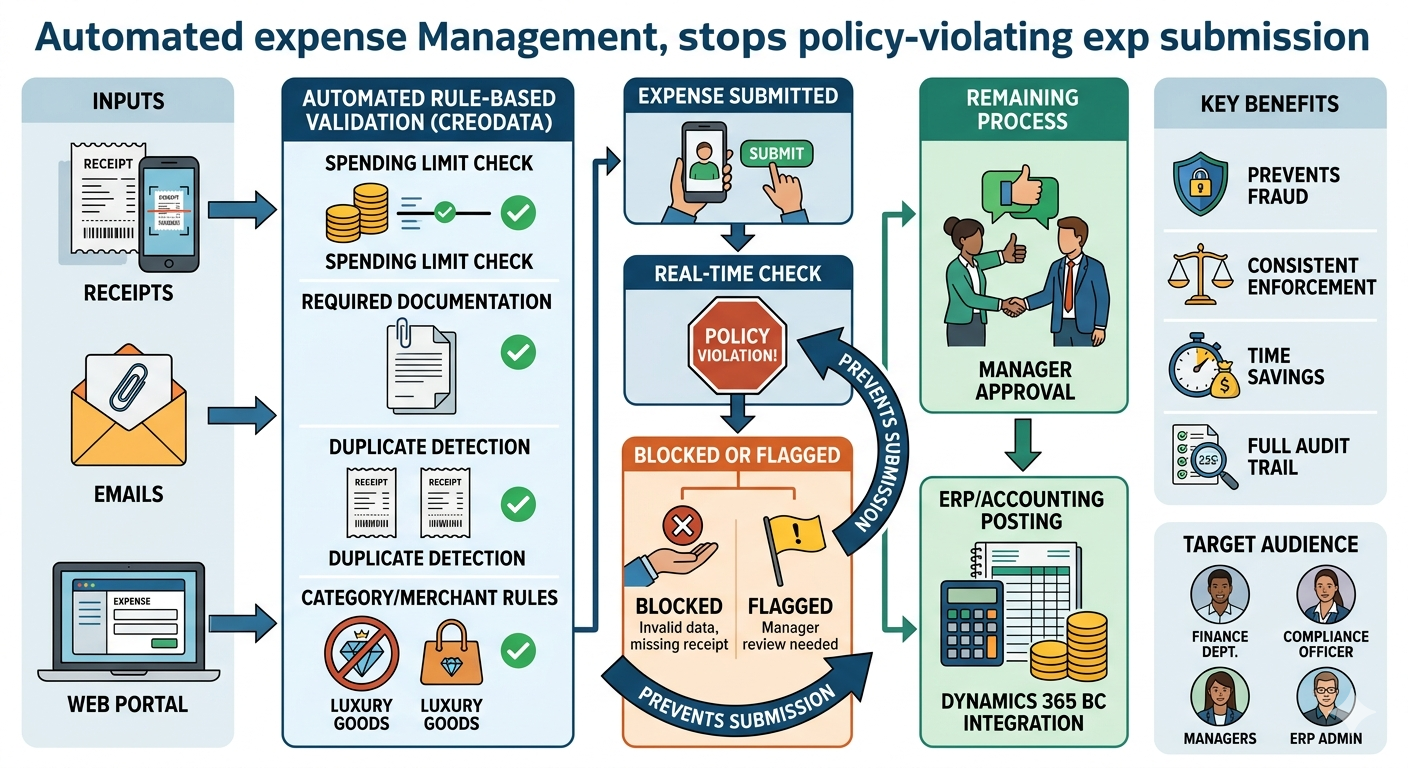
In modern organizations, controlling employee expenses — ensuring they comply with company policies, budgets, and regulatory requirements — is a major challenge. Manual expense reporting is prone to error, inconsistency, delays, and even fraud. That's where automated expense-management platforms with built-in rule-based validation come in. Through real-time checks at submission time, these systems can block or flag expense entries that violate policy before they move into the approval or reimbursement process.
What Is Rule-Based Validation for Expenses?
Rule-based validation in an expense-management system means the software enforces predefined business rules or policies automatically when an expense is submitted — before any human approval or accounting processing. These rules are configured by the organization and reflect its expense policies: spending limits, required documentation, allowed categories, vendor restrictions, duplicate detection, and more.
When an employee submits an expense (via mobile app, email, or portal upload), rules are applied in real time:
- Spending limits — if the expense amount exceeds a predefined limit (e.g., hotel stay above allowed per diem, meals above daily cap), the system flags or blocks the entry.
- Missing documentation — if required supporting documentation (receipt, invoice, or justification) is missing, the submission is rejected or flagged for review.
- Prohibited categories — if the expense is in a prohibited category (e.g., luxury vendors, blacklisted merchants, non-business items), the system enforces policy and prevents submission.
- Duplicate detection — identical receipts or repeated charges are automatically detected and blocked.
- Category/department-specific rules — e.g., travel expenses only for certain departments, maximum per-person or per-project limits.
In effect, rule-based validation ensures that invalid or non-compliant expense claims are caught at the earliest moment, long before they reach approvers or the accounting system. This approach shifts expense compliance from a reactive, manual review process to a proactive, automated guardrail.
How Rule-Based Validation Works in Creodata Expense Management
Creodata's Expense Management solution — available via Azure Marketplace — brings together AI-powered data extraction, configurable workflows, and policy enforcement to deliver real-time validation and compliance.
1. Expense Capture
Employees submit receipts or invoices using a mobile app, email forwarding, or web portal. AI-powered OCR (via Azure Document Intelligence) automatically extracts key data: vendor, date, amount, tax, and line items.
2. Pre-Submission Validation (Rule Check)
As soon as data is extracted — or even as the employee fills out the expense form — the system applies the company's configured policy rules: spending thresholds, required documentation, allowed categories, duplicate detection, etc. If an expense violates any rule, the system either blocks submission or flags it for review.
3. Approval Workflow / Routing
Compliant expenses are routed through predefined approval workflows (which may vary by department, amount, or cost center) for manager approval. The system supports configurable workflows, multi-level approvals, delegations, and escalations.
4. ERP / Accounting Integration
Once approved, expenses are automatically posted to the organization's ERP or general ledger (GL) system — for example, Microsoft Dynamics 365 Business Central — with correct accounts, cost centers, and coding. This reduces manual data entry, reconciliation errors, and ensures financial records are accurate.
5. Audit Trails and Compliance Logs
Every step — from submission, validation check, approvals, rejections, to posting — is logged for traceability. This enables strong governance, audit readiness, and simplified compliance reporting.
Key Benefits of Rule-Based Validation
1. Prevention of Policy Violations and Fraud
Overspending, missing receipts, duplicate claims, or vendor blacklists are automatically enforced. This helps curb abuse, reduces risk of unauthorized spending, and preserves budget integrity.
2. Consistency and Uniform Enforcement
Every claim is assessed against the same standard, irrespective of who submits or reviews it. This ensures fairness, reduces inconsistencies across departments, and enforces one version of policy across the entire organization.
3. Time & Cost Savings
Automating validation means fewer manual checks for finance or compliance teams. This reduces overhead, speeds up expense submission and approval cycles, and frees up staff for higher-value tasks.
4. Reduced Errors and Improved Data Quality
AI-OCR minimizes manual data-entry errors (typos, misread amounts, mis-categorization). Coupled with rule-based validation, only clean, policy-compliant entries proceed — improving financial data quality.
5. Better Governance, Compliance & Audit Readiness
Every expense — including rejected or flagged ones — is recorded in an audit trail, supporting internal governance, external audits, and compliance with industry regulations.
6. Real-Time Visibility & Spending Control
Managers and finance leaders gain insight into expense submissions as they happen — spend patterns, category distributions, potential violations, and departmental trends — supporting better budget management and strategic decision-making.
7. Improved Employee Experience
Instant feedback at submission, faster validation, and fewer back-and-forths lead to quicker reimbursements and less frustration, fostering better compliance and user adoption.
Who Should Use Rule-Based Validation?
| Stakeholder | Key Benefit |
|---|---|
| Finance Departments & Controllers | Reduced manual workload, better data quality, consistent enforcement |
| Compliance Officers & Internal Auditors | Audit trails, governance controls, proof of policy adherence |
| Managers and Department Heads | Real-time visibility and instant policy enforcement for budgets |
| Organizations with Dispersed/Field Staff | Mobile submission + validation reduces lost receipts and inconsistent claims |
| Medium to Large Enterprises | Scalable automation as transaction volume grows |
| SMEs with Budget Discipline Needs | Strict spending policy enforcement without large overhead |
| IT and Systems Administrators | Ensures expenses entering the ledger meet policy and data integrity standards |
Conclusion
Rule-based validation — exemplified by "Preventing Policy Violations Before Submission" — is a powerful feature in the domain of Governance & Control for expense management. By applying configurable business rules at the point of expense submission, organizations ensure consistent enforcement of spending policies, prevent out-of-policy or fraudulent claims, and reduce operational overhead associated with manual reviews.
With platforms like Creodata Expense Management, organizations get a comprehensive solution: AI-powered data extraction, real-time policy validation, configurable workflows, ERP integration, and full audit trails.
For more information, visit Creodata.com.