

Designing Policies That Match Your Business: A Guide to Dynamic Expense Governance
Build adaptive expense policies with custom rule builders that let administrators create, update, and enforce validation logic dynamically—without writing code.
Introduction: The Compliance Imperative in Modern Business
In today's rapidly evolving regulatory landscape and competitive business environment, compliance management has become a critical challenge for organizations of all sizes. Traditional approaches to policy enforcement—often reliant on static rules, manual reviews, and after-the-fact audits—are increasingly inadequate. These methods create bottlenecks, frustrate employees with delayed reimbursements, and expose organizations to financial risks and compliance violations when policies inevitably change.
The solution lies in transitioning from rigid, one-size-fits-all policy frameworks to adaptive, business-specific governance systems. This article explores how modern expense management platforms, particularly through custom rule builder capabilities, empower administrators to create, update, and enforce validation logic dynamically—without needing to write a single line of code. This transformative approach keeps organizations agile, compliant, and in control as their business needs evolve.
Understanding the Custom Rule Builder: Governance Without Coding
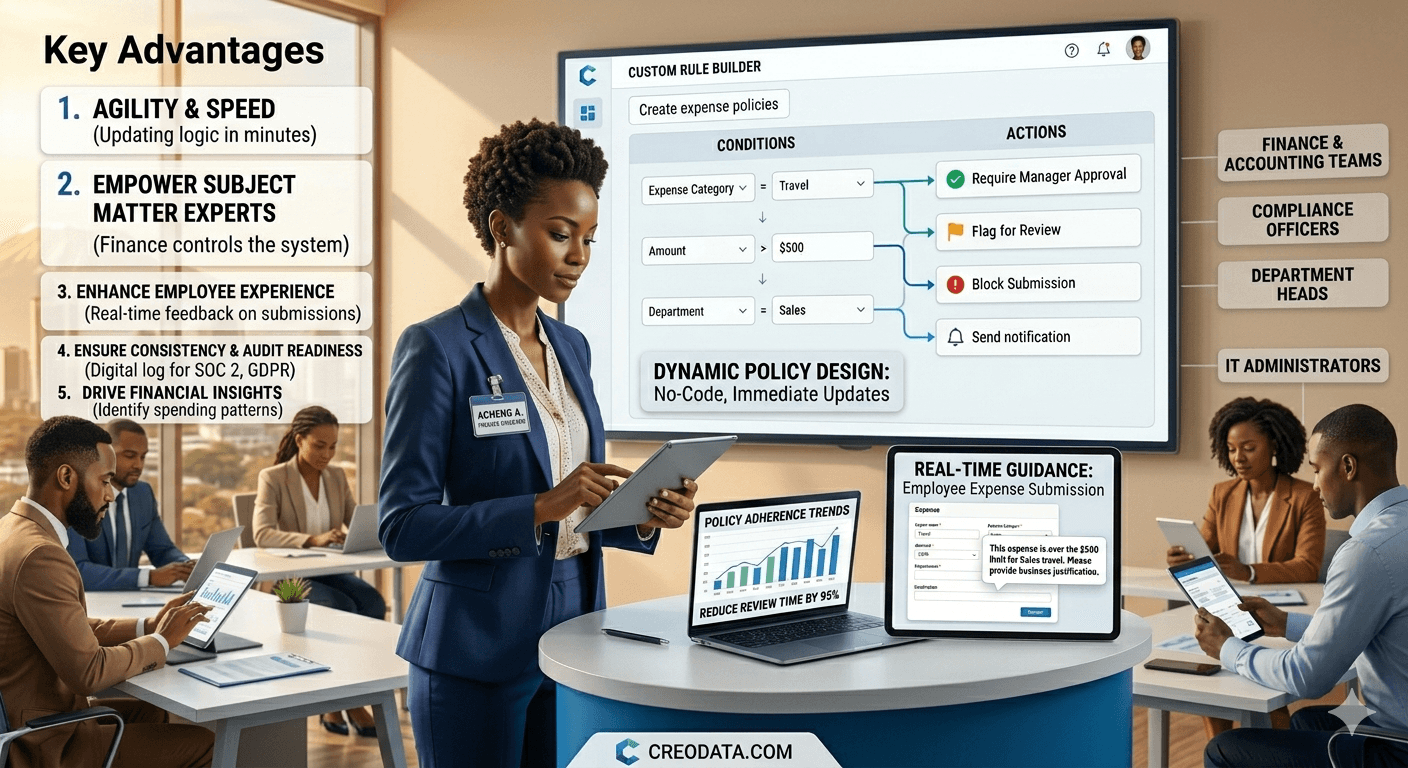
At its core, a Custom Rule Builder is a visual, configuration-based interface that allows non-technical administrators to define the business logic that governs expense submissions. Instead of requiring IT department intervention or custom development cycles, finance managers, compliance officers, or department heads can directly translate company policies into enforceable system rules.
This functionality transforms policy from a document that people should follow into an integrated system that ensures they follow it. Creodata's expense management solution enables organizations to automatically flag expenses that violate company policies before they're approved—shifting compliance from a reactive audit process to a proactive control mechanism.
How Dynamic Rule Building Works in Practice
The mechanics of a custom rule builder typically involve:
- Condition Definition: Administrators specify the "if" conditions using plain language or simple dropdowns (e.g., "If expense category is 'Travel'...").
- Parameter Selection: They select relevant parameters (e.g., amount, department, project code, vendor, receipt date).
- Action Configuration: They define the "then" actions the system should take (e.g., "require a detailed business purpose," "route to a specific approver," "flag for review," or "block submission entirely").
For instance, a company could build a rule stating: "If an expense is in the 'Entertainment' category AND the amount exceeds $200 AND the client is not listed in the CRM, THEN require Vice President approval AND attach a completed client entertainment form." This complex logic is built through simple selections, not code.
Key Advantages of a No-Code Custom Rule Builder
Implementing a dynamic, administrator-controlled rule system offers transformative advantages over traditional, static expense controls.
1. Unmatched Agility and Speed
When compliance requirements shift—due to new tax legislation, internal policy updates, or changing project requirements—administrators can immediately update validation logic. There's no waiting for the next software update or for a developer's bandwidth to free up. This ensures that policy enforcement is always synchronized with the latest rules, dramatically reducing organizational risk.
2. Empowering Subject Matter Experts
The finance and compliance teams who best understand the nuances of policy are directly empowered to enforce it. This eliminates the communication gap and potential for misinterpretation that occurs when business requirements are translated into technical specifications for an IT team. Control rests with the people who need it most.
3. Enhancing the Employee Experience
Clear, system-enforced rules provide immediate feedback to employees at the point of submission. Instead of submitting an expense and learning it's non-compliant days later during a finance review, employees receive real-time guidance. The system can prompt for missing information or explain why a rule is triggered, turning the expense tool into a coaching aid that improves policy understanding and reduces frustration.
4. Ensuring Consistency and Audit Readiness
Manual approval processes are inherently inconsistent. A custom rule builder applies the exact same logic to every single transaction, eliminating approver bias or oversight. Furthermore, every triggered rule and action is logged within a comprehensive audit trail. This detailed logging of all system activities provides immutable evidence for compliance audits (SOC 2, GDPR, ISO 27001) and internal controls.
5. Driving Deeper Financial Insights
The rules themselves become a source of business intelligence. By analyzing which rules are most frequently triggered, organizations can identify areas where policy is unclear, spending patterns are shifting, or where employees need additional training. This turns governance data into a strategic asset for continuous process improvement.
Target Audience: Who Benefits from Dynamic Policy Design?
This capability creates value across the organizational spectrum.
Finance & Accounting Teams The primary beneficiaries. They can directly configure rules for GL account coding, receipt requirements, spending limits, and approval matrices—ensuring financial accuracy and reducing manual review workloads by up to 95%.
Compliance & Internal Audit Officers These professionals can operationalize regulatory requirements (like travel policy laws or client gift regulations) directly into the workflow, creating a self-auditing system that provides continuous control monitoring.
Department Heads and Project Managers They can institute granular controls for their specific budgets, projects, or teams—such as capping daily meal allowances for a specific project or requiring pre-approval for certain vendor types.
IT Administrators Liberated from the cycle of fulfilling small, repetitive change requests for expense policy updates, allowing them to focus on strategic infrastructure.
Executive Leadership Gains real-time visibility into spending patterns and policy compliance, with confidence that controls are adaptive and robust—supporting better oversight and decision-making.
Implementing Effective Dynamic Policies: A Strategic Approach
To maximize the value of a custom rule builder, organizations should follow a strategic implementation path:
- Start with High-Risk, High-Volume Areas: Begin by codifying policies around the most common compliance pain points, such as T&E reimbursements, vendor gift policies, or project-based spending caps.
- Design for Clarity, Not Just Control: Rules should be configured to guide users toward compliance with helpful prompts, not just to block submissions. This builds a culture of compliance rather than one of frustration.
- Iterate and Optimize: Use reporting and analytics to review rule performance. Are certain rules constantly triggering exceptions? It may indicate a policy that needs adjustment or better communication.
- Integrate with Broader Systems: Ensure your rule builder can leverage data from other systems. The most powerful rules often reference dynamic data—such as current project budgets from an ERP (like Dynamics 365 Business Central), employee hierarchies from HR software, or vendor lists from a procurement system.
Conclusion: The Future of Governance is Adaptive
The era of static, brittle expense controls is ending. The future of governance lies in adaptive, business-matched policies that evolve as fast as the organization itself. A no-code Custom Rule Builder is the cornerstone of this future, shifting policy enforcement from a manual, after-the-fact chore to an automated, intelligent, and integrated business process.
By empowering administrators to dynamically design validation logic, organizations achieve more than just compliance. They build a framework for operational excellence—reducing costs, accelerating processes by up to 80% faster, improving employee satisfaction, and providing management with the confidence that their financial controls are both robust and responsive. In a world of constant change, the ability to design policies that match your business precisely is no longer a luxury; it is a fundamental component of resilient and intelligent financial management.
For more information, visit Creodata.com