

Different Rules for Different Expense Types: Governance & Control with Category-Based Rules
Apply custom validation rules per expense type—travel, meals, lodging, and more—to enforce policy automatically, reduce manual review, and strengthen governance across your organization.
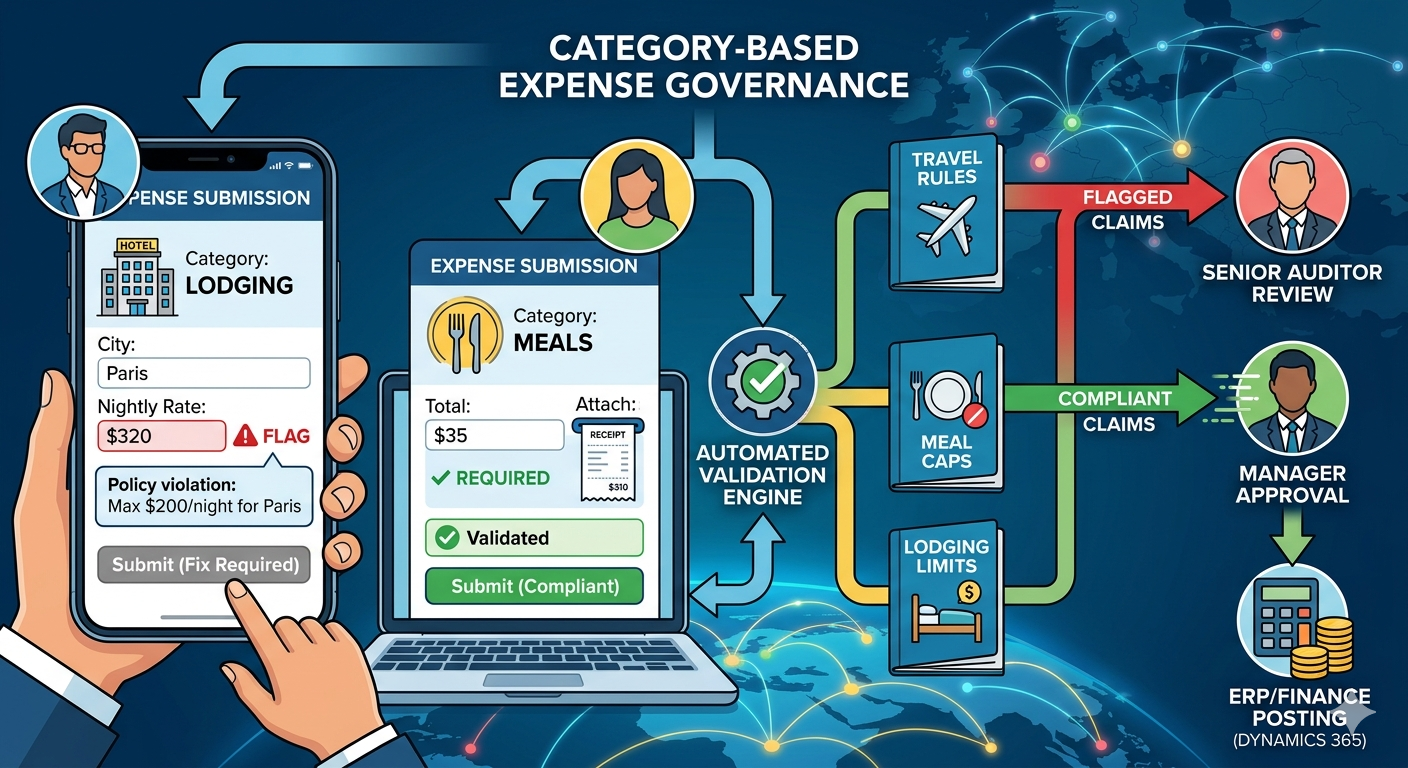
In modern organizations, expense management poses a perennial challenge: how to balance efficient reimbursement workflows with robust internal governance. Without clear controls, employees may submit inconsistent, out-of-policy claims; finance teams struggle with manual validation; and management loses visibility into spending patterns.
Category-based rules address these challenges head-on by enabling administrators to apply custom validation rules per expense type — such as travel, meals, and lodging — ensuring each category aligns with internal policy frameworks, regulatory requirements, and budgetary goals.
Understanding Category-Based Rules in Expense Management
A category-based rule is a policy that allows organizations to define how different types of expenses should be handled, validated, and approved based on their nature and associated risk or compliance considerations. Expense categories typically include:
- Travel — airfare, taxi fares, ride-share costs
- Meals — per-diem claims, corporate dining
- Lodging — hotel stays, accommodation
- Mileage — vehicle use reimbursements
- Entertainment — client-facing spend
- Miscellaneous — incidental or one-off costs
For example:
- Travel expenses may require stricter documentation and justification because they involve higher spend and external vendors.
- Meals might have per-diem limits or caps per person, with required explanations for business purpose.
- Lodging could be restricted to a permissible nightly rate based on city or internal travel policy.
These rules go beyond simple categorization — they embed business logic into the expense process, allowing systems to automatically scrutinize claims against policy before they reach an approver. Modern systems apply logic such as threshold limits, required documentation, submission windows, permissible combinations of expenses, and approval paths that vary by expense type.
Governance & Control: Why Category-Based Rules Matter
In any organization, governance and control are essential for financial health, regulatory compliance, and operational transparency. Expense management is a touchpoint where governance is frequently tested:
- Finance needs consistency to reconcile transactions with accounting systems.
- Internal auditors expect traceable policy enforcement to identify misuse or anomalies.
- Employees demand clarity and fairness so they understand what can and cannot be reimbursed.
- Managers require control to enforce budget discipline without slowing down operations.
Without category-based validation rules, these needs often conflict. Manual checks are slow, inconsistent, and easily bypassed. Category-based rules, by contrast, embed governance at the point of entry:
- Policies like "accommodation must not exceed $200 per night" or "meal claims must not exceed a daily cap of $50" are enforced automatically.
- Expenses outside policy are flagged in real time, preventing improper claims from progressing.
- Approval workflows route complex or high-risk categories to senior approvers based on configurable logic.
This automated enforcement translates governance from a retrospective audit task into a proactive control.
How CreoData Enables Category-Based Rules
CreoData's Expense Management Automation solution provides a robust platform for implementing category-based rules, built on Microsoft Azure and powered by intelligent data capture.
1. Configurable Expense Categories
Administrators can define and customize expense categories — travel, meals, lodging, subsistence, mileage, and miscellaneous — through an intuitive admin portal. Each category becomes a governance boundary where specific rules can be applied and enforced.
2. Tailored Validation Rules Per Category
For each category, organizations can configure rules that reflect internal controls and policy:
- Spend limits — set minimum and maximum spend amounts (e.g., maximum hotel spend per night).
- Documentation requirements — require receipts or proof of business purpose above certain thresholds.
- Time frames — enforce submission deadlines relative to the date of expense.
- Per-diem logic — automatically calculate per-diem rates for meals or lodging based on location or business standards.
- Mandatory metadata — require fields like project code or cost center before submission.
Non-compliant claims are flagged or blocked automatically during expense entry.
3. Policy-Aware Approval Workflows
Once expenses pass category-based validation, they enter configurable approval workflows — routing lodging claims to travel managers, meals to departmental supervisors, and so on — based on expense category, amount, department, or other metadata.
4. AI-Enhanced Accuracy & Capture
Leveraging Azure Document Intelligence, the system extracts key details from receipts and invoices — date, vendor, category — with over 95% accuracy. This ensures category-based rules are applied to clean, structured data.
5. Seamless Integration with Finance Systems
Approved and rule-validated expenses are automatically posted to accounting and ERP systems such as Microsoft Dynamics 365 Business Central, ensuring financial integrity and eliminating duplicate data entry.
Real-World Use Case: Tailored Rules for Travel, Meals & Lodging
Travel
Travel expenses — airfare, taxi rides, or ride-share costs — may be subject to corporate policies that cap allowable classes of service, enforce preferred vendor use, or require pre-approval. Category-based rules validate these constraints at submission, automatically flagging out-of-policy airfares or unapproved routes.
Meals
Meal claims often inherit per-diem allowances or require different documentation based on expense size. Small incidental meals might only need a logged amount, while large corporate dinners require itemized receipts and justification. Category-based logic enforces these differences safely and consistently.
Lodging
Hotel or accommodation costs typically have nightly rate caps and may require specific fields such as check-in/check-out dates or city codes. Rules ensure claims don't exceed established thresholds and that required documentation accompanies submissions.
By automating these validations at the category level, organizations reduce friction while ensuring compliance — rather than relying on post-hoc manual checks that delay reimbursements and increase administrative cost.
Advantages of Category-Based Rules
| Benefit | Impact |
|---|---|
| Stronger Policy Compliance | Automated checks ensure expenses align with internal and regulatory requirements before approval, reducing policy exceptions and financial leakage |
| Reduced Manual Work & Errors | AI-driven capture and rule enforcement cut processing times by up to 80% and reduce data correction overhead |
| Improved Visibility & Accountability | Real-time insight into spending patterns and exceptions by category empowers better budgeting and strategic decisions |
| Faster Approvals & Employee Satisfaction | Compliant expenses move quickly through approvals; employees receive faster reimbursements and clearer guidance |
| Enhanced Audit Readiness | Every check and approval step is logged and traceable, supporting audit and compliance teams |
| Scalability & Flexibility | Rules adapt as policies evolve, ensuring governance scales with organizational growth |
Target Audience
Category-based rules are especially valuable to:
- Finance & Accounting Teams — driving accuracy, compliance, and efficient reconciliation of expenses.
- CFOs & Finance Leaders — seeking transparent spending control and strategic spend insights.
- Internal Audit & Compliance Officers — requiring enforceable controls and traceable governance processes.
- HR & Administration Managers — designing equitable reimbursement policies and employee guidelines.
- IT & System Administrators — responsible for deploying secure, scalable platforms integrated with corporate systems.
- Operations & Travel Managers — overseeing travel budgets and policy adherence across distributed teams.
Conclusion
In an age of digital finance transformation, investing in governance and control is not just about stopping abuse — it's about enabling smarter, faster, and more insight-driven decisions. Category-based rules provide a powerful framework that ensures different types of expenses are validated and approved according to their unique policy requirements, aligning operational workflows with organizational standards.
With tools like CreoData's Expense Management Automation, organizations can implement these rules with minimal manual overhead, enhanced accuracy, and enterprise-grade security. The result is a more disciplined, transparent, and efficient expense ecosystem that supports both compliance and employee experience.
For more information, visit Creodata.com.