
Seamless Credit Workflow Transitions
Learn how event-driven workflow transition events can move loans smoothly from credit check to approval and disbursement, improving speed, consistency, and auditability for lenders.
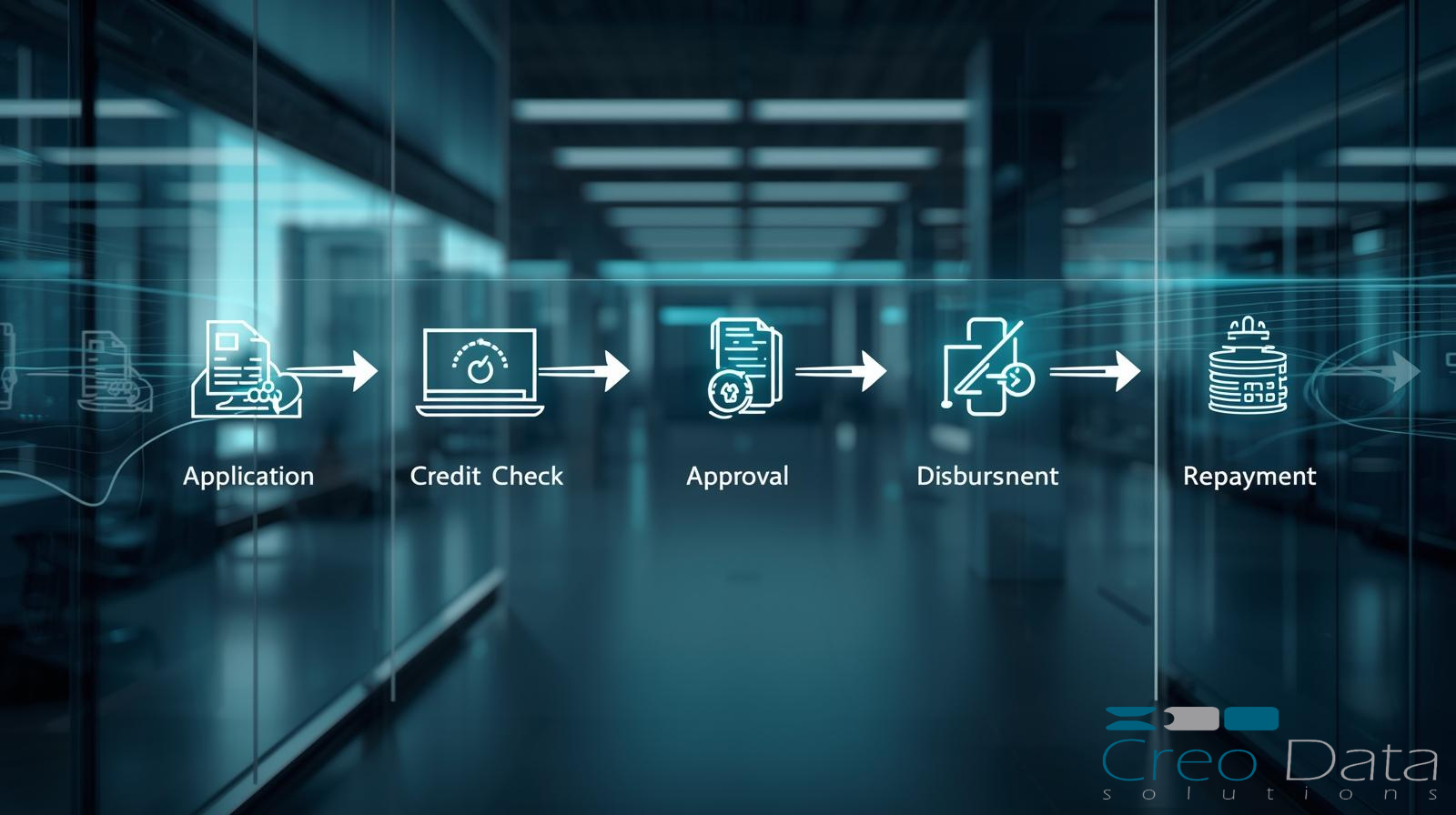
In today's fast-moving lending environment, speed and compliance are no longer optional—they are essential. Borrowers expect rapid decisions, while regulators demand full traceability. To drive both, credit workflows must transition seamlessly between stages such as credit check, approval and disbursement. By implementing event-driven transition logic within an integrated workflow system, lenders can turn what was once a series of manual hand-offs into a coordinated, automated process.
In this article we explore how event-based workflow transition capabilities enable seamless credit workflow transitions, how they map to the lending lifecycle, and how an end-to-end platform such as the solution from Creodata Solutions Ltd—their "Loan Management System" for financial institutions—provides the foundation. We'll cover the advantages of this approach and the target audience for whom it is most relevant.
Why Workflow Transition Events Matter in Lending
The Challenge in Traditional Credit Workflows
In many lending operations (banks, SACCOs, microfinance), the lifecycle of a loan moves through discrete stages:
Application → Credit Check → Approval → Disbursement → Servicing/Repayment
Each stage often involves manual triggers: a staff member receives a task, reviews information, then passes it on. This creates delays, risk of human error, poor transparency and inconsistent customer experience.
What Are "Workflow Transition Events"?
In simple terms, a workflow transition event is a system trigger—often defined in a workflow engine—that says:
"When event X happens (e.g., credit check completed), automatically transition the workflow to stage Y (e.g., approval review), send notification Z, and execute action A (e.g., allocate funds)."
A messaging or integration layer handles the event propagation so that disparate systems (credit bureau, underwriting engine, core banking, payment gateway) can coordinate.
How Event-Driven Transitions Transform Credit Workflows
Instead of manual signaling, the system watches for significant events (credit check result returned, manager approved, funding account set up) and then:
- Automatically advances the applicant to the next stage
- Raises internal or external notifications (e.g., SMS to the borrower, task to underwriter)
- Triggers backend systems (e.g., ledger setup, disbursement account funding)
- Logs the transition for audit/reporting
This significantly reduces latency, improves consistency, enhances transparency, and enables scalable lending operations.
Mapping the Credit Workflow Using Transition Events
1. Application Submission
The borrower fills in an application (web portal, branch, mobile). As soon as the form is submitted the system triggers an ApplicationReceived event. That event might:
- Initiate KYC check in a 3rd-party service
- Notify a credit officer that a new application awaits assignment
- Create the applicant record in the LMS
2. Credit Check Stage
Once applicant data arrives, the system sends a request to a credit bureau or credit scoring engine. When the scoring engine returns a result, it fires a CreditCheckCompleted event (including result: pass/fail, score). That event triggers two paths:
- If pass and score above threshold: automatically route to Approval stage
- If fail / questionable: route to manual review, send notification to underwriter
3. Underwriting / Approval Decision
Underwriter (or credit committee) receives the task. When they complete the decision (approve, reject, conditionally approve), an event like ApprovalDecisionMade is raised. Depending on the outcome:
- Approved: trigger
ReadyForDisbursementevent → next stage - Rejected: trigger
ApplicationRejectedevent → inform applicant, end workflow - Conditional: trigger
ApprovalConditionsSet→ assign tasks for fulfilment
4. Disbursement Setup
Once approved and conditions met, a DisbursementTriggered event is raised. The system automatically:
- Sets up loan account in core banking / ledger
- Transfers funds via payment gateway or internal transfer
- Sends notification
FundsDisbursedto borrower - Marks the application as closed-originated and moves into servicing
5. Servicing & Monitoring
The loan now moves into post-disbursement lifecycle—repayments, delinquencies, collections. Events might include RepaymentReceived, DelinquencyDetected, LoanClosed, each triggering tasks, reports, dashboards, and notifications.
Why This Approach Matters
| Benefit | Description |
|---|---|
| Reduced manual hand-offs | Each stage transition is automatic once criteria are met |
| Faster time-to-funding | Events drive transitions with minimal delay |
| Better visibility | Each event is logged and exposed to dashboards & audit trail |
| Scalable operations | Workflows run the same way, regardless of loan volume |
| Improved customer experience | Applicants are informed faster, fewer delays |
How Creodata's Loan Management System Supports This
Creodata Loan Management System (offered by Creodata Solutions Ltd) is a cloud-based solution built on Azure that targets small banks, SACCOs and microfinance institutions. Below is how it aligns with workflow transition events and seamless credit workflow transitions.
End-to-End Loan Lifecycle
The system covers application, approval, disbursement, repayment and delinquency workflows all in one platform. That means the transitions between those stages are handled in a unified environment—which is ideal for implementing transition-event logic.
Customizable Workflows
The product emphasizes customizable workflows for approvals, interest calculation, fee definitions and product setup. Custom workflows mean lenders can define the event triggers and transition logic suiting their business model.
Integration Capabilities
Creodata highlights seamless integrations with payment gateways, core banking, CRM and other systems. Integration is a key enabler for event-driven transitions (e.g., credit bureau returns, payment gateway completes disbursement).
Cloud-Native, Scalable & Secure
Built on Azure with bank-grade security and 99.9% uptime, the platform is designed to support production scale and dependable operations. That ensures the infrastructure can support real-time event handling and workflow transitions.
Real-Time Reporting
The product provides real-time reporting and dashboards, which helps track the transition events and monitor workflow health. This visibility supports audit and management oversight.
Summary: Creodata's LMS provides the foundational capabilities—integrated loan lifecycle, configurable workflows, integration readiness, and real-time visibility—making it well suited for implementing seamless credit workflow transitions via event-driven notifications and triggers.
Advantages of Seamless Credit Workflow Transitions
1. Reduced Processing Time
By automating transitions from credit check to approval to disbursement, the time between application and funding shrinks dramatically. Fewer manual hand-offs mean fewer delays.
2. Improved Customer Experience
Faster decisions, real-time status updates and fewer manual steps translate into a better experience for borrowers. That, in turn, increases competitiveness.
3. Enhanced Consistency & Control
Workflow rules ensure decisions and transitions are handled consistently according to policy (e.g., credit score thresholds, approval levels). Less variation means less risk.
4. Operational Efficiency
Staff spend less time chasing tasks, coordinating hand-offs or waiting for approvals. Automation frees them for higher-value work (e.g., portfolio monitoring, customer support).
5. Scalability
As loan volumes grow, the automated event-driven transitions scale more easily than manual processes. You don't need to proportionally increase staff.
6. Auditability & Transparency
Because every transition is logged as an event with metadata, the system supports full traceability—ideal for regulatory compliance and internal audit.
7. Better Decision-Making & Insights
Consistent data from workflow transitions gives managers and analytics teams improved visibility: where bottlenecks occur, how long each stage takes, and where policy tweaks may help.
8. Reduced Risk of Error or Omission
Automation helps avoid missed steps, approvals overlooked, or manual delays. That reduces operational risk, compliance risk and reputation risk.
Target Audience
The seamless credit workflow transitions capability is especially valuable for the following types of institutions:
- Small and mid-sized banks which wish to modernize their lending operations, reduce time-to-funding and compete with larger players.
- SACCOs and credit unions with moderate loan volumes but a desire for more automation and fewer manual bottlenecks.
- Microfinance institutions seeking to scale and wanting to automate credit workflows while maintaining responsiveness to borrowers.
- FinTech and digital lenders who require high automation, minimal manual intervention and fast transitions from application to disbursement.
- Multi-product lenders operating consumer, SME, and micro-enterprise loan products needing configurable workflows and transition logic.
- Microsoft Azure-aligned institutions seeking synergy with Creodata's cloud-native platform.
Conclusion
In the competitive and regulated world of lending, efficiency and control are mission-critical. By deploying event-driven workflow transition logic, lenders can ensure that each credit stage—from application, through credit check, to approval and disbursement—flows automatically, consistently and rapidly. The result is faster time-to-funding, improved borrower experience, reduced operational burden and stronger compliance.
The Creodata Loan Management System offers the ideal platform for this transformation: supporting end-to-end processes, configurable workflows, integrations and real-time reporting. For banks, SACCOs, microfinance institutions and digital lenders seeking to modernize, scale and accelerate their credit operations, this capability of Seamless Credit Workflow Transitions is a game-changer.
For more information, visit Creodata.com