
Querying and Filtering Mail Records via API
Learn how metadata indexing and API-driven filters make it easy to search, extract, and act on archived email at scale for compliance, audits, and e-discovery.
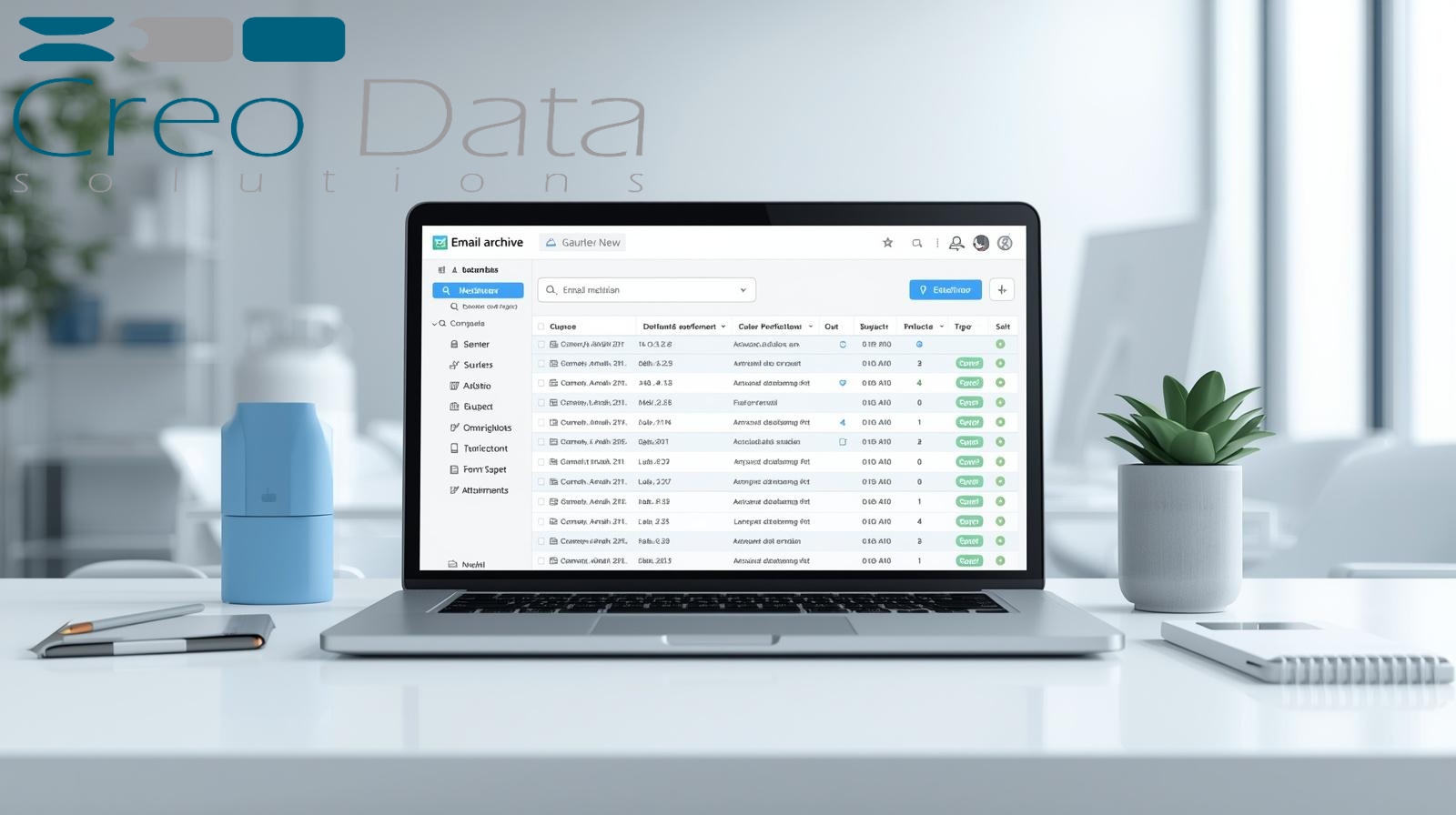
Mail Journaling → Metadata Management
Introduction
In today's data-driven world, organizations generate and receive enormous volumes of email traffic daily. For many — especially in regulated industries, legal sectors, or large enterprises — it is not enough to simply store emails. Teams need robust, reliable ways to search, filter, and extract specific mail data rapidly and accurately for analytics, compliance, monitoring, or e-discovery. This is where metadata management — surfaced via API — becomes a game-changer.
With Creodata Mail Journaling, captured emails are not only archived, but also indexed and exposed through APIs or advanced search mechanisms — enabling teams to query mail records based on metadata like sender, recipient, date, subject, attachments, and more.
What Is Mail Journaling & Metadata in This Context?
Before diving into querying and filtering, it helps to define key terms:
- Mail Journaling — the process of capturing copies of all inbound and outbound emails at the server/transport level, rather than at the individual mailbox level. This ensures a complete, tamper-proof archive of communications, suitable for compliance, legal discovery, or internal governance.
- Metadata — the structured data that describes various attributes of each email: headers (sender, recipient(s), CC/BCC, subject, timestamps), transport information, and additional contextual info (attachments, message identifiers, mail-flow tags, retention flags, etc.).
- Indexing & Searchability — rather than storing emails as opaque blobs, a journaling solution like Creodata's indexes both metadata and, optionally, full-text content, enabling efficient retrieval and filtering.
When properly implemented, journaling + metadata + indexing ensures that every message is archived in full (headers, body, attachments) and annotated with searchable metadata — foundational for any API-driven querying, filtering, or data extraction.
How Creodata Mail Journaling Supports This Use Case
1. Automatic Capture & Indexing
Once configured (via rules in Microsoft 365, using the journaling endpoint), the system performs indexing of archived emails — indexing metadata (headers, sender, recipient, timestamps, subject, etc.) and optionally the email content — enabling search and retrieval.
2. Secure, Compliant Storage
Emails are stored encrypted (in transit and at rest) within your Azure tenant, ensuring data sovereignty and compliance. The solution aligns with frameworks such as SOC 2, GDPR, and ISO 27001 — critical when dealing with sensitive communications.
3. Search & Retrieval Interface (and Potential API)
Creodata offers Advanced Search and Retrieval, enabling users to quickly locate archived emails with filters and full-text search. Because metadata is indexed and archived, an API layer can expose search/filter endpoints to allow programmatic querying, extraction, and automation — a typical architecture for metadata-based mail-archiving systems.
4. Scalability & Performance
The system is built on cloud-native architecture (Azure), designed to handle large volumes of messages — millions per day — while keeping search and retrieval performant. For organizations with heavy daily mail traffic, this scalability ensures that querying remains efficient even as archives grow over time.
5. Integration & Extensibility
Since the solution integrates deeply with Microsoft 365 and runs fully within Azure, it can be embedded into existing infrastructure without disrupting existing mail flows. Combined with metadata indexing and retrieval APIs, custom workflows — monitoring dashboards, compliance audits, legal e-discovery pipelines, automated alerts — can be built on top of the archived mail store.
Advantages of Metadata-Based Mail Querying & Filtering
| Advantage | Description |
|---|---|
| Fast & Precise Retrieval | Quickly pull exactly the subset needed — e.g. all emails from a specific sender last quarter that contained attachments |
| Compliance & Legal Readiness | Produce required communications promptly during audits or legal discovery, with full fidelity |
| Operational Efficiency | Automated querying reduces manual effort for longitudinal analysis, internal investigations, or e-discovery |
| Data Analytics & Monitoring | Treat archived mail as a dataset — analyze patterns, track behavior, detect anomalies, and generate reports |
| Scalable Search at Scale | Cloud-native design and indexing keep even very large archives queryable without performance degradation |
| Security & Governance | Encryption and compliance frameworks protect sensitive mail data while keeping it accessible for legitimate use |
Typical Target Audience — Who Benefits Most
Compliance and Legal Teams
Teams in regulated sectors (financial services, banking, healthcare, insurance, law firms) who require full audit trails, immutable archives, and the ability to quickly produce email evidence on demand.
IT Operations & Governance Teams
Teams responsible for ensuring business continuity, secure communications, and data governance — they benefit from automated capture and indexing without manual overhead.
Enterprises with High Email Volume
Large corporations, institutions, or organizations with many users, where manual archiving or ad-hoc retrieval becomes impractical at scale.
Public Sector / Government Agencies
Particularly where regulatory or legal retention requirements (e.g., for audits, transparency, or FOI requests) demand long-term, searchable archives with data sovereignty — especially relevant in regions like Africa.
E-Discovery, Audit & Investigation Teams
Risk management, internal investigations, or compliance monitoring teams that need flexible, automated access to historical communications.
Architects, Developers & DevOps Teams
Those who build custom workflows, dashboards, analytics tools, or integrations — such as exporting filtered mail records to BI tools, compliance dashboards, ticketing systems, or legal hold systems.
Conclusion
The "Querying and Filtering Mail Records via API" use case — under the broader umbrella of Metadata Management — represents a powerful, strategic approach to email archiving. Rather than simply retaining emails passively, it transforms them into a structured, searchable, and actionable data asset.
Creodata Mail Journaling exemplifies how this can be done right:
- Seamless integration with Microsoft 365
- Cloud-native scalability on Azure
- Encryption and compliance with SOC 2, GDPR, and ISO 27001
- Advanced indexing and search capability
For compliance officers, legal teams, IT operations, governance professionals, and large enterprises — especially in regulated sectors — the benefits are compelling: faster audits, reliable e-discovery, operational visibility, data governance, and long-term retention, all while keeping storage manageable and performance high.
In practice, metadata-based APIs unlock the full potential of email archives — enabling analytics, monitoring, compliance, and operational workflows that would be impractical or impossible with unstructured storage alone.
For more information, visit Creodata.com