
In-Panel Preview: Enabling Simple Legal Review in Journaling Systems
Discover how in-panel preview capabilities streamline legal review workflows by enabling users to view email content and metadata directly within the journaling system UI without external exports.
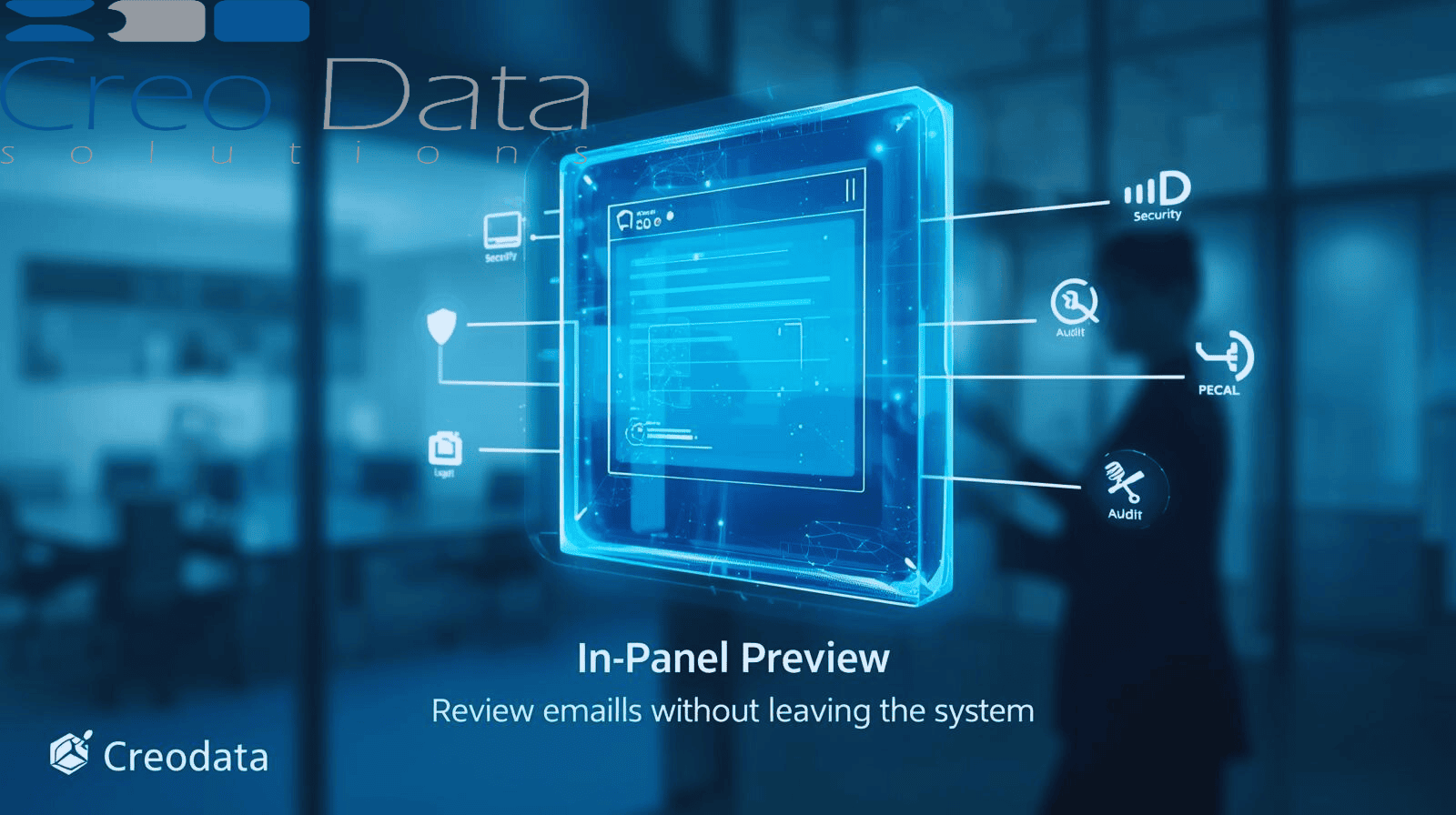
In regulated environments—such as finance, healthcare, legal, and government—email journaling is a critical requirement. An effective mail journaling solution must not only capture every email (including metadata and attachments) but also allow users to review and retrieve those messages efficiently. One feature that greatly improves usability is In-Panel Preview: the ability to view the email body and metadata directly within the journaling or compliance UI without forcing an export or external viewer launch.
The Use Case: Simple Legal Review via In-Panel Preview
The core need addressed here is for compliance, legal, or audit personnel to quickly inspect a journaled email—its content and metadata (sender, recipients, timestamp, subject, message-id, headers, attachments etc.)—directly within the journaling system's UI, without having to export the item (e.g. into a .eml or .msg file) then open it externally.
In many legacy or less sophisticated systems, to see contents, a user might have to export an email record to a local client, download attachments to disk, or invoke a separate viewer. This introduces friction, security risk, performance overhead, context switching, and often delays. In contrast, an In-Panel Preview (sometimes called inline preview, embedded preview, or read pane) presents the full or safe rendition of the email (HTML/plain text) and metadata on the same page or modal, streamlining review.
The legal reviewer can then do things like:
- Read or search the body text,
- Inspect headers and metadata,
- View (and possibly download) attachments,
- Flag or annotate,
- Forward, redact, or export only if needed,
- Link directly to related journal entries or threads.
Thus, the user can perform legal or compliance review tasks faster, with fewer steps, and less risk of mis-exporting or losing context.
Advantages of In-Panel Preview for Simple Legal Review
Implementing an In-Panel Preview feature brings numerous benefits across usability, governance, efficiency, and security:
1. Faster Review & Reduced Friction
The most obvious benefit is speed. Reviewers don't need to export, download, open external clients, or switch contexts. They stay within the journaling portal, which speeds up legal review cycles.
2. Better User Experience & Productivity
By removing extra steps, users can focus on substance rather than tool complexity. The UI is streamlined, intuitive, and delivers relevant content at a glance.
3. Improved Security & Control
Because the preview is generated server-side and sandboxed client-side, the system can enforce content sanitization, safe rendering, and role-based restrictions. The risk of opening a malicious file externally is minimized.
4. Consistent Audit Trail
When users preview inside the system, every access is logged—who viewed, when, and what. This aligns with compliance and internal audit requirements. Additionally, if an export is later done, that action too is logged.
5. Reduced Export Overhead & Data Leakage Risk
Since only authorized exports (when necessary) are allowed, the system limits the surface area for data leakage or accidental sharing of sensitive content. Many cases don't require full export—mere review suffices.
6. Context Retention & Threading Insight
By previewing inline, reviewers can better understand the context of the conversation, navigate threads, and follow replies without leaving the panel.
7. Efficiency Gains & Cost Savings
Over time, the reduced time per review translates to lower cost and higher throughput—particularly in litigation, e-discovery, compliance audits, or internal investigations.
Target Audience: Who Needs In-Panel Preview in a Journaling System?
The In-Panel Preview feature is especially beneficial to organizations with regulatory, compliance, legal, or governance obligations over email communications. Some of the key audiences include:
1. Legal & Litigation Teams
In e-discovery or legal holds, ability to quickly review emails in a system without needing to export is invaluable.
2. Compliance Officers / Audit Teams
During regulatory audits or investigations, they need fast visibility into email communications, metadata, and attachments while maintaining chain-of-custody and controls.
3. Data Privacy & Governance Teams
For subject access requests, data redaction, and privacy reviews, a preview interface reduces the burden of full exports.
4. Security Operations / Incident Response
When investigating an incident, security teams may need to inspect journaled emails for forensic purposes, and overview via inline preview is faster than mass exporting.
5. IT / Email Admins / Archivists
They may need to support or troubleshoot journaled email processing and ensure compliance. A preview facility helps them validate intact capture without needing to reconstruct files externally.
6. Organizations in Highly Regulated Industries
Banks, insurance companies, healthcare providers, law firms, government agencies—all of them benefit from embedded review tools in their journaling or archiving platforms.
7. Enterprises with Large Email Volumes & Dispersed Teams
Where scaling external export-based review becomes impractical, inline preview offers more scalable and centralized management.
How This Aligns with Creodata's Mail Journaling Offering
Creodata's Mail Journaling SaaS is designed to capture and archive emails across Microsoft 365 environments with enterprise-grade security, compliance, and ease of deployment. Their architecture appears to emphasize seamless capture, indexing, search, and retrieval.
While the publicly described features do not explicitly mention an "In-Panel Preview" capability, such a feature would logically complement their offering. A journaling solution that provides audit-grade storage and search but forces users to export for viewing would introduce friction and counter some of the usability gains their platform aims to deliver.
Thus, we can infer how such a feature might fit into their solution:
- Creodata could incorporate an in-panel preview within its journal viewer UI, allowing compliance or legal users to open an email record directly from search results.
- The system would present metadata in a header pane, content in a sanitized view, attachments in a sub-section, and support redaction or annotation workflows.
- Because Creodata emphasizes security, compliance (e.g. SOC 2, GDPR) and deep Microsoft 365 integration, embedding preview with proper access control and audit trails would be consistent with their value proposition.
- Users of Creodata's journaling interface would thus enjoy a more responsive, integrated review experience, reducing reliance on external exports.
Hence, while Creodata doesn't explicitly advertise this feature in the publicly accessible product page, In-Panel Preview is a plausible and beneficial enhancement that fits naturally into their mail journaling platform.
Conclusion
The In-Panel Preview feature under the Journal Viewer UI / Email Preview class is a powerful enabler of Simple Legal Review: allowing users to view email body and metadata seamlessly, without exporting. This capability dramatically streamlines compliance, audit, legal, and governance workflows by removing friction, improving security, and strengthening auditability.
For a mail journaling platform like Creodata's, embedding such a preview function would enhance user experience and align with the core goals of fast retrieval, compliance, and secure archival. The advantages—from speed, security, and cost savings to contextual insight and control—make In-Panel Preview a strategic feature for administrative and regulated environments.
For more information, visit Creodata.com