
Seamless Coverage: Hybrid/Cloud Support for Microsoft 365 Integration
How Creodata's hybrid/cloud journaling support delivers seamless coverage across on-premises Exchange and Microsoft 365 environments for compliance-ready email governance.
Introduction
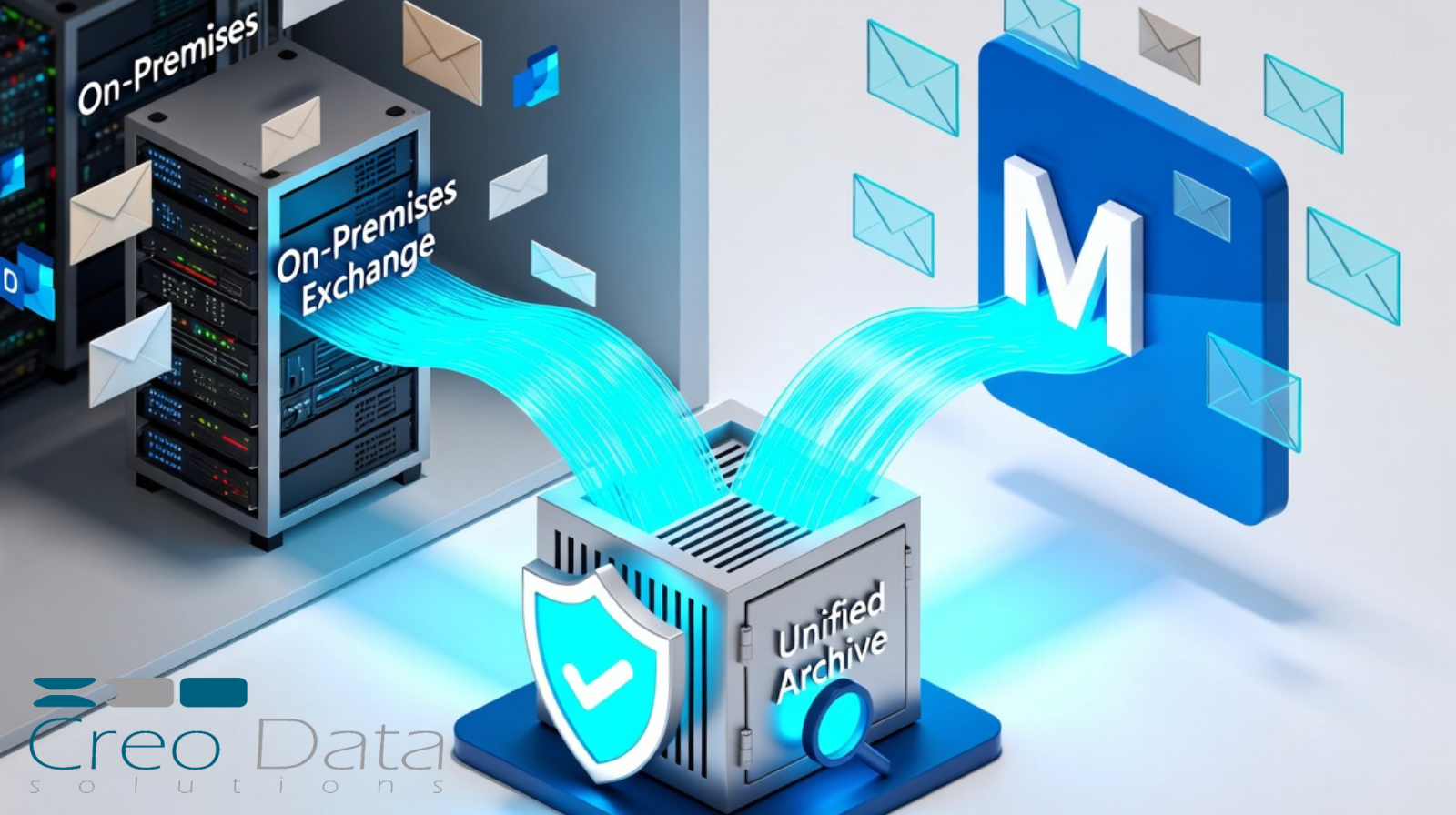
In today's enterprise IT landscape, many organizations are operating in hybrid environments—combining legacy on-premises infrastructure with cloud-first services such as Microsoft 365. This dual-mode deployment poses unique challenges for email governance, compliance, legal discovery and operational continuity. In this article we explore the integration category "Microsoft 365 Integration," focus on the Hybrid/Cloud Support feature, and examine the use-case titled "Seamless Coverage", specifically applying to the scenario of journaling emails both on-premises and in the cloud.
Feature Focus: Hybrid/Cloud Support in Microsoft 365 Integration
Under the category of Microsoft 365 Integration, the feature "Hybrid/Cloud Support" refers to the capability of a system to work seamlessly regardless of where mailboxes reside—whether on-premises, cloud, or a mixture. Key aspects include:
- Unified journaling rules: Ability to configure journaling rules that apply to on-premises mailboxes and Exchange Online mailboxes with consistent policy.
- Comprehensive capture: Unified capture of emails regardless of flow origin (internal-internal, internal-external, external-internal).
- Centralized storage: Journaled messages stored in a secure, scalable platform (often in the cloud).
- Cross-archive search: Search and retrieval across both archives, regardless of where the original mailbox lived.
- Minimal disruption: Minimal disruption to existing mail flows, minimal administrative duplication.
- Compliance-ready architecture: Encryption, audit trails, retention policies, e-discovery support.
- Rapid deployment: Cloud-native services with compatibility for legacy on-premises infrastructure.
By leveraging hybrid/cloud support, organizations can move toward a unified governance posture while still maintaining legacy systems or phased migration strategies.
Use Case: Seamless Coverage — Journaling Both On-Premises and Cloud Mail
Scenario Overview
Consider an organization that has several legacy business units using on-premises Exchange servers, while other departments are already migrated to Microsoft 365. The compliance team must ensure every email—whether from on-premises mailboxes or cloud mailboxes—is journaled consistently, stored for long-term retention, searchable and available for legal/operational purposes.
Requirements for Seamless Coverage
-
Unified journaling rules: Must apply uniformly to on-premises and cloud mailboxes, without gaps.
-
Hybrid compatibility: The solution must support connectivity from both on-premises Exchange and Microsoft 365 (Exchange Online) journaling endpoints. For example, according to Microsoft, in a hybrid deployment you must configure journaling rules in both environments.
-
Single archive location: Rather than maintaining separate archives for on-premises and cloud, the ideal solution consolidates captured emails into a central archive—reducing complexity and improving search/management.
-
Scalable, secure infrastructure: As email volumes grow and retention periods extend (e.g., 7, 10, 20 years), the archive must scale and maintain compliance-grade security (encryption, audit logs, immutable storage).
-
Search, e-discovery, retention policy enforcement: The ability to quickly locate emails across the archive, enforce retention/deletion policies, support legal holds, and maintain chain-of-custody.
-
Rapid deployment & minimal disruption: Ideally, the journaling solution should integrate with existing mail flows (on-premises and cloud), require minimal changes and avoid complex configuration.
How Creodata's Mail Journaling SaaS Addresses the Use-Case
The offering from Creodata presents a compelling solution for this "Seamless Coverage" scenario:
-
Hybrid environment support: The product is explicitly designed to work with both cloud-only Microsoft 365 environments and hybrid configurations that include on-premises Exchange servers.
-
Azure-hosted infrastructure: Hosted on Microsoft Azure, giving the organization enterprise-grade reliability, global scalability and centralized control.
-
Streamlined deployment: Deployment via the Azure Marketplace with "5-minute setup" capability.
-
Comprehensive features: Real-time email capture (inbound/outbound/internal), advanced search and retrieval (with full-text indexing), flexible retention policies, and secure encryption in transit and at rest.
-
Compliance credentials: SOC 2, GDPR, ISO 27001 certifications clearly described.
-
Hybrid FAQ confirmation: The FAQ explicitly addresses hybrid support: "Yes, our Mail Journaling SaaS is designed to work with both cloud-only Microsoft 365 environments and hybrid configurations that include on-premises Exchange servers."
Thus, for the use-case of journaling both on-premises and cloud mail with "Seamless Coverage", this product provides: hybrid support, unified archive, compliance readiness, and rapid deployment.
Advantages
Here are the key advantages of adopting a hybrid/cloud journaling solution like Creodata's in a Microsoft 365 integration context:
1. Comprehensive Coverage Across Environments
With hybrid/cloud support, you ensure no emails are missed due to mailbox location or flow path. Whether a user's mailbox is still on-premises or already in Microsoft 365, the journaling remains consistent.
2. Centralized Archive, Reduced Complexity
One platform for all journaled emails means simpler governance, easier search, simpler administration and fewer silos.
3. Compliance Confidence
Because journaled emails are captured automatically, encrypted, indexed and stored with audit trails, you strengthen your ability to meet regulatory and legal requirements (e.g., GDPR, SEC, HIPAA). Creodata's SOC 2/GDPR/ISO 27001 credentials bolster that trust.
4. Scalability and Global Reliability
Hosted on Microsoft Azure, the solution is capable of handling large volumes of messages, global deployments, and long-term retention without requiring internal on-premises archiving servers.
5. Fast Deployment and Minimal Disruption
Because you can launch via Azure Marketplace and use guided journaling rule configuration, organizations can stand up the solution quickly with minimal changes to existing mail flow.
6. Enhanced Search and E-Discovery
With real-time capture and full-text indexing, retrieving emails for audits, litigation or operational investigations becomes far easier and faster than manual retrieval from legacy tapes or distributed archives.
7. Flexible Retention Policies and Governance
Different departments or message types can have distinct retention lengths or deletion rules; legal holds can be applied seamlessly across mail sources.
8. Reduced Operational Burden
By shifting archiving infrastructure into the cloud, the IT team has less hardware/maintenance, fewer patching concerns, and fewer complex backup/restore processes.
9. Hybrid Preparedness and Migration-Friendly
For organizations migrating from on-premises to cloud, having a journaling solution that supports both environments ensures the migration doesn't compromise compliance. The hybrid support ensures continuity.
10. Legal Chain-of-Custody and Audit Readiness
Because captured emails are handled with encryption, indexing, immutable storage and audit logs, organizations are better prepared for e-discovery or regulatory investigation.
Target Audience
The target audience for this solution—both for the general feature set and specifically for the "Seamless Coverage" use case—includes:
-
Compliance Teams: Organizations subject to regulatory regimes (financial services, healthcare, legal services, energy/utilities, government) that must reliably capture and retain all email communications and produce them on demand.
-
Legal Departments & E-Discovery Teams: Entities that regularly respond to litigation, investigations or audits and need rapid, searchable access to journaled communications.
-
IT & Operations Teams: Those responsible for guaranteeing business continuity, governance of mail systems (on-premises + cloud) and reducing operational risk while enabling modern cloud services.
-
Organizations in Hybrid Transition: Enterprises migrating from on-premises Exchange to Microsoft 365, or maintaining a hybrid model for various business units, that need consistent journaling across both environments.
-
Large-Scale Enterprises and Global Organizations: With high message volumes, long retention periods, multiple geographies, disparate mail systems and complex governance requirements.
-
SMBs with Compliance Needs but Limited Infrastructure: Smaller organizations that may not want to build their own archiving infrastructure and prefer a cloud-native journaling solution with hybrid support.
-
IT Service Providers and MSPs: Those offering compliance or archiving services to clients; a solution with hybrid support and cloud scalability is a compelling offer.
Summary
As organizations continue to operate in hybrid email environments—mixing on-premises Exchange and Microsoft 365 cloud mailboxes—the need for a journaling solution that offers Seamless Coverage across both worlds becomes critically important. Under the Microsoft 365 Integration category, the feature of Hybrid/Cloud Support enables this by allowing unified, reliable journaling regardless of mailbox location.
The product offered by Creodata (Mail Journaling SaaS) clearly aligns with this requirement: supporting hybrid configurations, deployed via Azure, compliant with key standards, and designed for rapid setup. The advantages—comprehensive coverage, centralized archive, scalability, compliance readiness, reduced operational burden—make it a strong fit.
For more information, visit Creodata.com