
Hybrid Access Management for On-Prem Environments
Learn how organizations can unify access management across on-premises Active Directory and cloud identity systems, enabling seamless RBAC and consistent policy enforcement.
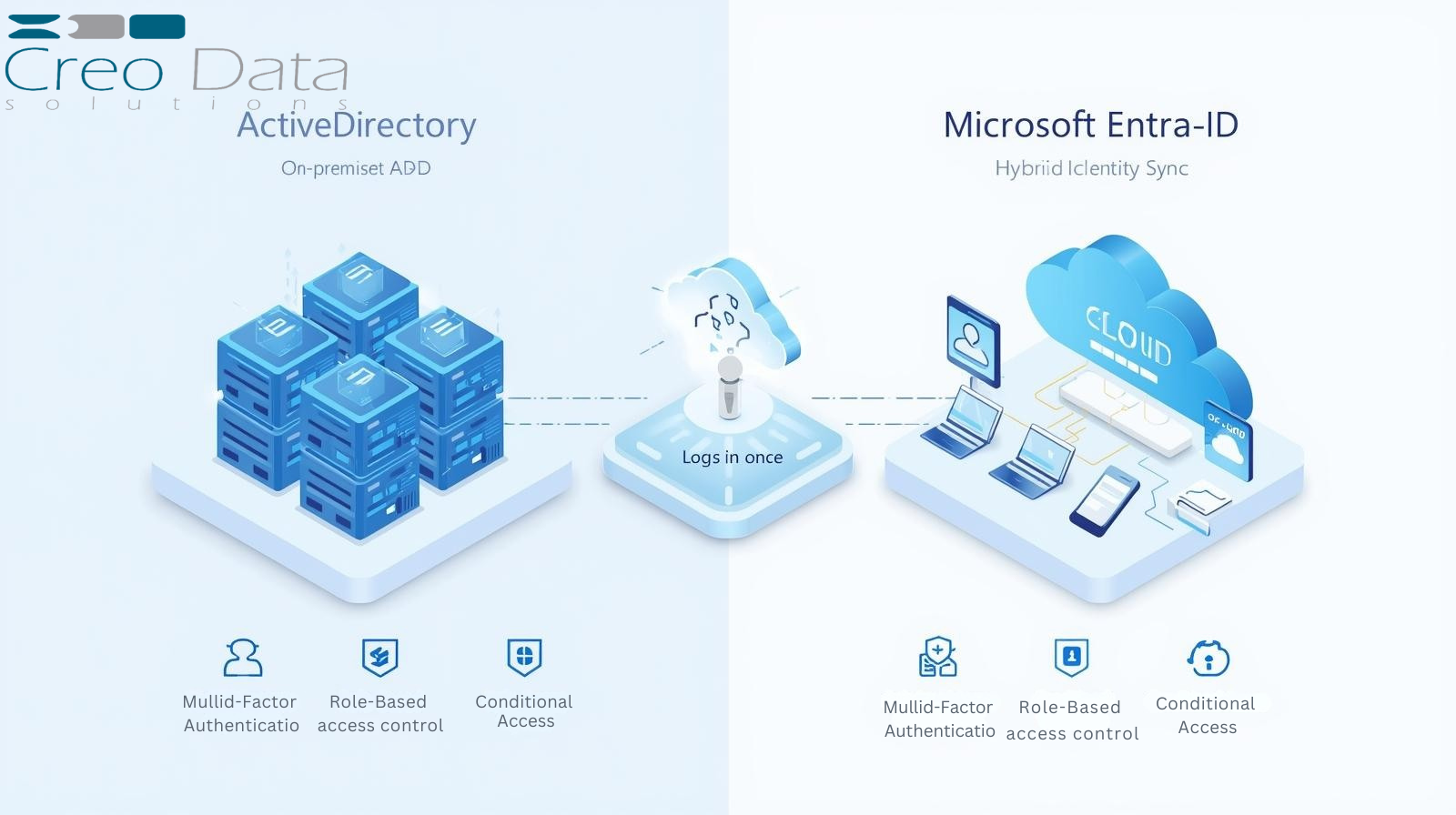
Introduction
In today's enterprise IT landscape, many organizations find themselves operating in hybrid mode: part legacy on-premises infrastructure (such as Active Directory Domain Services (AD DS) on Windows Server) and part cloud-based identity and application platforms (such as Microsoft Entra ID, formerly Azure AD). While cloud-first identity approaches bring many advantages, the reality is that large enterprises, public organizations and industries with legacy systems cannot simply rip out AD overnight. They need a unified access management strategy that spans both on-prem and cloud, ensures consistency of authentication and authorization, supports Role-Based Access Control (RBAC), and avoids identity silos.
This article addresses the scenario of Hybrid Access Management for On-Prem Environments. It explains how organizations can support their on-premises AD while enabling unified access control, linking to cloud identity and RBAC systems. We discuss the business drivers, architectural patterns, key challenges, design considerations, benefits (advantages) and target audience. We also highlight how a vendor such as Creodata Solutions Ltd (with its offerings like Mail Journaling) highlights modern identity transformation—and though their product is focused on email journaling, their broader message of secure, compliant infrastructure transformation underscores the relevance of identity management.
Why Hybrid Access Management Matters
-
Legacy systems still exist. Many organizations have Windows domains, applications relying on AD authentication (Kerberos, NTLM), on-prem file shares, databases, VPNs, RDP gateways, etc. A complete cloud identity overhaul may be impractical due to cost, risk or regulatory constraints. As the Microsoft Cloud Adoption Framework notes: "Organizations that operate in the cloud require a directory service … You can use Microsoft Entra ID as a standalone identity solution, or integrate it with an AD DS infrastructure."
-
Unified user experience. Users expect to login once and access both on-prem and cloud resources. Multiple credentials cause password fatigue, increased help-desk tickets, security risks. Synchronization or federation eliminates silos. As one resource points out: "Active Directory synchronization aligns on-prem and cloud identities … support unified authentication, policy consistency and operational efficiency."
-
Consistent RBAC and policy enforcement. With identities fragmented across systems, enforcing roles and access policies becomes complex and error-prone. A hybrid model allows centralized RBAC and governance across domains.
-
Compliance, auditing and security. Hybrid identity environments retain the on-prem authoritative source while benefiting from cloud-based monitoring, conditional access, MFA and the broader security ecosystem.
-
Flexibility and phased migration. Hybrid access management enables incremental migration of workloads to cloud, consolidating identity over time without disrupting business operations.
Use Case – Hybrid Access Management for On-Prem Environments
In this use case, an organization has an existing on-premises AD environment that supports core business applications, legacy systems and domain-joined devices. They also have cloud-based SaaS applications (Microsoft 365, Azure PaaS, third-party cloud apps). The business wants to unify access management: single credentials, consistent RBAC policies, a unified access experience for users and consolidated administration.
Implementation Steps
- Assess the on-premises AD environment — identify domain structure, group membership, user account hygiene, UPN suffix alignment, legacy authentication dependencies.
- Choose a hybrid identity architecture — for example, install Microsoft Entra Connect to sync users and groups to Microsoft Entra ID, choose authentication method (password hash, pass-through, federation).
- Map on-prem RBAC roles to cloud roles/groups — define security groups in AD for roles such as "Finance: Read-Only", "HR: Approve Contracts", "IT-Admin: Helpdesk". Ensure cloud apps honor these group assignments.
- Ensure device identity is hybrid-aware — domain-joined devices enroll into Azure AD (hybrid-joined) so access policies (Conditional Access, MFA) apply both on-prem and cloud.
- Implement unified access policies — multi-factor authentication (MFA), conditional access (device compliance, location/X-ref), session monitoring should apply regardless of whether the resource is on-prem or in cloud.
- Ensure seamless user experience — users authenticate once (via AD credentials) and access both on-prem applications and cloud applications using the same identity and RBAC.
- Deploy monitoring and audit — collect logs from on-prem AD (sign-in events, group changes) and cloud directory; unify into a SIEM/monitoring solution for visibility of access across the hybrid estate.
- Handle migrations and de-provisioning — when users leave or role changes occur, their access should be revoked across both on-prem and cloud; ideally from one user-lifecycle system.
Advantages
By enabling on-premises AD support as part of a hybrid access management strategy, organizations gain the following advantages:
- Preserves investment — No need to rip out existing AD infrastructure. Leverage its identity store and processes, while extending access to cloud.
- Improved user experience — Single identity across on-prem and cloud reduces friction, simplifies sign-in, reduces credential fatigue.
- Centralized RBAC and governance — Role definitions and access rights are centrally managed instead of being split between multiple systems.
- Uniform security and policy enforcement — MFA, conditional access, device compliance and session monitoring can apply to both on-prem and cloud resources.
- Reduced administrative overhead — Unified provisioning, synchronization, de-provisioning means fewer separate access systems to manage.
- Better compliance and auditing — Unified visibility into access across heterogeneous environments helps to meet regulatory and internal governance requirements.
- Incremental migration path — Organizations can move workloads to cloud at their own pace while keeping the identity infrastructure consistent.
- Reduced security risk of identity silos — When identities are fragmented, orphaned accounts, inconsistent policies and elevated privileges often arise. A hybrid model mitigates that.
- Business continuity and flexibility — Hybrid access allows access to cloud apps even if some on-prem resources are offline (dependent on design), and supports remote/hybrid workforce scenarios.
Target Audience
This feature and use case are particularly relevant for:
- Enterprises operating large on-premises AD domains (often with legacy applications relying on AD authentication) and yet adopting cloud/SaaS apps.
- Organizations in regulated industries (financial services, healthcare, public sector) which cannot fully migrate identity to the cloud due to compliance, audit or legacy dependencies.
- IT and security professionals responsible for identity management, access governance, RBAC, and hybrid-cloud access strategies.
- CIOs/CTOs aiming to unify identity and access management across the enterprise, reduce help-desk load, improve user experience and strengthen security posture.
- Hybrid workforce environments where some resources remain on-premises (file shares, databases, on-prem portals) and others move to cloud, requiring seamless access.
- Organizations undertaking a phased migration to cloud identity and applications — this provides a manageable path rather than "big-bang" cut-over.
- Security teams needing a consolidated view of user access (on-prem and cloud) for audit, compliance and insider threat detection.
How This Relates to Creodata's Approach
While the focus of the product from Creodata Solutions (namely Mail Journaling SaaS) is on email archiving and compliance, their underlying messaging emphasizes secure, compliant and unified infrastructure solutions built on Microsoft Azure. Organizations that adopt such solutions often face the larger identity and access challenges described here — namely, how to link legacy on-premises systems (including identity) with modern cloud services, while maintaining access governance, compliance and unified control. The hybrid access management model described here represents one of the foundational pillars of that broader infrastructure transition.
In other words, when an organization is adopting cloud-based compliance/archiving (e.g., Mail Journaling on Azure) while still retaining on-premises systems (for email routing, legacy applications), they must also ensure their user management and RBAC spans both realms. A hybrid identity model underpins that.
Summary
Hybrid Access Management for On-Prem Environments is a strategic feature for organizations aiming to unify their user management and RBAC across both on-premises and cloud resources. By linking on-prem AD with cloud identity systems, organizations gain improved user experience, centralized governance, consistent policy enforcement, and a flexible path toward cloud adoption — all while preserving legacy investments and meeting compliance needs.
Whether you're responsible for the identity strategy, access governance, or IT architecture of a hybrid estate, this feature supports a robust, business-aligned approach: retain what works, modernize where necessary, and ensure your users and access controls operate seamlessly across both environments.
For more information, visit Creodata.com