
Handling Multiple Cards: Managing Reconciliation at Scale for Large Corporations
Discover how Creodata's Expense Management Automation helps large corporations manage reconciliation at scale when employees hold many physical and virtual corporate cards.
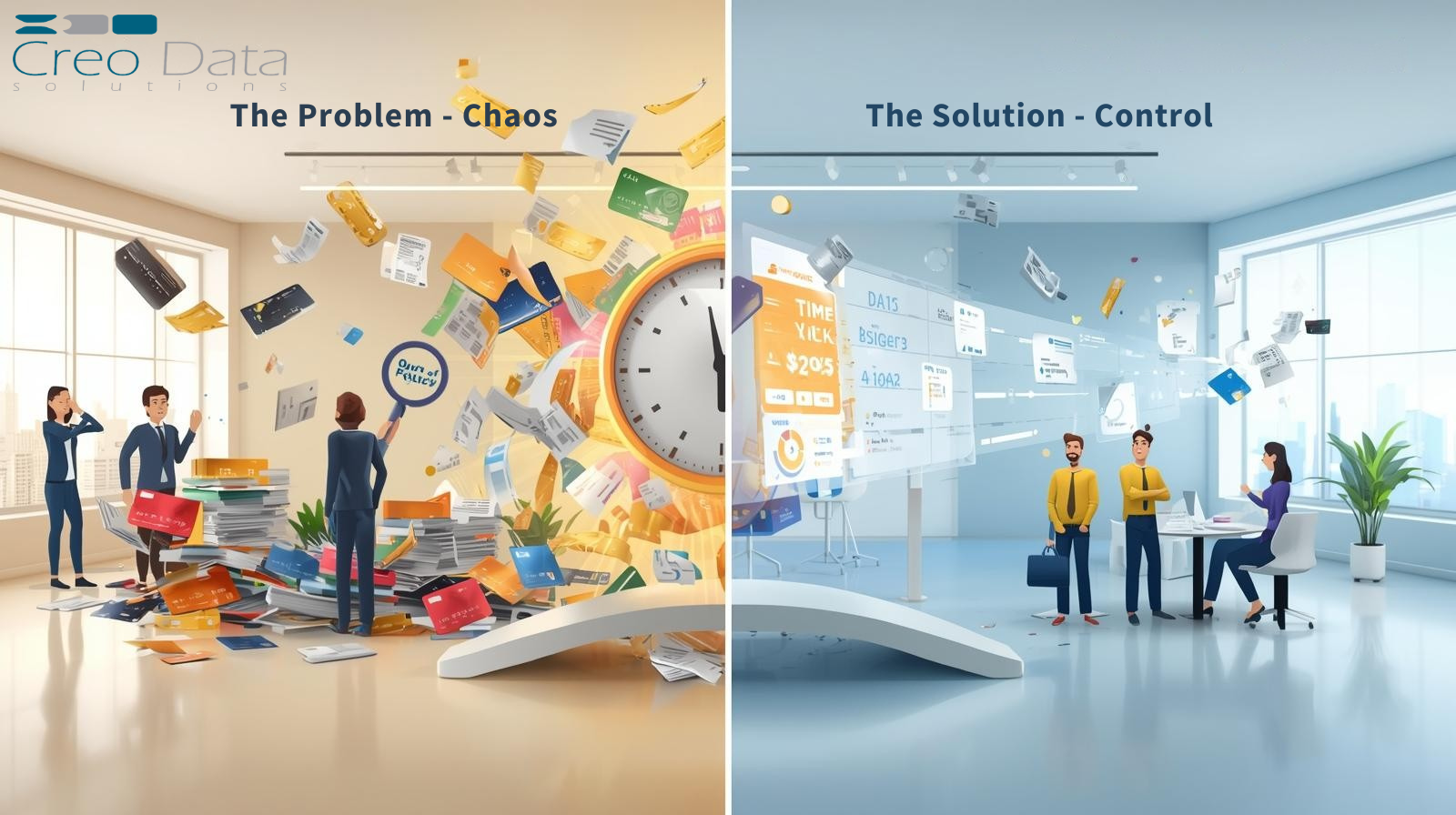
In the modern enterprise environment, large corporations often issue a plurality of payment cards — both physical and virtual — to employees across departments, geographies and business functions. The complexity this introduces to expense tracking and reconciliation can be immense. This article, titled "Handling Multiple Cards", explores how large organizations can scale their reconciliation processes effectively when employees hold many corporate cards. We focus on the scalability challenge and describe how a solution such as the one offered by Creodata Solutions Ltd (via their Expense Management Automation product) supports this use case. We also cover key advantages and identify the target audience within an enterprise.
The Use Case: Large Corporations & Multiple Corporate Cards
In large organizations, the number of issued corporate cards can grow rapidly: marketing teams might have cards for campaign spend; sales teams have cards for travel, entertainment, client hospitality; procurement may use virtual cards for online subscriptions; project teams may hold cards for site-costs, etc. Each card generates a stream of transactions, which must be captured, validated, matched to receipts, coded, approved and reconciled in the accounting system. When multiple cards per employee, across many employees, are in use, the challenge becomes scaling: how to keep control, maintain policy compliance, ensure timely reconciliation and avoid back-logs or errors.
The complexity is amplified when you add virtual cards (often single-use or limited-use), multi-currency transactions, global teams, multiple cost-centers and myriad card-issuers. The organization needs to ensure that:
- Every transaction is captured and linked to a card and employee/cost-center
- Receipts and supporting documentation are obtained and matched
- Corporate spend rules (limits, merchant restrictions, expense categories) are enforced
- Reconciliation is timely, accurate and auditable
- The system scales without exploding cost or headcount
This is precisely where scalability becomes the focus area: not just "can we handle 50 cards?" but "can we handle thousands of cards across geographies and still keep tight controls and efficient processes?"
How Creodata's Expense Management Automation Supports Scalability
Creodata's solution is built for enterprise-scale expense processing and reconciliation. According to their website, their product "simplifies and accelerates the process of capturing, validating, and posting expense data … powered by Azure Document Intelligence and seamlessly integrated with Microsoft Dynamics 365 Business Central."
Here's how it addresses the multiple-card, large-corporation scenario:
- Automatic data extraction and capture: The solution uses AI-powered data extraction of receipts, invoices and expense forms. This means that instead of manual entry of each card transaction and corresponding receipt, the system can pull out key fields. This helps when the card-transaction volume is high — a major factor in scalability.
- Integration with ERP/accounting: Creodata's solution supports seamless posting into Microsoft Dynamics 365 Business Central, allowing transactions from multiple cards (and spend channels) to feed into the accounting system without manual rekeying. This reduces reconciliation effort and risk of error.
- Mobile and decentralized submission: Employees can capture receipts via mobile app or email forwarding, submit expenses quickly, improving timeliness of reconciliation. This supports dispersed card-holders (travel, remote teams, global workforce).
- Configurable approval workflows and policies: Large organizations need spend-control rules, multi-level approvals, cost-center / project coding. The solution allows setting categories, approval flows, custom settings. This is essential when many cards and many users are involved.
- Scalable cloud infrastructure: Built 100% on Azure, the platform is inherently scalable for large numbers of users and transactions.
- Visibility and real-time insights: With multiple cards issuing many transactions, finance teams benefit from real-time visibility into spend patterns and reconciliation status, enabling proactive control rather than reactive cleanup. While Creodata doesn't emphasize this in the excerpt, standard best practice emphasizes visibility as key.
In the context of "Handling Multiple Cards", these features combine to allow large corporations to scale their card-program operations while maintaining control, accuracy and efficiency.
Advantages of Scaling with the Right Expense Management Platform
Implementing a scalable solution for multiple-card reconciliation brings tangible advantages:
- Reduced manual effort and costs: Automation of receipt capture, transaction import, posting and approval reduces the manual burden on finance teams. For large volumes of card transactions this translates into significant savings.
- Improved accuracy and fewer errors: Manual data entry is error-prone. With 95%+ accuracy in data extraction (as Creodata's product claims) the reconciliation process becomes more reliable.
- Faster cycle times: Employees submit receipts faster, approving managers act quickly, posting to accounting happens sooner — this improves reimbursement times and financial close cycles.
- Greater control and policy enforcement: When many cards are in circulation, enforcing spend policies becomes harder; scalable platforms enable rule enforcement, automated routing of exceptions, and visibility into out-of-policy spend.
- Scalability without proportional headcount growth: Because the platform handles high transaction volumes via automation and cloud infrastructure, companies can grow card-programs without scaling up the reconciliation team significantly.
- Better visibility and spend intelligence: With many cards and many transactions, you gain richer data on spend patterns, cost-centers, geographies, projects. This allows strategic decision-making and cost optimization.
- Audit readiness and control: Especially important for large corporations, the expense-management platform can provide audit trails, integrated postings, and documentation — reducing risk in internal/external audits.
- Global and multi-card type support: For large corporations operating in multiple countries, with various card-types (virtual, physical, single-use), a scalable solution supports all card-types and geographies seamlessly.
These advantages align with what Creodata emphasizes in its solution: AI-powered automation, cloud scale, seamless integration with Microsoft 365/Business Central, and rapid deployment.
Target Audience
Who in the organization should be thinking about "Handling Multiple Cards" at scale, and who benefits from a solution like Creodata's? The primary audiences include:
- Finance/Corporate Accounting Teams: Responsible for expense reconciliation, posting to the general ledger, ensuring accurate financial data, closing the books, month-end processes. They will directly benefit by reduced manual work, faster cycle times and better accuracy.
- Treasury/Payments Teams: Often manage the corporate-card program (issuer relationships, card issuance, virtual card program). They are concerned with spend control, card utilization, fraud risk and cost-management.
- Procurement and Corporate Card Program Managers: Responsible for designing card programs (virtual vs physical, user categories, spending policies), managing card issuance and ensuring the program scales efficiently.
- IT and Systems Integration Teams: Especially when large corporations deploy solutions integrated with ERP/Finance systems, IT is responsible for implementation, integration (e.g., Microsoft Dynamics or other systems), security and scalability. Creodata's cloud-native, Azure-based architecture will appeal to them.
- Internal Audit & Compliance Teams: Because many cards and transactions raise compliance and audit risk, these teams require visibility, audit trails, policy enforcement and documentation.
- Business Unit or Line-Manager Stakeholders: While not direct users of the finance system, they are card-holders, approvers, project leads. Their experience (ease of submitting receipts, fast approvals, clarity of policy) influences adoption and compliance.
- C-Suite/CFO/Head of Finance: From a strategic standpoint, the CFO or head of finance is interested in cost-control, risk-mitigation, scalable finance operations and spending insights. Efficient card reconciliation is part of that broader agenda.
Given the scale and complexity of card-programs in large corporations, it's critical that all these stakeholders are aligned and supported by a system designed for high volume, many user-cards, global operations and tight integration.
Conclusion
In large corporations where employees hold many corporate cards — physical and virtual — the challenge of reconciliation at scale is very real. The use case "Handling Multiple Cards" emphasizes scalability as the key focus: how to manage multiple cards across many users, geographies and business units, while maintaining control, accuracy and cost-efficiency.
The solution from Creodata (Expense Management Automation) aligns strongly with this challenge: AI-powered data extraction, mobile submission, policy workflows, ERP integration, cloud-scale infrastructure — all designed to help finance, treasury, procurement and compliance teams handle large card-programs effectively.
The advantages of implementing such a scalable solution include reduced manual effort, improved accuracy, faster processing, better compliance, and strategic visibility into spend. The target audience spans finance and accounting teams, card program managers, IT/integration teams, audit/compliance, business unit stakeholders and the C-suite.
For more information, visit Creodata.com