Security & Compliance: Encryption & Sovereignty
Explore how encryption and data sovereignty in Creodata's mail journaling solution protect sensitive data inside tenant environments while meeting global regulatory requirements.
Introduction
In today's digital world, organizations are under increasing pressure to protect sensitive data — both from external attackers and from inadvertent exposure due to internal misconfiguration or weak governance. Among the many tools in the security and compliance toolkit, encryption and data sovereignty play a central role in locking down data in a way that meets regulatory requirements and builds trust. In the context of a SaaS or cloud-based offering, enabling secure storage of data in a tenant environment means ensuring that the data is encrypted, never leaves its intended jurisdiction, and remains under the control of the subscriber rather than the service provider.
Secure Storage Use Case: Protect Sensitive Data in Tenant
Here's how the use case plays out in practice:
- A customer (e.g. a company) subscribes to a SaaS service (such as Creodata's mail journaling).
- The tenant is logically isolated for that customer.
- Sensitive data (e.g. archived emails, attachments, metadata) must be stored securely within that tenant.
- The service ensures that all data is encrypted in transit and at rest.
- The data also never leaves the physical boundaries of the permitted jurisdiction (country or region).
- The service may provide key management options (customer-managed keys, region-locked keys) so the customer retains control.
- For auditing, the service records metadata: who accessed what, when, and from where — all under strict security.
- The result: the customer has confidence that their sensitive data is both protected and compliant with local laws.
Creodata's Mail Journaling & Its Encryption & Sovereignty Features
Creodata offers a Mail Journaling Solution (for Microsoft 365 / Exchange environments) that captures, archives, and lets you retrieve critical emails.
In their marketing materials, Creodata emphasizes key security and sovereignty features:
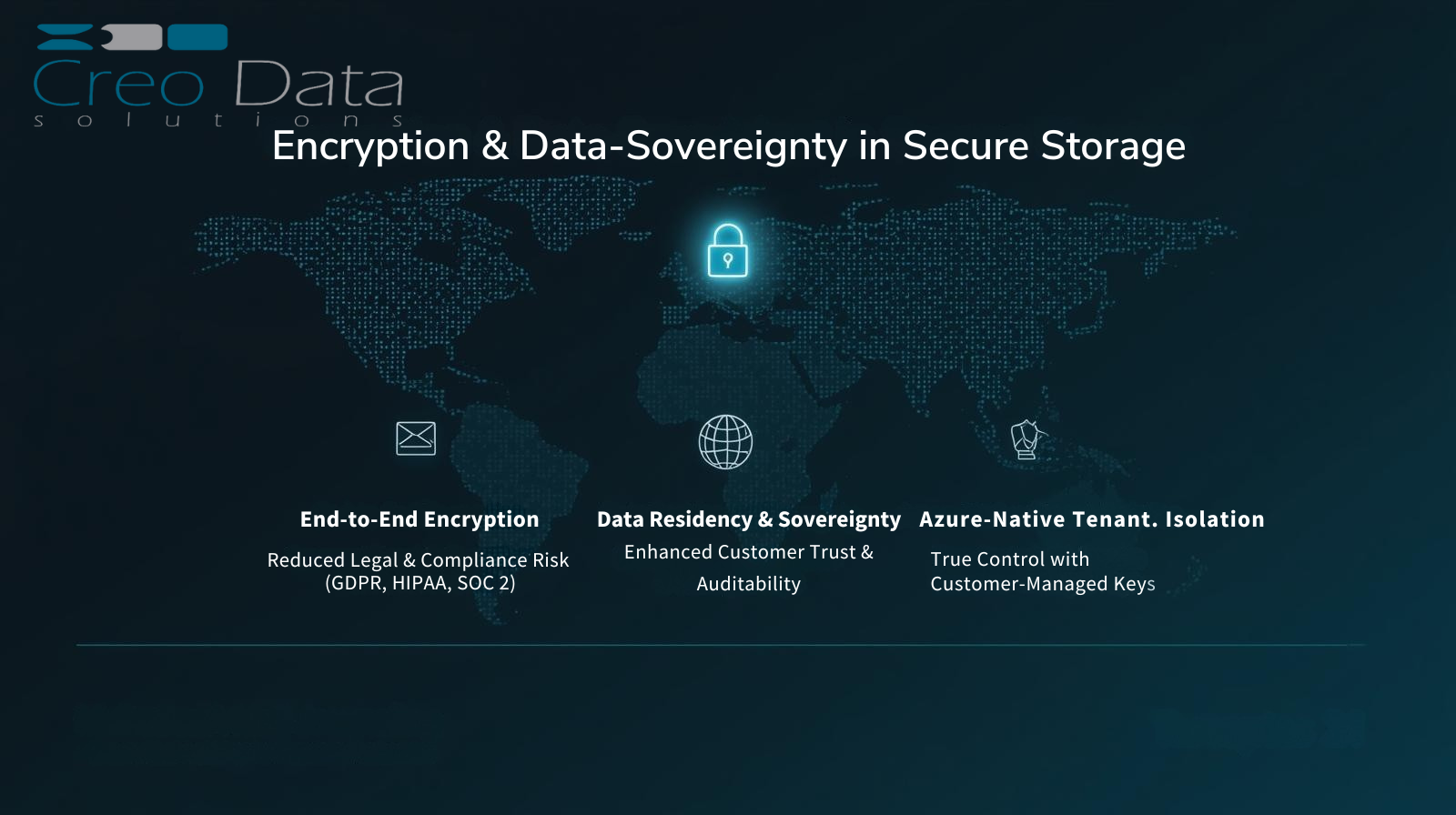
- End-to-end encryption: The data is encrypted both during transfer and at storage.
- Data sovereignty: The archived data does not leave the secure Azure tenant, giving customers full control over location and jurisdiction.
- Compliance-ready: The solution is built with regulatory frameworks in mind (GDPR, SOC 2, HIPAA, etc.).
- Azure infrastructure / Microsoft partner: Creodata leverages Azure's secure infrastructure and their partner certifications as part of the trust model.
Thus, Creodata's Mail Journaling is a good real-world example of how encryption + sovereignty is embedded in a secure storage context. In that product, sensitive email data is stored within the customer's tenant, encrypted, and under compliance controls.
Advantages of Encryption & Sovereignty in Secure Storage
Implementing a secure storage solution with encryption + sovereignty brings many benefits:
1. Regulatory Compliance & Reduced Legal Risk
Organizations in regulated industries (finance, health, telecom, government) often face strict data localization or sovereignty mandates. By ensuring data stays within boundaries and is encrypted, you avoid fines and regulatory backlash.
2. Strong Security & Reduced Breach Impact
Even if infrastructure is compromised, encrypted data is useless without keys. This reduces the risk of data exposure or liability.
3. Customer Trust & Competitive Differentiation
Clients, especially large enterprises and government agencies, often demand assurances about data location and control. Offering sovereign, encrypted storage can be a key differentiator.
4. Auditability & Accountability
With robust logging and transparent controls, customers can trace every access and action — useful in internal audits, compliance checks, or forensic investigations.
5. Flexibility & Scalability
A well-designed system lets many tenants share infrastructure while keeping their stored data secure and isolated. Encryption and sovereignty features scale as you onboard more customers.
6. Data Portability & Exit Capability
By allowing customers to manage keys or export encrypted data, you provide them a safe exit path — increasing confidence and reducing lock-in concerns.
7. Mitigation of Cross-Border Data Risks
Cross-border data flows can be legally and politically risky — sovereignty constraints avoid ambiguity about which laws apply, preventing compliance conflicts.
8. Reduced Attack Surface
By limiting where decryption can occur (e.g. only within certain regions) and controlling key usage, the attack surface is narrowed. Administrators outside the jurisdiction can't access the data.
9. Longevity & Future-Proofing
As data privacy laws evolve, a system built around encryption + sovereignty is more adaptable. You won't need wholesale rewrites when new regulation arrives.
Target Audience
The features of encryption and sovereignty in a secure storage solution are particularly valuable to:
-
Large Enterprises & Corporations
- Especially those operating in regulated domains (finance, insurance, healthcare)
- They often have strict data protection, privacy, and audit requirements
-
Government & Public Sector Agencies
- Many governments require data to remain within national borders
- Sovereign cloud or region-locked solutions are often mandated
-
Telecom / Utilities / Infrastructure Firms
- These often handle personally identifiable information (PII) or critical infrastructure data, subject to regulation
-
Financial Institutions & Fintechs
- Handling transaction data, credit bureau data, customer identities, etc.
- They must comply with banking regulators, central banks, and financial data laws
-
Healthcare & Life Sciences
- Patient data, medical records, and clinical trial data are tightly regulated
- HIPAA, local data privacy laws, and cross-border restrictions often apply
-
Legal, Audit & Compliance Firms
- Firms that store or archive communications (e.g. emails) for clients with strict compliance needs
-
Global SaaS Providers with Local Presence Requirements
- SaaS vendors that serve customers in multiple jurisdictions
- They need to support data sovereignty per country demand
-
High-Security or Defense Organizations
- Agencies with top-secret, sensitive or classified data that must remain controlled and non-exported
-
Cloud Service Resellers & Integrators
- Partners who deliver local versions of cloud services and want to offer sovereign, encrypted storage
Conclusion
In an era where data breaches and privacy regulations dominate headlines, encryption and data sovereignty aren't optional extras — they are fundamental building blocks for secure, trustable cloud services. The Secure Storage use case — protecting sensitive data inside a tenant — is a perfect intersection of those two domains.
By combining in-transit and at-rest encryption with strict data residency, tenant isolation, key management, audit trails, and compliance alignment, a SaaS provider can offer customers true control and security — even when underlying infrastructure is shared.
Creodata's Mail Journaling product already showcases key elements of this: end-to-end encryption, data that remains within the secure Azure tenant, and compliance-ready architecture. For organizations that must archive email communications under regulatory or legal frameworks, this is a powerful foundation.
For more information, visit Creodata.com