
Reducing Compliance Costs Through Gzip/Brotli Compression in Email Archiving
Cut compliance costs by applying Gzip and Brotli compression to email archives without sacrificing audit readiness or searchability.
Introduction
In today's digitized business landscape, organizations face mounting regulatory requirements—SOC 2, GDPR, ISO 27001, and more—that demand robust email archiving for compliance, litigation readiness, e-discovery, and operational continuity. While ensuring complete email journaling is non-negotiable, the ever-growing volume of archived communications can drive costly storage and infrastructure burdens.
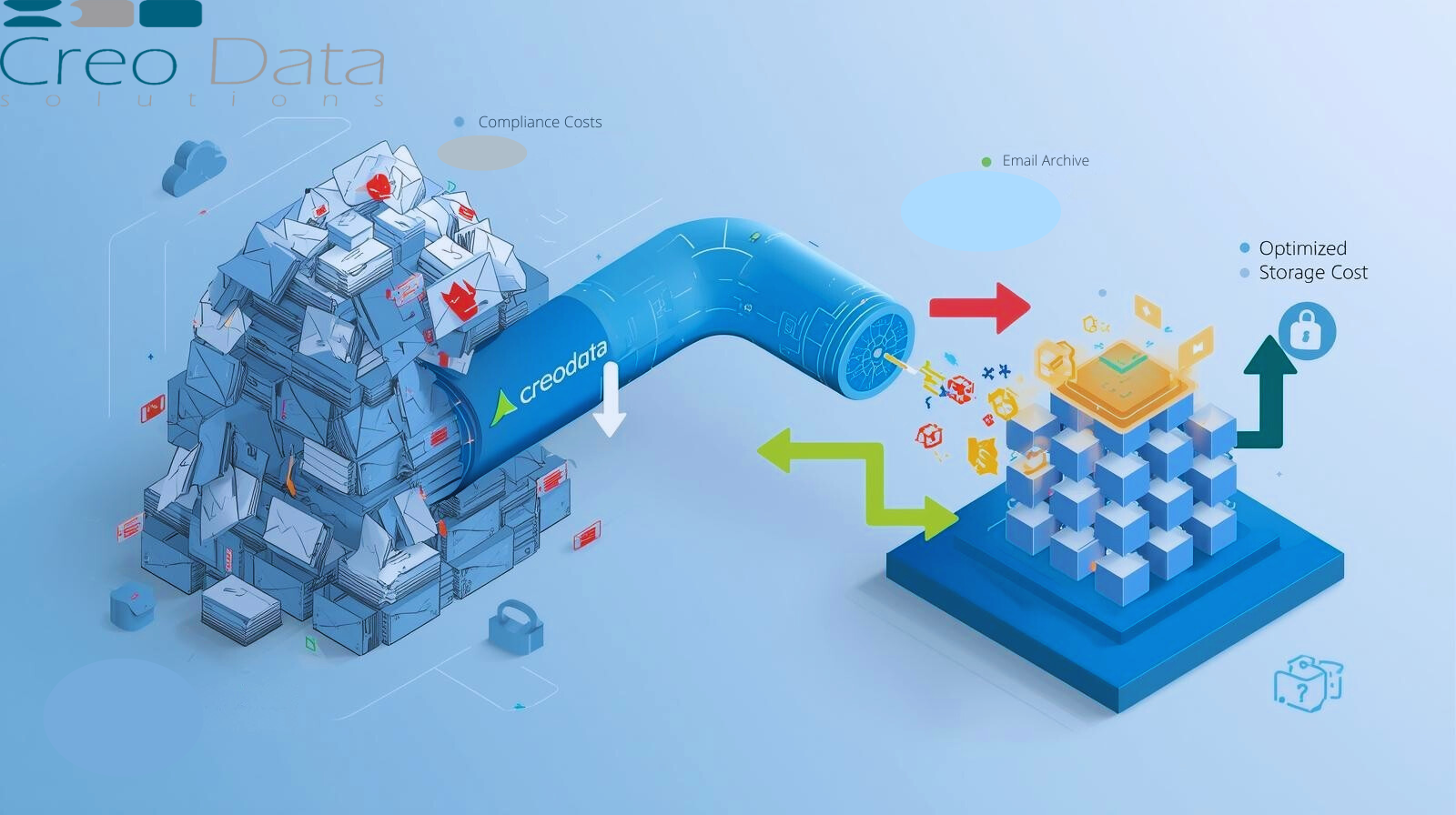
To address this, implementing efficient compression—especially via algorithms like Gzip and Brotli—is a powerful strategy. By reducing storage footprint, compression directly contributes to lower compliance costs and reduced IT infrastructure demands.
Background: Creodata Mail Journaling SaaS
Creodata Solutions offers a Mail Journaling SaaS specifically designed for Microsoft 365 environments, hosted entirely on Microsoft Azure. As a certified Microsoft Partner, Creodata emphasizes security, compliance, and ease of deployment:
- Enterprise-grade archiving with 99.9% SLA and zero maintenance overhead
- SOC 2 and GDPR compliant, with end-to-end encryption
- Rapid setup via Azure Marketplace—5-minute deployment with guided journaling rule configuration
- Powerful search and retrieval through full-text indexing
- Tailored for compliance teams, legal departments, and IT operations
This solution ensures emails are captured, indexed, and searchable—critical for audit readiness, e-discovery, and business continuity—but as archives grow, so do storage and infrastructure costs.
Why Compression Matters: Gzip & Brotli Explained
Gzip and Brotli are two leading lossless compression algorithms widely used to reduce data size:
- Gzip, based on DEFLATE, has been a staple of web content compression since the early 1990s. It's supported ubiquitously and offers a range of compression levels (1–9).
- Brotli, developed by Google and standardized later, often achieves superior compression ratios (20–30% smaller files than Gzip) at the cost of higher computation during compression—especially at higher levels.
For static content—such as archived email data that rarely changes—Brotli at its highest compression levels offers the best storage ROI. For dynamic or real-time data capture, Gzip or mid-level Brotli might strike a desirable balance between performance and efficiency.
By incorporating these compression methods into email journaling (either at ingestion, before storage, or via storage format like Parquet), organizations can substantially reduce storage volume—and by extension, cost.
Use Case: Reduce Compliance Costs
When email archives are compressed effectively using Gzip/Brotli:
- Storage footprint shrinks, reducing Azure storage costs
- Backup and replication costs decrease—less data to move
- Search performance improves—smaller volumes mean faster indexing and retrieval
- Regulatory retention becomes more financially sustainable over time
For audits or litigation, compressed archives still deliver full content fidelity (both algorithms are lossless), but with a fraction of the storage overhead.
Target Audience
The target audience for this use case spans multiple organizational functions:
1. Compliance and Risk Management Teams
- Handle data retention mandates; pressured by audit costs and regulatory fines
- Seek secure, searchable archives that remain cost-efficient at scale
2. Legal Departments and e-Discovery Teams
- Require rapid retrieval of historical emails, with minimal lag or infrastructure drag
- Benefit from compression in enabling faster searches across smaller datasets
3. IT Infrastructure and Operations
- Responsible for architecture costs, backup volumes, and storage budgeting
- Value reduced storage usage, easier management, and potential savings in compute overhead for archiving services
4. Finance and Budget Stakeholders
- Focused on cost control across cloud resources
- Drawn to quantifiable savings from more efficient storage strategies
5. Executive Leadership
- Interested in balancing compliance effectiveness with lean infrastructure spend
Advantages of Integrating Gzip/Brotli Compression
1. Reduced Storage Costs
Brotli can outperform Gzip by notable margins—studies show up to 27% better compression on assets like ReactDOM, and a 3× savings on larger files—even when compared at max Gzip levels. Over millions or billions of emails, this becomes significant cost savings.
2. Efficient Use of Azure and Cloud Resources
Smaller archive sizes translate directly to lower Azure storage charges, reduced bandwidth for backups, and cheaper long-term retention.
3. Faster Search and Retrieval
Indexes built over compressed datasets require less I/O and storage access. Retrieval across fewer bytes is inherently faster, aiding compliance and legal response times.
4. Seamless Fallback and Compatibility
If a system automatically serves Brotli-compressed data but the client environment doesn't support it, most implementations gracefully fall back to Gzip. This ensures compatibility with older tools or browsers.
5. Configurable Compression Levels
Brotli supports compression levels 0–11; lower levels offer faster compress/decompress, while higher levels maximize size reduction. This flexibility allows tuning based on performance vs. storage savings needs.
6. Optimized for Static Data
Email archives are typically static—there's no need to recompress them frequently. This aligns perfectly with Brotli's strengths: heavy initial compute for long-term storage efficiency.
7. Preserved Data Integrity
Both Gzip and Brotli are lossless. Compressed archives retain full email fidelity for audit and e-discovery purposes.
Implementation Guidance (High-Level)
Below is a conceptual overview of how compression could integrate into an email journaling workflow:
1. Email Capture & Ingestion
- The journaling system captures emails as they're sent/received within Microsoft 365
- Before encrypting and storing, the content is compressed—either on-the-fly (Gzip or mid-level Brotli) or batch-processed (high-level Brotli)
2. Indexing & Storage
- Compressed content is encrypted, indexed, and stored in Azure
- Indexes refer to compressed files, enabling efficient lookup with minimal footprint
3. Retrieval
- When a compliance search or legal request occurs, only the needed compressed file segments are retrieved, decompressed, and served
- Smaller download size speeds up extraction and review
4. Fallback Strategy
- If a retrieval client can't use Brotli-compressed files, the system can decompress at the server side or store a Gzip fallback if needed—but ideally just use Brotli universally to simplify storage
This flow ensures compression delivers value at every touchpoint—during capture, storage, and retrieval.
Conclusion
In the domain of email archiving for compliance, the challenge isn't just capturing every message—it's doing so in a way that's sustainable. As archives grow, unchecked storage use leads to ballooning cloud costs and infrastructure complexity.
Incorporating Gzip/Brotli support, particularly leveraging Brotli's superior compression on static email archives, reduces storage needs and associated costs—fulfilling the use case of reducing compliance and IT infrastructure expenses.
Creodata's Mail Journaling SaaS already delivers secure, compliant, Azure-based archiving. By layering in efficient compression, the solution becomes not only effective but also optimally economical—providing compliance teams, legal professionals, IT operations, and finance executives with a streamlined, cost-aware approach to enterprise email retention.