Dynamic Task Routing: Routing Applications Dynamically to the Right Personnel to Avoid Bottlenecks
Learn how dynamic task routing automates workflow assignments in loan management systems, reducing bottlenecks, improving turnaround times, and ensuring tasks reach the right personnel automatically.
What is Dynamic Task Routing
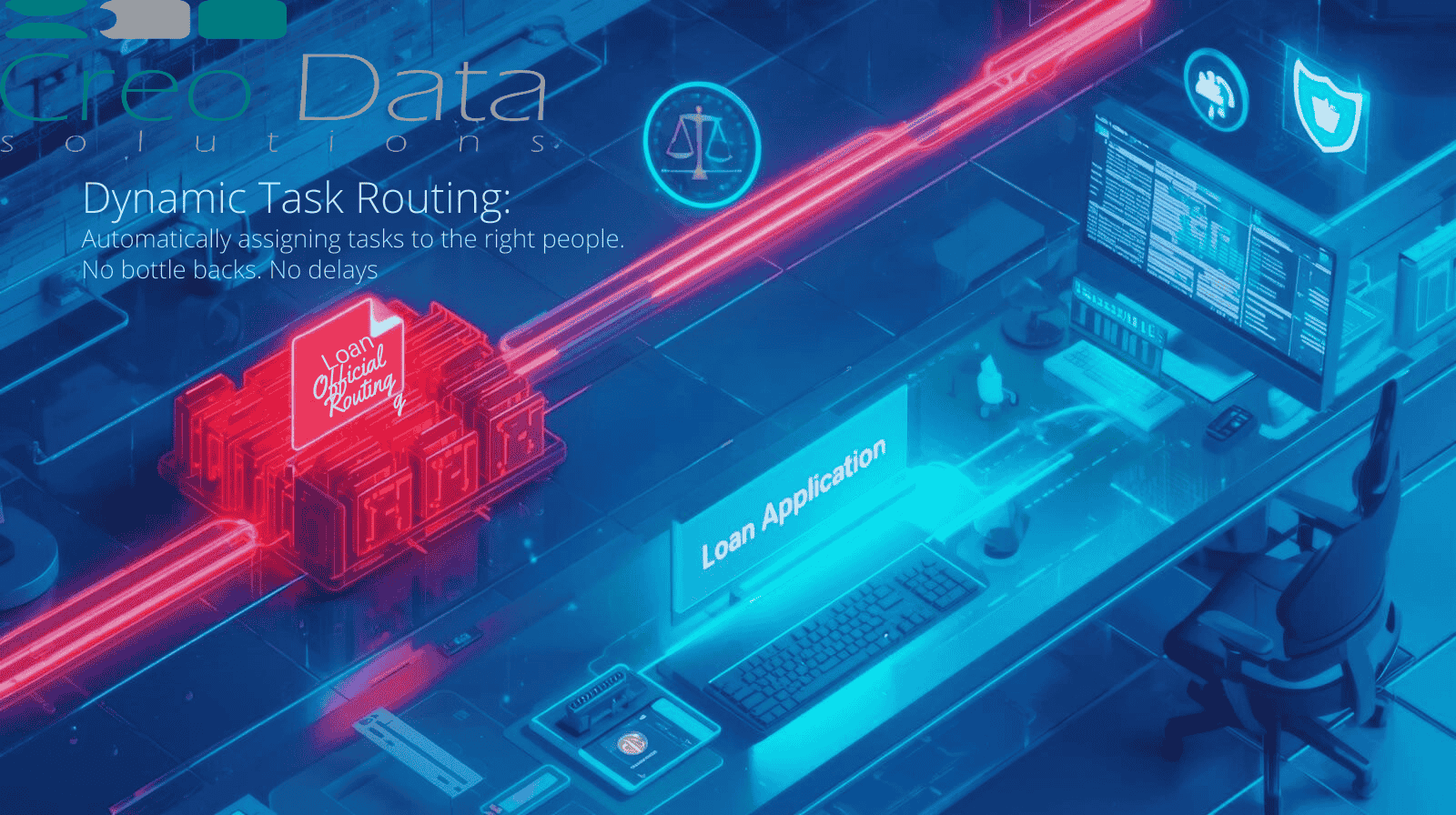
Dynamic Task Routing is a workflow automation feature that ensures tasks, applications, or work items are automatically assigned to the most appropriate person or team based on predefined business rules, load balancing, role hierarchies, or other criteria. Rather than having applications wait in a generic queue until someone picks them up, the system routes them proactively to the correct "Assigned To" party.
In the "Assigned To" feature, each task (e.g. a loan application, document verification, KYC, approval, etc.) is automatically assigned to a user or group defined by workflow logic. This removes manual assignment overhead, reduces delays, and helps ensure accountability and visibility at every stage.
Use Case: Dynamic Task Routing in Loan Management Systems
In a loan management system (such as what Creodata offers), loan applications pass through multiple stages: customer onboarding/KYC, loan origination, approval, disbursement, repayment tracking, delinquency management, etc. In each stage, certain verifications or approvals must be done. Dynamic task routing ensures that the application moves immediately to the relevant officer (credit analyst, risk officer, branch manager, compliance, etc.) without manual intervention, based on:
- Predefined rules (loan size, product type, risk score, branch)
- Availability (who is free or has lower backlog)
- Seniority/hierarchy (smaller loans go to junior staff, large ones to senior or manager)
- Geographic location or branch
- Required skills (e.g., foreign currency experience, SME lending)
Thus, as soon as a loan application is submitted, the system uses its parameters to choose the best person ("Assigned To") to do the next step, reducing waiting times and hand-off delays.
Relation to Creodata's Loan Management System
To tie this into Creodata Solutions' product (as per their Loan Management System):
- Workflow configuration and approval hierarchies are part of the core features: Creodata allows configuring loan products and "approval workflows"
- It supports customizable workflows for different loan types, branches, fees, etc.
- It also features real-time reporting and dashboards, which means the institution can see where bottlenecks are (e.g. many tasks stuck at "Credit Assessment" or "Document Verification") and trace "Assigned To" history
- Role-based access control and permissioning ensures that only people with the right roles see or act on tasks assigned to them
Thus implementing Dynamic Task Routing in such a platform means leveraging existing features (custom workflows, approval hierarchy, role-based access) and adding routing logic + assignment + escalation rules.
Advantages of Dynamic Task Routing
| Advantage | Explanation |
|---|---|
| Reduced Bottlenecks & Queues | Tasks don't pile up in generic holding queues waiting for manual assignment. This speeds up processing. |
| Faster Turnaround / Reduced Time-to-Decision | Since tasks go immediately to the right person, the time taken from application to decision is shortened. |
| Better Resource Utilization | Workload is balanced; overburdened officers are relieved; tasks are assigned to idle staff or according to capacity. |
| Improved Accountability | Always clear who is "Assigned To." Easier to track delays, measure performance, identify weak points. |
| Consistency & Compliance | Rule-based routing ensures that policy or regulatory requirements are always honored (e.g. certain sized loans must go through a senior approver). |
| Scalability | As volume increases, dynamic routing scales better than manual "who picks up next." Easier to add branches, staff, and new rules. |
| Better Customer Experience | Faster and more reliable service: fewer lost/mis-routed applications, less waiting. |
| Visibility and Transparency | Dashboards showing who is handling what, what's pending, where delays are occurring. Enables management to intervene. |
| Reduced Errors | Less manual mishandling or forgetting to reassign tasks; fewer misassignments. |
| Cost Savings | Less manual overhead, fewer delays, fewer duplicate or repeated work; potential to reduce staffing costs or reallocate staff to higher-value tasks. |
Target Audience
- Small to Medium Banks that want to achieve operational efficiency while keeping headcount and overhead low
- Microfinance Institutions with field agents and multiple small loans, where speed and cost per loan are critical
- SACCOs and Credit Unions, especially those with multiple branches or multiple loan product offerings
- Regulated Financial Institutions (banks, non-bank lenders, fintech lenders) where compliance, audit, traceability are essential
- Institutions with Diverse Product Portfolios or Varied Regions: where different branches or loan products have different rules, risk exposure, or require different approvers
- Institutions with High Volume of Applications: When volumes are high, manual assignment delays become significant; dynamic routing scales better
- Organizations Undergoing Digital Transformation, modernization, or seeking to reduce human error, improve turnaround, or reduce operational costs
Conclusion
Dynamic Task Routing (via "Assigned To" logic) is a powerful workflow automation feature that makes loan management systems much more efficient, consistent, and scalable. For institutions using systems like Creodata's Loan Management System, combining this routing capability with Creodata's customizable workflows, real-time monitoring, role-based access, and support for many loan types provides a strong operational advantage.
By automating who each application or task goes to, institutions avoid delays, reduce bottlenecks, enforce policy and compliance, improve customer experience, and make better use of their human resources. Particularly for small banks, SACCOs, microfinance institutions, and any lender handling many loan products or large volumes, the gains can be substantial.
For more information, visit Creodata.com