
Credit Proposal Workflow: From Approval to Formal Agreement in the Credit Department
See how a structured credit proposal workflow in Creodata's Loan Management system bridges approved credit decisions and legally binding agreements with full auditability.
Introduction
In a lending institution, the process of granting credit involves multiple stages: application intake, credit assessment, approval, and then formalization of the agreement (contract, disbursement, servicing). While much attention is paid to underwriting, risk scoring, and approval logic, one of the critical but often overlooked phases is execution: taking approved credit decisions and converting them into legally binding agreements, contracts, and loan documentation.
The Credit Proposal is that transitional stage: once a credit application is approved (by committees, automated decision engines, or manual review), the credit department must generate a well-structured, formal agreement (term sheet, loan contract, collateral schedule, amortization schedule, covenants) and prepare it for signature and disbursement. This article explores how a systematic execution workflow for the credit department can streamline, standardize, and safeguard the proposal drafting and agreement issuance stage—particularly in the context of a robust Loan Management System like the one from Creodata.
Why the Credit Proposal Stage Matters
Many institutions treat contract generation as an afterthought—manual document teams or legal units take over once approval is granted. But this handoff can introduce friction, errors, delays, and inconsistencies. Some of the common challenges include:
-
Template maintenance and version control: Multiple loan types, jurisdictional requirements, or collateral types require numerous contract templates. Ensuring the right template version is used is critical.
-
Data consistency and alignment: The numbers, terms, interest schedules, fees, amortization, collateral, and borrower details used in the proposal must match exactly the approved decision parameters; any mismatch leads to renegotiation or legal risk.
-
Manual drafting errors or omissions: Missing clauses, inconsistent numbering, missing signatures or annexes.
-
Approval and review loops: Legal, compliance, or risk teams often need to review the draft before signing; managing that review workflow manually is cumbersome.
-
Auditability and traceability: It must be possible to trace which approved decision led to which contract draft, who modified it, and why.
-
Scalability and throughput: As loan volumes grow, manual contract drafting becomes a bottleneck.
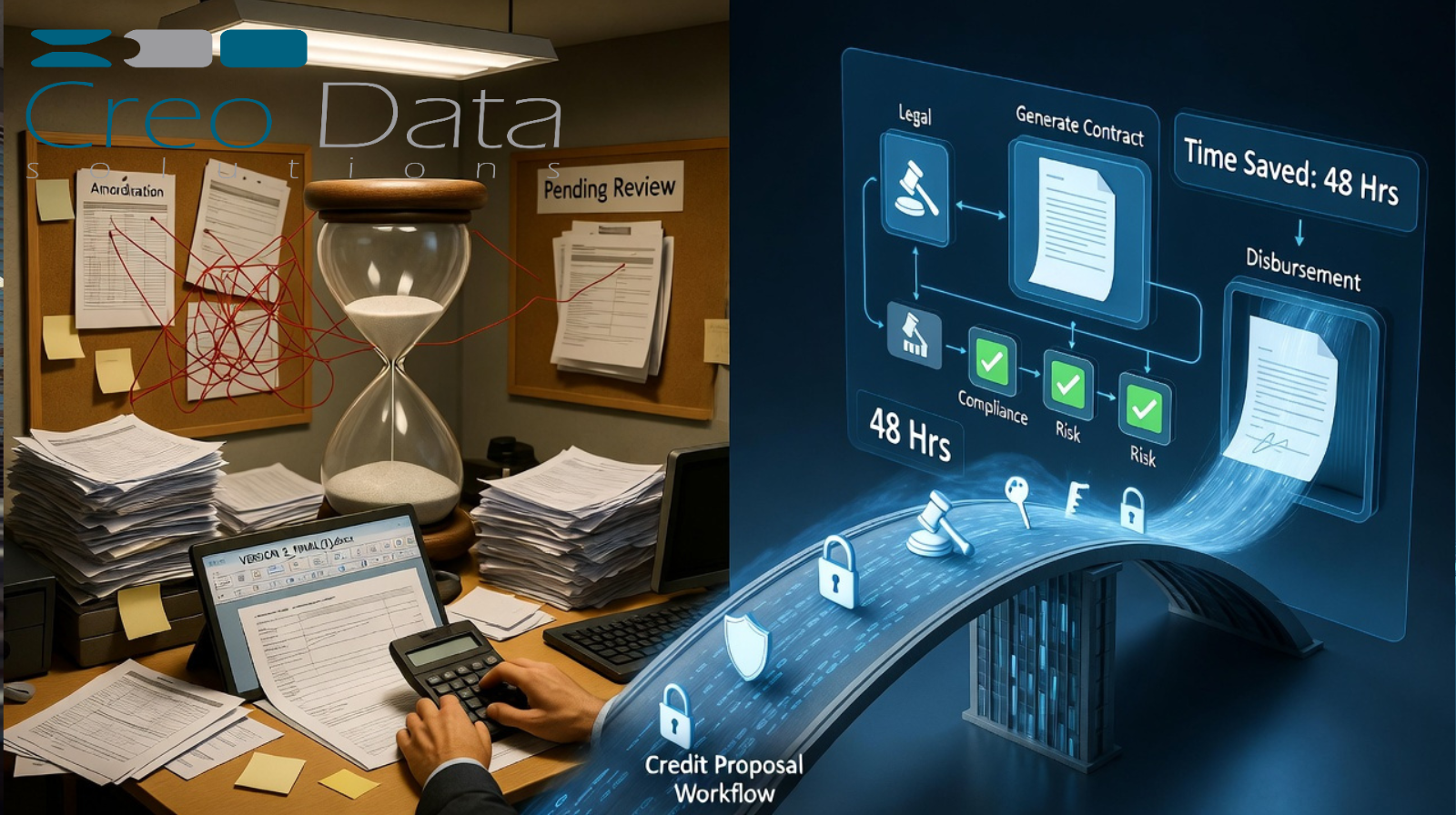
By embedding a Credit Proposal workflow into a lending platform, the credit department gains a structured, auditable, configurable, automated path from approval to signed agreement, minimizing risk and accelerating turnaround.
Execution Workflow in Creodata's Loan Management System
Creodata offers a Loan Management System designed to streamline the entire lending lifecycle, built on Azure and tailored for banks, SACCOs, microfinance institutions, and lending arms of organizations. Within that end-to-end system, the Credit Proposal feature is an execution workflow component inside the credit/contracting module that sits between approval and disbursement.
Here's how it typically fits within the overall execution workflow:
1. Approval Finalization
After credit assessment and decisioning (automated or via credit committees), the system records the final approved terms: principal, interest rate, tenor, schedule, fees, collaterals, covenants, etc.
2. Triggering Proposal Generation
The credit department dashboard or automated rule triggers the creation of a proposal document based on the approved terms. The system selects the appropriate contract template (loan agreement, promissory notes, guarantee schedules) per product type and jurisdiction.
3. Data Merging and Clause Population
The system populates the contract template with the approved data: borrower name, address, loan amount, amortization schedule, interest formula, fee schedule, collateral descriptions, security documents, covenants, events of default, repayment account details, and so on.
4. Document Versioning & Flows
The draft contract is versioned, and workflow rules determine which stakeholders must review it: legal, compliance, risk, or senior management. Notifications and tasks are issued. Comments, redlines, edits, and tracks are captured in the system.
5. Approval and Sign-Off
Once legal/compliance sign off, the contract is routed to executing parties (borrower, guarantors) for signature. Electronic signature integration (if available) or document print-and-sign flows can be supported.
6. Linking to Disbursement & Servicing
After signatures, the system marks the credit proposal as "executed" and triggers the disbursement workflow. The executed agreement is stored in the document repository and linked to the loan account. Loan servicing, monitoring, and compliance modules refer to that agreement.
7. Audit Trail & Reporting
The system logs all changes, approvals, timestamps, responsible users, and version history. Reporting dashboards allow monitoring of how many proposals are pending, where bottlenecks lie, and cycle times.
In Creodata's system, this is integrated with its underwriting, customer, and portfolio modules, so the proposal is not a disconnected document but part of the cohesive lending record.
Advantages of Embedding Credit Proposal Execution Workflow
Introducing a structured Credit Proposal workflow inside the credit department offers substantial benefits:
1. Faster Turnaround and Time-to-Loan
Automating generation, routing, and approval of proposals eliminates manual document drafting and reduces cycle time. What might take days or weeks manually can shrink to hours.
2. Lower Error Risk & Consistency
Automated population and logical clause inclusion minimize human errors (typos, mismatched terms, missing annexes) and ensure consistency across contracts and borrowers.
3. Better Compliance and Legal Control
Standardized templates, review workflows, and audit logs ensure that legal and compliance oversight is maintained. Uncontrolled ad-hoc draft modifications are avoided.
4. Scalability and Throughput
As loan volumes grow, the credit proposal process does not become a bottleneck. The system scales without requiring proportional increases in legal or operations staff.
5. Transparency, Traceability & Audit Readiness
Every change, review, comment, version, and approval is recorded. Auditors and regulators can trace the path from credit decision to executed agreement.
6. Operational Efficiency & Cost Savings
Reduced rework, fewer handoffs, fewer manual interventions—thus lower operational cost per loan.
7. Better Coordination Across Teams
Legal, credit, operations, risk, compliance all interact within the same system—no silos, no email chains, and fewer lost documents.
8. Linking to Downstream Processes
Since the proposal is directly tied to disbursement and servicing in the same system, downstream modules can reference exact terms, enforce covenants, trigger events of default, and monitor compliance.
9. Version Management & Flexibility
If a credit committee changes a variable (e.g. interest margin), a new proposal version can be auto-generated, tracked, and reviewed without starting over.
10. Data-Driven Insight & Bottleneck Tracking
Dashboards can reveal where proposals are stalling (legal, review, signature), enabling managers to intervene or rebalance workloads.
Target Audience & Ideal Institutions
Which organizations stand to benefit most from embedding a Credit Proposal execution workflow? Below are key profiles:
1. Banks, Microfinance Institutions, SACCOs, Credit Unions
Institutions that issue many loans or credit lines, especially across diverse products and risk tiers, need rigor, consistency, and scalability.
2. Fintech Lenders and Digital Lending Platforms
Faster loan issuance is a competitive differentiation. A digital end-to-end flow (approval → contract generation → signing → disbursement) is essential.
3. Institutions with In-House Legal / Compliance Review Teams
Those that require legal signoff or structured review (e.g. for consumer protection, regulation) will benefit from workflow orchestration.
4. Organizations Seeking Digitization and Process Automation
Lenders seeking to modernize their core operations rather than relying on spreadsheets, Word docs, and manual handoffs.
5. Growing Institutions with Scaling Credit Volume
As the loan portfolio and applicant volumes increase, manual drafting becomes unsustainable; automation is essential.
6. Lenders Operating Across Multiple Jurisdictions
Where contracts must adapt to local legal or regulatory nuances, clause logic and template variation must be managed cleanly.
7. Institutions Already Using (or Considering) Creodata's Loan Management System
Because the Credit Proposal workflow is best leveraged when tightly integrated with the rest of the loan lifecycle (origination, servicing, reporting).
Conclusion & Strategic Imperative
The Credit Proposal workflow is a critical bridge between credit decisioning and loan execution. By embedding a structured, auditable, automated execution workflow within the credit department, lending institutions can dramatically improve turnaround times, reduce errors, enhance legal and compliance control, and scale contract issuance seamlessly.
In the context of Creodata's Loan Management System—a cloud-native, Azure-based system built for financial institutions—this workflow becomes part of an integrated lending platform. It aligns with Creodata's commitment to streamlining the full loan lifecycle (from origination to repayment) with high security, customization, compliance, and reporting capabilities.
For more information, visit Creodata.com